

Inside the Zillow–Compass lawsuit, the quiet birth of a National MLS, and the one small rule that started all of it.
This entire national fight — the lawsuit, the headlines, the billion-dollar accusations — traces back to one thing.
A Tour.
Not pricing. Not brokerage fees. Not buyer agreements. A private showing tour. One MLS rule that wouldn’t let a “Coming Soon” listing be visible to other agents, marketable and tourable at the same time – homeowner choice. That single gap in policy is the “butterfly effect” that flapped its wings in Chicago — and the storm it kicked up may end up reshaping how every home in America gets searched, priced, and sold.
Most of the news coverage you’re seeing frames this as “consumer transparency versus homeowner choice.” That’s the wrapper.
Pull the wrapper off and here’s what’s underneath:
- Two publicly traded companies fighting over revenue
- A Chicago MLS quietly positioning itself as the first national listing platform
- A fresh crop of competitors building the next search engine
— all while everyone else stares at the courtroom.
Here’s the part that matters to you, the buyer or seller:
- While Zillow and Compass burn money forcing their business models on the market
- The rest of us are out here doing the actual work
And the data — your local Reston data — proves it.
Let me show you what we found when we peeled the onion all the way back.
HUD’S TAKE:
Fifteen years ago, Zillow solved a genuinely hard problem. They took hundreds of fragmented, inconsistent regional listing databases and stitched them into one clean, beautiful, nationwide search experience.
Coming out of three decades in technology, I can tell you that data integration problem is brutal — and they nailed it. They earned their position. They own search, they own the buyer’s attention, and then they monetized that attention through agent advertising. Credit where it’s due.
HERE’S THE ENDING, TOLD UP FRONT: that fifteen-year monopoly on search now has real competition for the first time. Not from a prettier website. From companies going after the data layer underneath the website over a policy issue. Chicago’s MLS, MRED, just opened its doors nationwide. New players like Real are building modern, AI-native versions from the ground up. And the door that let all of them in?
A fight over one private tour.
That’s the whole story. Now let’s look at how the pieces fit together — and why the loudest players in this fight are the least useful to you.
WHAT’S ACTUALLY HAPPENING
(IN PLAIN ENGLISH)
Zillow is a public company that needs every listing in America on its platform. Listings drive traffic, traffic drives buyer leads, leads drive ad revenue. Take away a chunk of the listings and the whole machine sputters. Zillow’s CEO has exactly one job: protect that machine.
Compass is a public company that makes the most money when one Compass agent represents both the seller and the buyer on the same deal. Keep the listing inside Compass, show it to Compass buyers first, and the commission stays in the house. Compass’s CEO has exactly one job: protect that funnel.
Neither one of those CEOs wakes up thinking about your equity. As a thirty-plus-year Marketer and Market Analyst in the start-up tech world, that’s not an insult — it’s the literal legal obligation of a public company executive. Shareholders first. Always.
Compass CEO Robert Reffkin told CNN, “The secret to Compass’s success is knowing that the real estate agent is the client.” Read that carefully. The agent is the client — which means the agent’s production, and the brokerage revenue riding on it is the priority. Not the buyer. Not the seller. That doesn’t make him a villain. It makes him a CEO doing his job. But you should know whose interests sit at the center of the model before you hand it your largest asset.
When that same CEO goes on national television and calls days-on-market and price history “value killers,” understand what you’re hearing. That’s not market truth. That’s a sales pitch built to keep your home inside his funnel.
And it’s wrong for you.
“VALUE KILLER” IS BACKWARDS – THE MARKET DECIDES THE VALUE
The market decides the value. End of Story – Done.
A home hidden from the open market isn’t protected from scrutiny — it’s untested. And untested almost always means mispriced for the condition. The argument that hiding price history protects your value has the logic exactly upside down. Exposure is what produces a true price. Concealment is what produces a guess by buyers without great market pricing strategy knowledge. Lack of knowledge produces risk, and risk is why buyers walk.
The assumption a buyer will act out of the “fear of missing out” is false with investments of this size. This is nothing more than a way to buy time to keep the sale and purchase in one brokerage by strong-arming buyers in low inventory markets. I have received that phone call from a father describing a situation with his daughter, and I said, “stop — is this brokerage Compass…” That’s all I had to say and the relief poured out. If the home they represent is not the home your daughter seeks, do not buy into the pressure — there is an alternative.
Here’s the part I want every seller to hear clearly: I don’t need a home’s full history to price it or to negotiate on it. Hidden or public, it doesn’t change my work. I price against assessed value, current home condition, current market comparables, current market “behavior,” and where the home should be positioned in today’s market. Days-on-Market doesn’t intimidate me — it’s a data point, not a verdict.
Thirty-plus years of Marketing and Market Analysis skills, and as a lifetime Northern Virginian, comes down to four levers on every transaction: price, condition, positioning, and promotion. Right now, in Reston, comparable homes are going under contract in under five days or in ten days — at similar final prices. The difference isn’t luck or magic marketing. The ten-day homes took a price reduction because the original number didn’t match the condition. The market spoke. It always does.
I’ll state this again: The Market defines the price. List price is an auction price, a starting point – not something to measure against as it is not rooted in anything marketable. No tracked statistic kills or improves value. The only thing that kills value and lengthens a sales cycle is “invisibility.” Being the Best Kept Secret is not a valuable marketing tool. Never has been. Sellers holding back from the market are merely adding time to selling cycle and depending upon how you hit the cycle, you may win or lose at hitting the window of market behavior opportunity.
And here’s the quiet truth about most “private” listings:
- Greater than 90% end up on the open market
- They take two weeks longer to sell
- Zero price advantage.
The home sits, doesn’t move, and gets relisted on the MLS a few weeks later — now with a stale story. I’ve watched it happen. I’ve had a buyer’s father call me directly because a Compass agent was steering his daughter toward a Compass private listing she didn’t want, when she’d told them exactly what she was looking for.
That’s not “buyer or seller choice.” That’s funnel control with a friendly name.
But don’t take my word for it. Take the data.
THE RECEIPTS – WHY PRE-MARKET BLUSTER IS MOSTLY HOT AIR
The entire private-listing pitch rests on one promise: that controlled, curated pre-market exposure commands a premium. Fine. Let’s check whether the people selling that promise are actually doing the work that would make it true.
A recent snapshot of Reston listings — the marketing tools present on “Coming Soon” versus “Active” (Coming Soon rows highlighted):
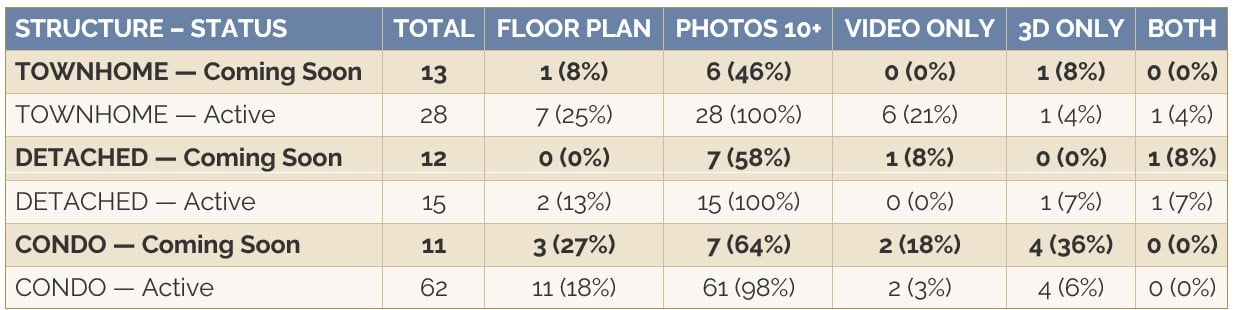
Look at the “Coming Soon” rows. Detached homes: zero floor plans. Townhomes: zero video. A combined count of full 3D-plus-video packages across all three property types you could hold up on one hand. Agents and homeowners are not utilizing a pre-market strategy for all the noise in the market.
In April, 12 homes (10% of all April sales) went under contract in 0–1 days on market, with another 5 of April’s new contracts moving that fast. These aren’t off-market deals. They’re the opposite — homes that hit the open market priced right, in great condition, and the market rewarded them instantly. The sellers who won the speed-and-premium game weren’t hiding their homes. They were on the market, ready, when the window opened. That’s velocity and power: full exposure, executed well, beats concealment every time.
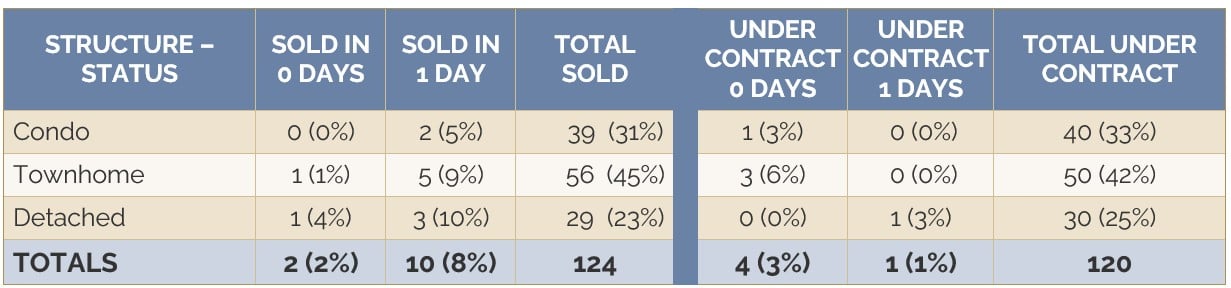
* Sold in April were Under Contract in March.
The pre-market window is the only moment in a transaction when a buyer faces zero competition. It’s the most valuable real estate in the entire sale. And here’s what most listings bring to that moment: not much. The tools that would justify a pre-market premium — floor plans, video, 3D tours — are cheap, available, and largely absent from the very listings using the pre-market label. Why? Because going on the open market for a home in great condition lets the Market compete for the home and push the price to its greatest value. Selling off market is not utilized and/or not desirable to the homeowner selling.
One fair challenge before we go further: Reston is a single community — is it too small a sample to mean anything?
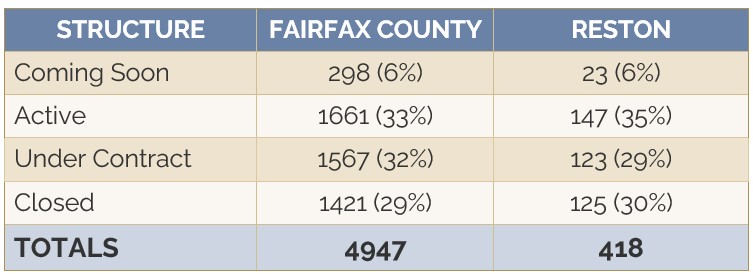
I ran the check. Pulling the active market across all of Fairfax County — the largest jurisdiction in the region, nearly 5,000 properties — the distribution mirrors Reston almost point for point. Coming Soon is identical at 6%. Active, Under Contract, and Closed all land within one to three points of the county. Reston isn’t an outlier or a rounding error. It’s a clean local read on a pattern that scales to the entire county — close enough to the ground to be useful, big enough underneath to be trusted.
And this isn’t just my read of one ZIP.
- Bright MLS — our own MLS, not Zillow, not Compass — studied over 100,000 home sales and ran the regression. Their findings, in plain English:
- 87% of office-exclusive listings end up on the open MLS before they sell.
- 17 extra days — nearly three weeks longer — a median 37 days to contract versus 20 for standard listings.
- Zero price advantage. After controlling location and property characteristics, pre-marketing privately had no measurable effect on sale price.
- In McLean’s 22101, office exclusives were at least 24% of new listings — nearly a quarter of the inventory.
The “value killer” pitch isn’t just wrong in my market. It’s wrong in the data — and this study predates this entire lawsuit. The pattern was already proven before the drama.
Two things are true at once, and both matter:
First, the marketing gap is real — but it’s not why homes sit. Homes don’t sit because of a missing floor plan. They sit because of price and condition. The media audit is context, not the headline. A seller who hears “it’s not your videos; it’s your price and your condition” is getting more useful truth than one who hears “your agent is lazy.”
Second, the pre-market premium is being sold far harder than it’s being executed. This is not a claim that agents are lazy. It’s a claim that the strategy is mostly talk. When the pre-market play is done right — full visual and interactive package, a home in genuinely great condition — an off-market sale can absolutely happen fast. I’ve represented the buyer on exactly that kind of deal and “wrote the offer that took the home off the market before it went on market.” But the tools were all in place and the home earned it. The numbers above show how rarely that level of execution shows up. The bluster is loud. The follow-through is quiet.
I’ve also listed and sold homes at 20% greater value than comparable homes that were sold exclusively off market. In a highly competitive market, an off-market, fast sale can happen — but it requires condition and tools in proper alignment to execute the marketing strategy well.
This is why more than 90% of homes still sell on the open MLS. The market is the great equalizer. You can hide a listing, but you can’t hide it from the laws of price, condition, and positioning. Sooner or later, the home meets the market — and the market always gets the last word.
THE ROOT CAUSE – ONE RULE THE MLS COULD FIX IN TEN MINUTES
Here’s the part that should frustrate every working agent and consumer.
This entire war exists because of a small, fixable flaw in how MLSs handle pre-market listings.
Today, most regional systems — including Bright MLS here in Northern Virginia — force a choice:
- Coming Soon listings are visible to other brokerages and marketed to the public — but can’t be toured.
- Office Exclusive / Private listings can be marketed and toured — but are invisible to other brokerages.
That’s it. That’s the whole problem. Marketability, visibility, tourability — pick two. The MLS forces the seller to surrender the third. The fix is one line of policy: let a Coming Soon listing be marketable, visible, AND tourable across every subscribing brokerage.
Let a Coming Soon listing be marketable, visible, AND tourable across every subscribing brokerage.
Done. Sellers keep their privacy options. Buyers see every available home. No brokerage gets to build a hidden funnel. The MLS stays exactly what it’s supposed to be — a neutral utility serving every agent equally.
The MLSs didn’t make that change. Thus Compass built a workaround. And one MLS, MRED, said yes to becoming the workaround.
That single decision is what cracked the door to competition open.
THE REAL HEADLINE – A NATIONAL MLS JUST QUIETLY SHOWED UP
While everyone watched the courtroom drama, MRED — the Chicago MLS — did the thing nobody’s talking about: it opened its platform to brokerages nationwide.
Read that again. MRED is no longer just a Chicago MLS. It’s now functionally a national one that any brokerage in any state can join. Compass was the first major brokerage to jump in. It will not be the last.
That’s the structural shift. For the first time since Zillow conquered search, there’s a credible challenge to its data moat — and it isn’t coming from a better search box. It comes from a competitor consolidating the source data itself. Whoever owns the data dictates the terms. Zillow has spent fifteen years politely licensing listings from MLSs on the MLSs’ terms. A national MLS gets to flip that and write the rulebook.
And there’s a tell hiding in the Compass strategy. By partnering with MRED for national distribution instead of building its own search engine, Compass effectively admitted something it would never say out loud: it cannot sell homes at national scale on its own buyer network. The country’s largest brokerage needs outside syndication to move inventory. If they owned the buyers, they wouldn’t need anyone. The lawsuit accidentally put that on the record.
WHAT’S NEXT – WHERE I’M PLACING MY BETS
Thirty years of watching technology consolidation cycles tells me how this rhymes:
The fastest path isn’t brokerage-by-brokerage. It’s MLS-by-MLS. Twenty agreements with the right regional MLSs gets you roughly 80% of the country’s listings in one motion. Let Compass pay a premium for direct access while everyone else rides in free through their existing MLS. Compass would, in effect, be subsidizing the very platform that levels the playing field against it. But is this the MRED strategy or is it to monetize it brokerage-by-brokerage fragmenting the market with regards to listing visibility?
Then the rules tighten. Build volume on permissive terms, get to critical mass, launch a consumer search portal — then dictate the feed standards once you own the demand. Build it, white label it, or buy a smaller portal. It’s the same playbook Amazon ran on publishers and Netflix ran on studios.
And there’s a wildcard worth watching. Companies like Real are building national syndication from the ground up with modern, AI-native architecture — no legacy baggage to retrofit. The first war is Zillow versus the consolidators. The second war — clean new technology versus retrofitted old technology — is the one that decides who’s standing in five years.
THE CATCH NOBODY’S TALKING ABOUT – WHEN YOU CONSOLIDATE DATA, YOU LOSE LOCAL NUANCE
Here’s the trap in all of this, and it’s the part that should matter most to anyone buying or selling in a market like ours.
When you merge hundreds of listing databases into one, the simplest shared definition tends to win. The industry’s seen this before — one major brokerage’s system once lumped townhomes in with condos, which is fine until you try to use it in a market where those are completely different products with different buyers, financing, and value drivers.
A few things at risk in a sloppy national rollup:
- Structure type. A Reston townhome and a Tysons high-rise condo are not the same product. Collapse them and local pricing analysis breaks.
- Days-on-market math. Every MLS counts it differently. Blend them and the one number sellers obsess over becomes meaningless.
- Local rules and boundaries. School boundaries are a perfect example — Zillow tracks them now, but not every MLS does, and a national consolidator is only as good as its weakest source. Incorporated cities like Falls Church City and Fairfax City are not the same as Fairfax County — different taxes, schools, and governance. Flatten that and search quietly lies to buyers.
Will modern AI-native platforms solve this with smarter, layered data models? Maybe. The good ones will preserve local granularity and offer a national view. The retrofitted ones are far likelier to fall into the lowest-common denominator trap.
Either way, here’s the upside for buyers and sellers working with a real local agent: if the giants win by erasing local distinctions, local expertise becomes the moat they cannot replicate. The platforms will fight over the data layer. The good agents will own the interpretation layer. Same as it ever was — better tools, same fundamental truth.
THE PART THAT SHOULD WORRY EVERYONE – A “SHADOW MARKET” HURTS SOME BUYERS MORE THAN OTHERS
Here’s the angle the headlines keep missing, and it’s the one I care about most as an Equity Strategist.
When inventory gets hidden behind private networks, it doesn’t disappear evenly. It disappears for the people outside the velvet rope. The connected buyer with the connected agent still hears about the home. The first-time buyer, the family relocating from out of state, the buyer working with a small independent brokerage — they never see it. Real estate veterans are now using a blunt word for what a fragmented, hidden-inventory market produces: a “shadow market.”
This isn’t my term — it’s coming from inside the MLS world itself. One Connecticut MLS president compared the pre-marketing wave to commercial real estate’s “woeful tale,” where brokers have to canvass multiple portals and physically work an area just to find what’s for sale, because there’s no single open marketplace. Worse, he warned that a growing pool of hidden inventory could land hardest on historically disadvantaged communities — something he said legislators are beginning to call a new form of redlining.
Sit with that. The MLS was built as a cooperative — a potluck, as one MLS leader put it. A brand-new agent on day one pays the same dues as a thirty-year veteran and gets access to the same listings, at the same time. That low barrier to entry is precisely what makes the market fair. Strip the inventory out of that cooperative and into private networks, and you don’t just inconvenience buyers and hurt the homeowners selling — you rebuild the information asymmetry that the entire MLS system was invented to eliminate. The people with the fewest connections lose the most.
That’s the quiet cost of funnel control disguised as “seller choice”: it’s sold as a premium service for the few, the bill gets paid by the many who never even knew the home existed — until it finally hits the open market weeks later, like 87% of them do. An open, transparent market isn’t bureaucracy. It’s the fairest deal a buyer or seller will ever get — and it’s worth defending.
THE BOTTOM LINE
All of this — a federal lawsuit, two billionaires, the possible end of a fifteen-year search monopoly — over one private tour.
Bravo.
While Zillow and Compass are busy forcing their business models on the market and consumers — and suing each other over who controls your listing — the rest of us are doing the unglamorous work: pricing on real value, telling sellers the truth about condition, and making sure buyers see every home they’re entitled to see. The market doesn’t care who wins the data war. The market cares about price, condition, and positioning. It always has. It always will.
Let them fight. The consumer gets the final vote. And your equity deserves an agent whose only job — first, last, and always — is YOU.
Michele Hudnall
I Guide. You Decide. Equity Focused.
Real Estate of Northern Virginia | Equity-First Real Estate Strategy
[email protected] | 703.867.3436
RealEstateofNVA.com | @realestateofnva
I help Northern Virginia buyers and sellers make smarter decisions with local market analysis, strategic guidance, and real-world context supported by current market behavior, not hype headlines.
If you want a clear read on your home, your neighborhood, or your next move, let’s talk.
Disclosure: Michele Hudnall is a licensed real estate agent in Virginia. This post represents her personal analysis and good-faith opinion as a Reston resident and does not constitute legal or financial advice. Full disclosure at RealEstateofNVA.com. All analysis and opinion are my own and based upon local, real-time data. Please consult with a financial or legal professional as required.
Privacy Statement | Disclosure Notice
SOURCES: ALL PUBLICLY ACCESSIBLE – NO SUBSCRIPTION REQUIRED
- Bright Research / Lisa Sturtevant, PhD, Chief Economist, Bright MLS. “Impacts of Office Exclusives on the Housing Market: An Empirical Analysis,” April 2025. View report (PDF)
- CNN Business. “Zillow sues Compass and Chicago-area MLS over private home listings,” May 20, 2026. Read article
- Dickerson, Lillian. “Dividing Lines” three-part series, Real Estate News (T3 Sixty), May 15–20, 2026: “Resist — or join — the pre-marketing movement” (Pt. 1); “MLS CEOs warn of fragmentation, ‘shadow’ market, erosion of trust” (Pt. 2); “MLSs must adapt to ‘structural shift’ in listing strategies” (Pt. 3). Read article
- Reston market snapshot data — original research, Real Estate of NVA, May 2026. realestateofnva.com
- Reffkin, Robert (Compass CEO), interview with CNN Business, “The risk-takers,” April 26, 2026. Read article