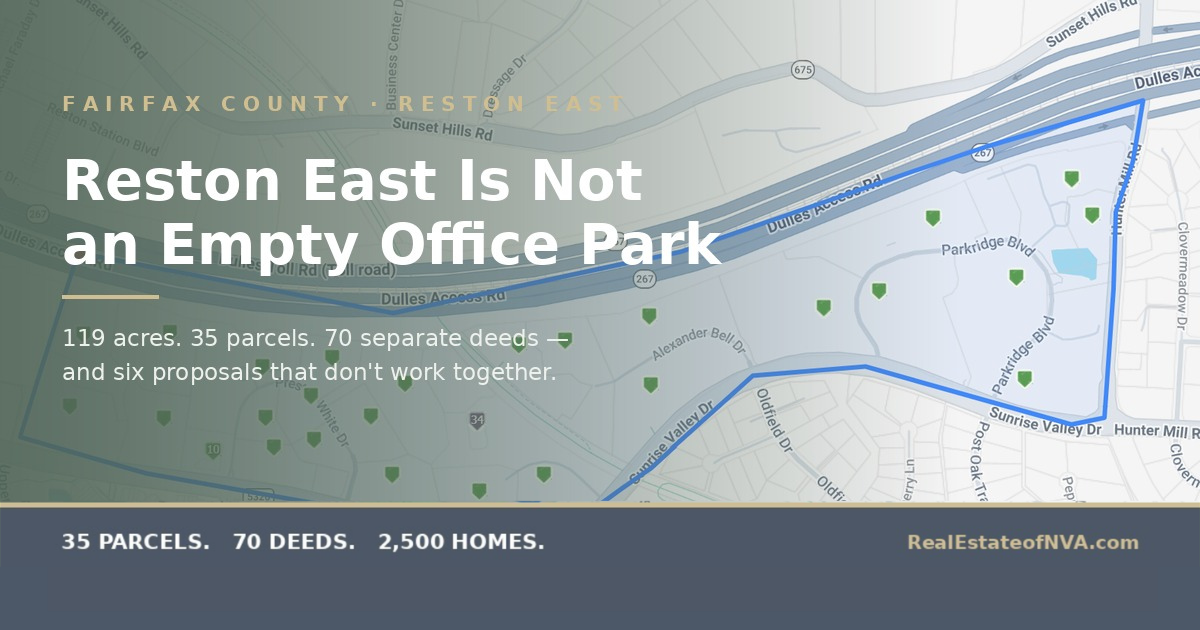
Fairfax County counts 35 parcels in the Reston East study area. There are 70 separate deeds. Forty-one of them can never be assembled — and that single fact answers the question county staff asked out loud on August 31.
Links to all cited sources can be found at the end.
On August 31st, Fairfax County planning staff presented the Reston East study to the Reston Planning and Zoning Committee. Near the end, Clara Johnson of the Department of Planning and Development asked the room a question: “Do we pick winners and losers?”
She was asking because staff genuinely does not know how to decide which of these owners gets to build housing. Six developers filed six unrelated concepts across two application cycles, many without knowing the others existed. Staff told the committee the concepts do not relate to one another and do little to establish a street grid, a connected park network, or adequate open space. And the thing nobody said out loud: these are rezoning requests from I-3 Industrial to Residential, inside an industrial park.
I pulled all 70 tax records inside the study boundary. Here is the fact that answers her question, and it is not in the county’s record: the county counts 35 parcels. There are 70 separate deeds. Forty-one of those are individually owned professional offices, held by 28 different owners across two condominium regimes.
They cannot be assembled by anyone, at any price, ever. More than half of this study area is not available to anyone’s plan.
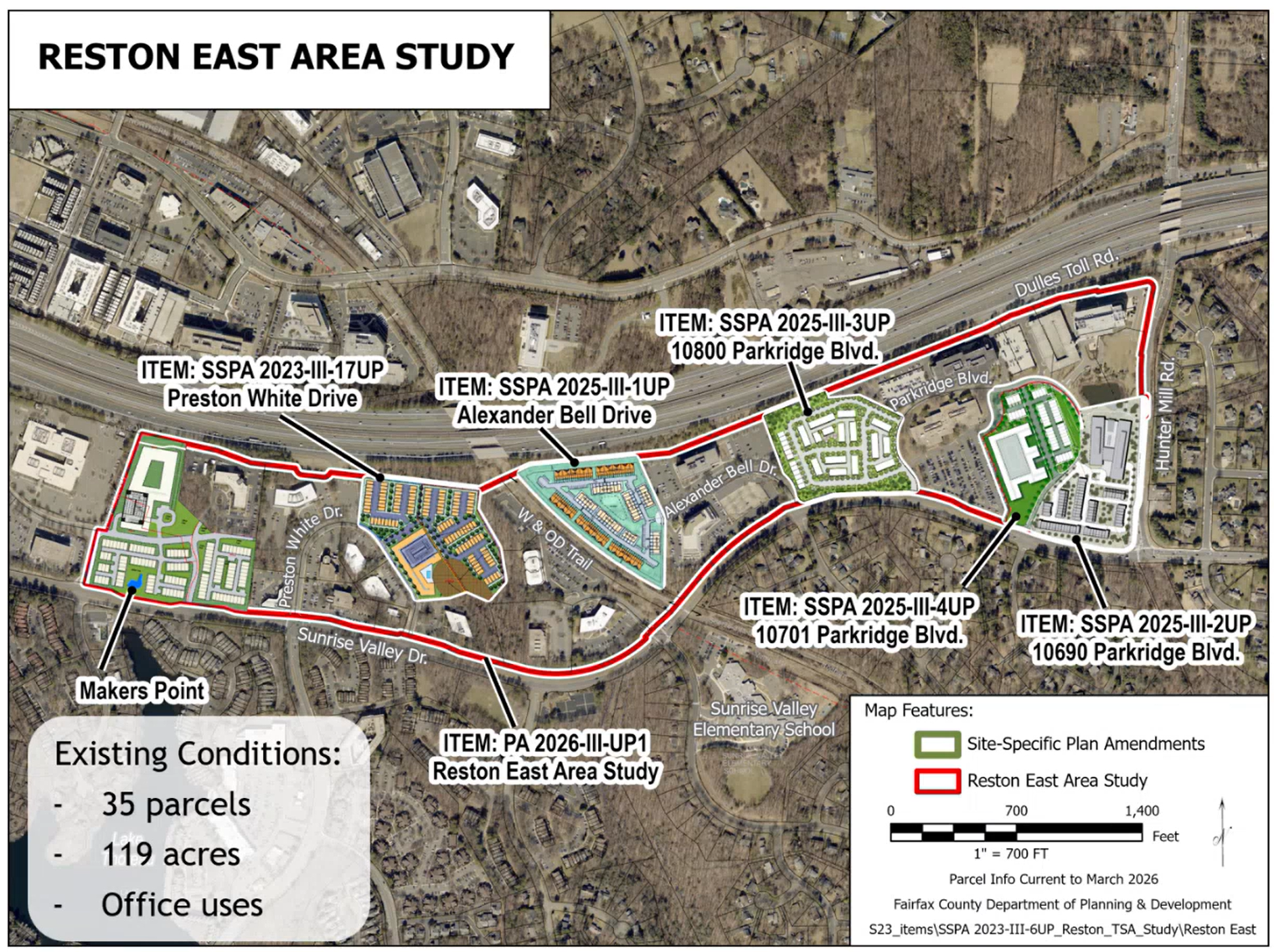
Six separate applications, each with its own case number, inside one study boundary. Makers Point sits outside the line entirely. Source: Fairfax County Department of Planning and Development.
WHY IT MATTERS
Reston is ground zero for a land grab. Secure entitlement fast. Convert the zoning, build high-dollar condominiums and townhomes now, before anyone puts the whole picture together.
Reston was one of the first modern planned communities in America, and many of the constructs Fairfax County still uses were built around it. Balance. Cohesion. It is why commercial and industrial sits on the fringe, and why open space, schools and retail districts are so hard to invent after the fact. They were planned in from the beginning, or they were not planned at all.
Approving this conversion parcel by parcel puts townhomes, condominiums and apartments in between operating commercial buildings inside an industrial zone. We will no longer be talking about “Pocket Parks” but rather “Pocket Residential.”
Four things have to be on the table before guidance goes out to developers, and right now none of them are:
- Ownership. Forty-one of 70 deeds are individually owned professional suites held by 28 owners. Any guidance about a connected grid or shared open space is aspirational across more than half the boundary.
- Supply and demand. What is already approved and waiting to be built, measured against what the market is actually absorbing. Without it, unit counts are a guess.
- Density. Staff’s own modeling puts the ceiling at roughly 2,500 homes, with 1,500 to 1,800 on the concepts already submitted — before counting others trying to get in while the door is open. Staff is testing 0.75 to 1.0 FAR against the 0.50 the adopted Plan allows, and confirmed this land sits outside the half-mile Metro walkshed entirely.
- Land use. Industrial land is 3.4% of Fairfax County and runs under 5% vacancy. Once it converts, it does not come back.
Testing FAR, roads and schools first is putting the cart before the horse. It assumes entitlement is imminent, and signals to every developer watching that the only remaining work is building some roads and a school to go with it.
And Makers Point, which sits between the Campus Commons project and this study area, added itself to the mix without ever filing a nomination. Staff confirmed on August 31st that Makers Point went on to submit a zoning application after the July open house — while the planning study that governs its land is still being written. Others are angling to be inside this boundary without a filing of their own. That is what a density decision looks like when everyone can see the door is open and nobody knows when it closes.
WHO IS ACTUALLY HERE
The phrase that keeps getting used for Reston East is “vacant office.” It is doing a great deal of work without much proof.
I pulled all 70 tax records. These are functioning owner operators who chose to purchase in these parks, current on their taxes, in buildings that are appreciating.
Who Owns Reston East
Working buildings inside the 119-acre study boundary — current on their taxes, going nowhere.
| Owner | Location | Acres | Sq Ft | Assessed Value | 2026 County Tax |
|---|---|---|---|---|---|
| Federal Republic of Germany | 11150 Sunrise Valley Dr | 4.37 | 67,744 | $7,229,560 | $138,886 |
| American Society of Civil Engineers | 1801 Alexander Bell Dr | 5.00 | 113,430 | $12,144,310 | $207,042 |
| Atlantic Union Bank | 1800 Robert Fulton Dr | 2.99 | 47,595 | $4,463,510 | $88,381 |
| Hensel Phelps Construction | 1891 Preston White Dr | 5.56 | 51,237 | $4,245,980 | $111,101 |
| Sunrise Oak Professional Park + Preston White Professional Center |
Robert Fulton Dr Preston White Dr |
41 deeded suites 28 owners |
$27,940,130 | $401,356 | |
35 parcels. 70 separate deeds. Forty-one of the 70 are individually deeded professional offices held by 28 owners. They cannot be assembled, by anyone, at any price.
Source: Fairfax County real estate assessment records, icare.fairfaxcounty.gov, 2026 tax year. All 70 tax records inside the Reston East study boundary reviewed. All parcels zoned I-3, Industrial Light Intensity.
And then the two that change the math entirely.
Sunrise Oak Professional Park on Robert Fulton Drive and Preston White Professional Center are office and medical condominiums — 41 separately deeded suites held by 28 different owners. Together they carry $27.9 million in assessed value and pay $401,356 a year in county taxes.
They are not distressed. Values are rising. One Preston White suite assessed at $292,530 in 2004 is assessed at $390,040 today. A Sunrise Oak suite went from $1,246,370 in 2018 to $1,463,130.
That is the pattern you would expect, because medical office never emptied out the way conventional office did. These are functioning small practices — employers, in exactly the kind of space they were meant to occupy. At the August meeting, a committee member made the point that being able to walk to your dentist is part of the Reston promise, and that pricing out small medical providers cuts against it. She is right.
Now put the two facts together. Twenty-eight owners. No common agent. No obligation to sell. Prospering businesses and rising values giving none of them a reason to leave. There is no legal instrument in Fairfax County that assembles that — not consolidation requirements, not plan guidance, not a developer with a checkbook.
So when the conversation turns to a cohesive street grid or shared open space across 119 acres and 70 deeds, it is a conversation about a fraction of the land. The parcels that can move are the ones with a single owner. Everything else stays exactly where it is, and whatever gets built gets built around it.
This is not an argument against redevelopment. It is the governed growth constraint that should be shaping the guidance.
WHAT THE MARKET IS SAYING
The trade on the table sacrifices successful businesses for high-margin “Pocket Residences” wedged in between them. Who is buying those residences? What is the target market? Where is the strategic plan that identifies the buyer?
From the August 2026 Compass:
- Reston condo inventory is back to 2017 levels, but buyer competition is at a ten-year low.
- Months of Supply is 3.2 — a straight climb, no seasonal reversal all year.
- Contract Ratio is 0.23. That is the demand side: 23 homes under contract for every 100 on the market.
- Against 2023, both sides moved by nearly the same factor in opposite directions. Contract Ratio 1.75 → 0.23, demand down 7.6x. Months of Supply 0.43 → 3.2, supply up 7.4x.
This is not a 2026 phenomenon. The trend has been steady since 2023, through the development growth. And these numbers describe condos that are not embedded in an industrially zoned office park.
Has there been a study showing residential inventory mixed into an industrial zone is a successful model? What should that mixed-use community look like? Do you see children playing in the parking lots of professional buildings? Do prospective buyers seek a home in an industrial park?
THE INDUSTRIAL QUESTION NO ONE IN RESTON IS ASKING
County staff confirmed on August 31st that every parcel in the study area is zoned I-3, Industrial Light Intensity — developed with office, but industrially zoned. I confirmed it when I pulled the property records. Every single parcel.
On March 11, 2025, the Board’s Land Use Policy Committee took up industrial land countywide. Staff reported roughly 8,300 acres zoned industrial, about 3.4% of Fairfax, with vacancy under 5%. Compare that to office, which has been the county’s problem child for five straight years.
Franconia Supervisor Rodney Lusk put the risk in seven words: “Once it’s gone, you can’t get it back.” Chairman Jeff McKay said protecting industrial areas was essential. Hunter Mill’s Walter Alcorn landed on a middle position, that some mix of uses probably makes sense.
Here is the thing about the two professional condominiums: that is the jobs base the I-3 designation was meant to hold. Not a factory. Small practices, service businesses, professional offices — the kind of employment a residential community uses. It is sitting there, successful, appreciating, paying $401,356 a year.
Is Fairfax County prepared to overturn working parcels that provide jobs because a handful of office buildings failed? That is the easy way out. There are other ways to convert an empty office building into something productive, and the evidence is sitting on these same 119 acres.
What is clear is that vacancy is currently more profitable to an owner than tenancy. Nothing in the current Fairfax County process is correcting that behavior, and the pattern repeats across the county.
The buildings that failed in Reston East failed as big single-tenant office space.
That is a business outcome, not a land use verdict on 119 acres.
WHAT THIS MEANS
If you own or lease a suite inside the boundary. Your deed is one of 41 that cannot be consolidated, and that is leverage, not exposure. Any plan that assumes a unified street grid or shared open space needs you at a table that does not currently exist. Values in both condominium regimes are rising. Nothing obligates you to sell.
If you are wondering who carries the long-term risk. Conversion from industrial to residential is a build, sell, depart strategy. The developers know it. It is a recurring pattern across redevelopment presentations countywide, and it means the entity making the case for 2,500 units is not the entity that lives with the result. The businesses that stay, the homeowners who buy, and the county that has to find industrial land somewhere else — they carry it.
If you own a home nearby. Between 1,500 and 2,500 units are being modeled a third of a mile from your address, in a zone with no residential precedent, against a condo market where demand has fallen 7.6x since 2023. The relevant question is not whether homes get built. It is what gets built around the parcels that never move.
If you are tracking the whole corridor. Watch two things. The guidance staff sends back to developers this fall, and whether the county ever publishes its count of approved-but-unbuilt units in Reston. That number exists, it is updated quarterly, and nobody outside county offices has seen it.
WHAT HAPPENS NEXT
Staff told the committee they are at the point of packaging community feedback and sending developers back to redraw their concepts. That means the most influential moment in this entire study is happening right now — before revised concepts exist, before a staff report, before any hearing. Guidance written now shapes what gets submitted later.
Four things belong in that guidance:
- An ownership assembly analysis. Which of the 70 deeds can realistically consolidate and which cannot.
- A strategic plan for the 119 acres as one corridor — with a market analysis attached. Who is the buyer, is there real demand for residences wedged into an industrial park, and what does success look like? Outgoing Hunter Mill Planning Commissioner John Carter asked a version of this on August 31st: what are the national examples of suburban office park retrofits that actually worked? Nobody has answered him.
- A published count of approved but unbuilt housing in Reston. Staff confirmed Reston is the only place in Fairfax where the county tracks this, updated quarterly. You cannot evaluate 2,500 more homes without knowing what is already approved and waiting.
- The cumulative schools number. FCPS now provides cumulative impact estimates because clusters of applications hit the same schools. Sunrise Valley Elementary sits directly across from this boundary. That analysis has been run. Publish it.
Three of the four already exist inside the county. Only the strategic plan would be new work — and it is the one that should have come first.
Comment now, not at the hearing. The county’s Reston East Planning Study page accepts input and lists the assigned planning staff. Comments that arrive after a staff report is published are commentary on a decision that has already been framed. Ask for those four items by name — specific requests get answered, general concern gets summarized.
Watch for the next community meeting. Staff confirmed another one is required and that it is not yet scheduled. When it posts, it will come with revised developer concepts, which is exactly when the questions get harder to ask.
Failing to start with a plan is a plan that starts out failing.
I track Fairfax County development filings parcel by parcel. If you own or lease near this area, I can tell you what is actually pending on a specific address — not what is rumored.
Michele Hudnall
Real Estate of Northern Virginia | Equity-First Real Estate Strategy
Life Long Northern Virginia Native | 25-Year Reston Resident | HOA Board President, Whitney Park East | South Lakes Drive
[email protected] | 703.867.3436 | RealEstateofNVA.com | @realestateofnva
I help Northern Virginia buyers and sellers make smarter decisions with local market analysis, strategic guidance, and real-world context, not hype headlines.
Disclosure: Michele Hudnall is a licensed real estate agent in Virginia. This post represents her personal analysis and good-faith opinion as a Reston resident and does not constitute legal or financial advice. Full disclosure at RealEstateofNVA.com. All analysis and opinion are my own and based upon local, real-time data. Please consult with a financial or legal professional as required.
Privacy Statement | Disclosure Notice
SOURCES
Based on a parcel-level review of 70 Fairfax County tax assessment records inside the Reston East study boundary, the county’s August 31, 2026 presentation to the Reston Planning and Zoning Committee, and the Board of Supervisors Land Use Policy Committee’s March 11, 2025 discussion of industrial land. Parcel counts differ from the county’s because this review counts every separately deeded tax record, including individually owned condominium offices; the county counts land parcels.
SOURCES: All Publicly Accessible — No Subscription Required
Fairfax County real estate assessment records: icare.fairfaxcounty.gov — 70 parcel records inside the study boundary: zoning, land use code, acreage, ownership, assessed value, value history, annual tax.
Fairfax County — Reston East Study (PA 2026-III-UP1): fairfaxcounty.gov/planning-development/plan-amendments/reston-east-study — Study scope, 35 parcels and approximately 119 acres, assigned staff contacts, and the input form.
Reston Planning and Zoning Committee, August 31, 2026 — county staff presentation and discussion: restonplanningandzoning.org and the meeting video — Staff statements on coordination between nominations, I-3 zoning across the study area, unit projections, intensity range studied, the Makers Point zoning application, approved-unit tracking, and cumulative school impact analysis.
Fairfax County Board of Supervisors — Land Use Policy Committee, March 11, 2025: fairfaxcounty.gov/boardofsupervisors/land-use-policy-committee — Industrial land trends; approximately 8,300 acres countywide and vacancy under 5%. – https://www.fairfaxcounty.gov/boardofsupervisors/board-supervisors-land-use-policy-committee-meeting-march-11-2025
Fairfax County Board committee meeting video archive: video.fairfaxcounty.gov/viewpublisher.php?view_id=9 — Searchable archive; the March 11, 2025 Land Use Policy Committee meeting contains the industrial land discussion with the Agenda.
FFXnow, March 13, 2025: ffxnow.com/2025/03/13/fairfax-county-board-cautious-on-conversion-of-industrial-land-to-housing/ — Supervisor comments on protecting industrial land.
FFXnow, April 27, 2026: ffxnow.com/2026/04/27/county-planners-consider-future-of-development-in-office-heavy-reston-east/ — Study expansion to all 35 parcels and what each application proposes.