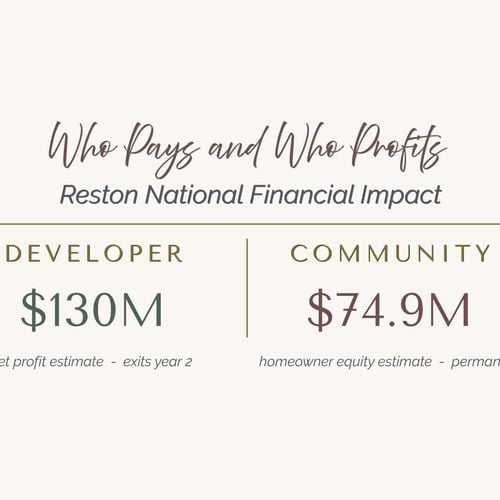

Buying a property with plans to develop it is not a free pass from the process — not for a homeowner, and not for a developer. The question every Fairfax County resident should be asking: if a back-door amendment works on this golf course, does the Comprehensive Plan still govern your street, or just advise it?
When you buy a home in Fairfax County, your plans for it are not a free pass. You can want a second story, a bigger deck, a structure where the trees stand today — but what you may build is governed by your covenants, your deed, and the plan on file. Intent does not override process. Every homeowner in Northern Virginia learns this the moment they look out the kitchen window and count on the view staying what the plan says it is.
A developer is now testing whether that rule applies to them — and the answer will reach far past one golf course.
This is not, at its heart, a story about a golf course. It is a story about the governance system that decides what gets built in Fairfax County — the Comprehensive Plan and the Site-Specific Plan Amendment (SSPA) process working together. The Plan says what should happen on the land. The SSPA process makes sure the analysis — traffic, schools, lighting, noise, environmental, infrastructure — happens before anything is built. Together they are the checkpoint that decides what is a genuine enhancement and what is a redevelopment that has to be studied. Break that checkpoint, and everything downstream of it is up for grabs.
That is exactly what is being attempted at Reston National Golf Course. After the proper process said no, the developer turned to a back-door amendment that asks the County for nothing — no Plan change, no public hearing, no studies — and asserts the Plan simply does not apply. The vote on November 4th is not whether a golf course becomes housing. It is whether that back door stays open. And if it does, it opens everywhere: Hidden Creek, every open-space line, every Planned Residential Community parcel, every commercial-to-residential conversion in Fairfax County becomes amendable the same way. The Plan stops governing your street and starts advising it.
This post walks the five precedents that one September vote would set — and the cash-out it is built to serve. To be clear up front: I am not anti-development, and I am for compromise. Good development happens through the governance process every day. What I am against is compromising on the governance process itself — because once the vehicle that bypasses the checkpoints is blessed here, it is available to every developer who would rather not be studied.
WHAT THIS ANALYSIS COVERS:
▸ The plan in the developer’s own words. Which door was loaded first, the price that flagged the intent in 2019, and the strategy the applicant put in writing
▸ The vote you think is happening isn’t the vote that’s happening. It is voting on whether to approve a PRC Plan Amendment
▸ Precedent 1 · Transit Oriented Density (TOD) outside the transit zone. Roughly 18.7 units an acre — double the neighbors — outside the TOD zone
▸ Precedent 2 · The zoning studies that no longer have to happen. What counts as an “enhancement,” and the bypass the County confirmed in writing
▸ Precedent 3 · A Comprehensive Plan turned advisory with no teeth. When a named, by-parcel designation becomes a starting bid
▸ Precedent 4 · Density inside Reston without joining Reston. 306 condominiums in the residential fabric, outside the obligations RA policy requires, while still enjoying amenities
▸ Precedent 5 · Goal = Revenue, not Golf. Forum-shopping, no exit plan, no maintenance plan — the cash-out the broken checkpoint is built to serve
▸ Why the RA Board’s voice matters now. The largest PRC in Fairfax County needs to weigh in supporting and speaking for the members
▸ The Bottom Line. This is not a Reston question, this is a Fairfax County vote
▸ The question on November 4th. What one September vote will set loose if the back door stays open
▸ What you can do before November 4th. The hearing, the channel, and the sheet to sign
▸ The Reston rezoning series. This is part 4 of a multipart series … more still to come
Why You Should Care?
This is not a Reston issue. This is Reston being used to set precedents that will shape development across all of Fairfax County.
▸ Your neighborhood has a plan on file too — and it is only as strong as the weakest precedent set against it. Reston National is named in the Comprehensive Plan, by parcel, to stay a golf course. If a designation that explicit can be set aside through a back-door vehicle, so can the one protecting your street, your open space, or the buffer behind your lot.
▸ The studies that protect you become optional. Traffic, schools, lighting, noise, environmental review — the analysis that decides whether your roads and schools can absorb what gets built next door. The vehicle on the table skips all of it, confirmed in writing by the County.
▸ This is how a community ends up living next to an outcome no one studied. An hour west in Loudoun, planning protections proved over-rideable parcel by parcel, and residential neighborhoods are now boxed in by data centers. That is what over-rideable governance produces — already built, already permanent.
▸ Density is bleeding out of the transit zone and into yours. The highest residential intensities were written for the half mile around the Metro in the TOD zone. This proposal carries that scale outside the TOD zone, into low-rise residential fabric planned for half the density.
▸ It reaches your wallet, not just your planning map. Density can now be parked next to a community’s trails, pools, and open space without joining it or paying to maintain it — shifting the cost onto the homeowners already there.
HUD’S TAKE:
I am not anti-development, and I am not anti-compromise. Good development happens through the governance process. I have written in praise of projects that did it right.
What I am against is compromising on the governance process itself. The deal on the table is not “how tall, how dense, how many.” It is “let us build what we want through a back-door amendment” instead of the SSPA process the County built to govern it. The moment you compromise on the vehicle, you have ratified the bypass for every plan and zoning amendment that comes after.
This was never anti-housing, and it was never “save my view.” It is pro-governance. The objection is the vehicle and the disregard for the Comprehensive Plan it is designed to route around. And for the record: this is not an affordable housing solution. It is a cash-out wrapped around a golf course the developer has told the County, in writing, they do not expect to grow.
The question I would leave you with: If a designation this explicit — named by parcel, affirmed through decades of public process — can be set aside through a vehicle chosen to skip the review, what designation in your neighborhood’s plan is reliable, and what is just waiting for the right back door?
THE PLAN IN THE DEVELOPER’S OWN WORDS
They bought it to develop it. That part has never been a secret — it is written into the County’s own records.
When War Horse Cities acquired Reston National Golf Course from RN Golf Management on May 22, 2019, it paid $23.75 million. The notation in Fairfax County’s property records reads: “price reflects future redevelopment.” 1 That was not golf-course money for a golf course. It was redevelopment money for a parcel with redevelopment already priced in.
Intent is not entitlement. Early in 2025 the developer did what the process requires. They asked. What matters — and what most of the community has never been told — is the order in which they asked.
The back door was loaded first. In the applicant’s own Site-Specific Plan Amendment filing, dated February 12th, 2025, Cooley LLP wrote that the property owner “has initiated a by-right PRC Plan to modernize the golf course and develop 288 stacked townhomes” on the portion of the property still subject to a 1966 zoning case.5 The PRC Plan Amendment — the back door — was already in motion before the front door was filed. It was never the fallback. It was the plan.
The front door was the offer. Cooley described the SSPA, in the same filing, as a way to give the County and the community “an alternative development concept not limited by the existing Zoning Approvals and the by-right development they permit.” 5 In plain terms: take the bigger plan we will negotiate through the front door — residential on roughly 86 acres with about 80 acres returned as public open space — or we proceed with the smaller plan you cannot stop. The front door came with a community-benefit story. The back door came with none. Same developer, same parcel, two doors, offered as a choice.
The front door numbers were never fixed. Press coverage put the SSPA at “nearly 800 homes,” a figure that traces to the developer’s own annexation-fee math in a side letter to Reston Association, not to the filing itself — the SSPA nomination committed to no unit count at all, describing only “townhomes of varying sizes and multiplex units.”5 What it did commit to was the framing: “attainable housing” near transit, funded by the residential development. Cooley wrote it plainly — “development of the remaining portions of the Property with residential units will help to fund” the public space.5 The houses pay for everything. That is the engine, in their words.
In June 2025, the Board of Supervisors declined to add the SSPA to the work program.2 The front door closed. The community held. And the back door — already loaded since February — simply proceeded.
Three concurrent PRC Plan Amendment applications — RZPA-2025-HM-00034, RZPA-2026-HM-00007, and RZPA-2026-HM-00008 — now carry a fundamentally different claim. Not please change the Plan. Instead: we do not need you to. The applicant asserts an existing right to build housing and to “enhance” the golf course without SSPA approval — which means without the traffic study, the school-capacity analysis, the lighting study, the noise study, or the environmental review.6
Of the 168-acre course, the PRC Plan application covers roughly 132 acres: about 14.8 acres for 306 condominium units, the balance reconfigured as a modernized golf course, and a remaining eastern arm — governed by a separate 1971 approval — left outside this application entirely. No public-benefit dedication. The housing is the move; the golf changes are the wrapper.
Then the developer’s own attorney said the quiet part on the record. Asked why they filed the SSPA at all, Cooley land use attorney Amanda Williams told FFXnow it was to ensure there were “opportunities for public input” — something a PRC Plan application alone, she acknowledged, would not guarantee.1 The applicant’s own counsel, in the press, confirming the distinction at the heart of this series: the back door bypasses the public.
Supervisor Walter Alcorn named the motive just as plainly, saying the owners are likely to keep pushing because they “paid too much to operate them profitably as a golf course.” 1 The sitting Supervisor for the district put the economic engine of this proposal on the public record.
So here is where the community gets stuck. The applications look smaller than the 800-home headline. They sound technical. And the message everyone has organized around — vote no on developing the golf course — is not the vote in front of the Planning Commission on November 4th.
The November 4th vote is not on the golf course. It is whether the back door stays open.
THE VOTE YOU THINK IS HAPPENING ISN’T THE VOTE THAT’S HAPPENING
For more than a decade, the community’s message has been simple and correct: protect the golf course. That is the substantive question — should this land become housing. It is not the question the Planning Commission takes up on November 4th. The Commission is not voting on whether to develop Reston National. It is voting on whether to approve a PRC Plan Amendment — the vehicle that would let the development proceed without the studies, the hearings, and the Comprehensive Plan conformance review the front door requires. Two different questions. Two different outcomes. Only one is on the agenda.
To see why the vehicle matters, you have to see the two halves of the governance system — because the developer’s whole strategy depends on splitting them apart.
The Comprehensive Plan is the destination. It says what should happen on the land. In Reston, it is the product of more than fifty years of community engagement, named designations, and density rules built parcel by parcel. The Plan tells you where Reston is going.
The SSPA process, adopted by Fairfax County in 2007, is the road. It ensures the analysis happens before anything is built — traffic, schools, lighting, noise, stormwater, environmental, fiscal, infrastructure capacity. The Plan names the destination; SSPA confirms whether the road can get you there safely. One without the other is half a system.
The PRC Plan Amendment vehicle takes the destination and skips the road. The Comprehensive Plan for Reston names Reston National and Hidden Creek by tax-map parcel and designates them “to remain as golf courses.” 7 The back door asks the County to let a development override that named designation without running the SSPA analysis the designation was built on.
If the Plan can be overridden through a vehicle that bypasses the very analysis the Plan depends on, the question writes itself: what does the Comprehensive Plan and Governance System mean anymore?
That question is the rest of this piece. Here are the five precedents the November 4th vote would set.
PRECEDENT 1 • TOD DENSITY OUTSIDE THE TRANSIT ZONE
Start where I live. Whitney Park East is a cluster of 32 homes on South Lakes Drive, built at roughly 10 units per acre — the cluster fabric Reston was planned around, the density the Comprehensive Plan has protected for more than sixty years. It is not an accident. It is a designation, honored parcel by parcel, for six decades. Now the proposal: 306 condominium units on roughly 14.8 acres of residential land — a density the applicant’s own filing puts at 18.7 units per acre, just at 20 per acre with the bonus units the 1966 case allowed, and roughly double the surrounding clusters.6
Density alone does not describe a community, though — typology does. The SSPA filing named only “townhomes of varying sizes” and “multiplex units,” with no commitment to building height, tree retention, setbacks, or buffer preservation. Ten units an acre of low-rise townhomes woven into existing tree canopy is the Reston cluster. Ten units an acre of four-story stacked product is concrete and asphalt where the green space used to be. The same number on paper can preserve the fabric or erase it — and the filing committed to neither.
Then there is where that density belongs. The highest residential intensities in the County are written for the TOD areas — defined as the land “within approximately one-half mile of the four Metrorail Station entrances.” 10 Reston National sits outside the TOD — four times that distance. This is transit-scale density dropped into the low-rise residential fabric the Plan was specifically designed to keep low-rise. Outside the boundary of the transit zone, by the County’s own measure.
Here is why that travels — and why it is not a Reston story. Once a PRC Plan Amendment can carry transit-zone density onto a non-transit parcel through a vehicle that skips review, the same move is available wherever a specific Comprehensive Plan designation stands between a developer and a denser build. The precedent is not “Reston gets 306 condominiums.” It is that a named, by-parcel designation — anywhere in Fairfax County — becomes a starting bid instead of a baseline. That is the moment a planned density stops being a guarantee for tens of thousands of households and starts being an opening position.
PRECEDENT 2 • THE ZONING STUDIES THAT NO LONGER HAVE TO HAPPEN
This is the mechanical heart of it, and it turns on one deceptively small word: enhancement.
The PRC Plan Amendment vehicle is built for genuine upgrades to existing recreational facilities — the routine improvement that does not warrant a full rezoning. The developer is using it to argue that what they propose is mere enhancement of a golf course, and therefore, exempt from the analysis a redevelopment would trigger. The County agreed the vehicle skips the traffic study: the applicant’s engineer asked in writing on October 17th, 2025, whether a Traffic Impact Analysis was required, and County staff confirmed on February 27th, 2026 that because no rezoning or equivalent was submitted, “no determination is needed.” 3 No traffic study. No school-capacity analysis. No lighting study. No noise study. No environmental review.
Now ask the question the vehicle is designed to keep you from asking: is this an enhancement?
The Zoning Ordinance itself draws the line between a golf course feature and a commercial operation:
“A golf course may include an accessory driving range; however, when a driving range is not accessory to a golf course, it is an outdoor commercial recreation use.” — Fairfax County Zoning Ordinance, Sect. 4102, Golf Course or Country Club 4
Now look at what is proposed, described by Cooley in the applicant’s own SSPA filing: a “full rerouting of nine (9) holes requiring substantial changes to the Property’s topography, tree canopy and landscaping”; a “new lighted, multi-story driving range and clubhouse”; “lighted/gamified training facilities”; and a new standalone restaurant, the “Back 9 Grill.” 5 The restaurant is folded into the “Golf Course” use definition so it does not trigger separate commercial review. And by the applicant’s own answer to the County, the golf upgrades are not even projected to grow membership. This tells you what is really paying for them.
A single, modest range can be accessory to golf. A lighted, multi-story entertainment complex with ball-tracking bays and a restaurant, built feet from people’s homes, is by the Ordinance’s own standard an outdoor commercial recreation use, with no lighting study and no noise study attached to it. That is not an enhancement of a golf course. It is a redevelopment wearing the word.
Reston Association already knows where that line sits, because it has lived on the strict side of it. When RA wanted to add lights to the tennis courts at Barton Hill, the community raised questions about noise, light, and impact on adjacent homes, and rather than carry the project through the full PRC Plan process, RA scrapped the lighting.12 RA applied the standard to a handful of tennis-court lights on its own property. The developer is asking that the same standard not apply to a 306-unit building with a commercial entertainment complex attached.
And Reston’s own leadership is now moving to write that line down. At the June 25th, 2026, RA Board meeting, Director John Farrell — a land use attorney — moved to direct staff to prepare a formal position for the Planning Commission and the Board of Supervisors. His draft points read like a definition of “enhancement” by exclusion, in his own words:
▸ “Reston National Golf Course must be maintained as a 6,800-yard, par-71 championship golf course with no dwelling units on the 168 acres of the course.”
▸ “That no lights be installed on the Reston National Golf Course.”
▸ “That no Top Golf-style multi-story driving range be installed on the Reston National Golf Course.”
▸ “That no new building be built adjacent to existing residential RA members’ homes” — the structure shown in the drawings as the Back 9 Grill.
▸ “That preservation of the property values of its members is a core purpose of the association.”
▸ “That the RA trails running through Reston National Golf Course substantially contribute to the health and well-being of the RA members beyond those that own abutting residences.”
▸ “That unique among Fairfax zoning districts, the PRC district requires that residential development must conform to the provisions of the current Reston Master Plan.”
▸ “That any change from the land designation for the Reston National golf course in the current Master Plan requires an amendment to the Reston Master Plan, which the pending applications do not seek.”
The motion passed 6–0–1 and the document was set for draft review at the Board’s June 30th meeting, for adoption at the July 23rd meeting ahead of the November 4th hearing.13 That is the standard, drawn by the people who live next to it: lights, a multi-story driving range, and a new restaurant building beside homes are not enhancements of a golf course. They are the precise features a real review exists to catch and the precise features this vehicle is built to waive through.
PRECEDENT 3 • A COMPREHENSIVE PLAN TURNED ADVISORY WITH NO TEETH
Here is the macro — the reason this is not a Reston story.
Let me concede the point a sophisticated reader will raise, because conceding it is what makes the rest unbreakable. In Fairfax County, the Comprehensive Plan has always been a guiding document, not a binding one. Localities deviate from their plans through individual rezonings all the time; that is legal and normal. The threat here is not that one approval makes the Plan legally void. It never had that kind of force.
The threat is to the Plan’s authority as a governing system hand-in-hand with the SSPA process — and that authority to govern is the only thing that makes a guiding document worth anything. The Plan works because the community, the staff, and the decision-makers treat its specific designations as the baseline you can count on: this is what we decided, through years of public process, this land should be. Reston National is named in that Plan, by parcel, to remain a golf course in a PRC. When a designation that explicit can be set aside through a vehicle chosen specifically to avoid full review, the message to every other parcel is unmistakable: the designations are not the baseline. They are the opening position. The Plan stops governing and becomes advisory with no teeth.
And here is the part that makes this more than rhetoric: the Zoning Ordinance that governs this very vehicle does not treat the Comprehensive Plan as optional. The standard that controls every planned district application reads:
“The planned development must substantially conform to the Comprehensive Plan with respect to type, character, intensity of use, and public facilities. Planned developments may not exceed the density or intensity permitted by the Comprehensive Plan, including any permitted density or intensity bonus provisions.” — Fairfax County Zoning Ordinance, Sect. 2105.1.C 1
Conformance is not a courtesy the County may waive. It is a required test, in the County’s own code — and it is precisely the test the back-door vehicle is built to slip past. The question on November 4th is whether that test still means anything when a developer would prefer it did not.
That is not hypothetical, and you do not have to imagine the consequence, you can drive to it. An hour west, in Loudoun County, residential protections gave way parcel by parcel until the Regency, a 143-home Ashburn neighborhood, found itself an island inside Data Center Alley, its home values sliding while the land around it was repriced for industrial use. I documented that one in detail.14 Both Loudoun and Fairfax built checkpoints precisely to force the question of what a compatible enhancement is and what is a redevelopment that warrants full study against the Plan. Precedent 3 is the moment Fairfax County weakens its own checkpoint.
This is a precedent-setting moment in the history of the Fairfax County Comprehensive Plan and governance system. Every open-space designation, every commercial-to-residential conversion, and the other named golf course — Hidden Creek — sits downstream of how November 4th is decided. Not because of what happens to one golf course. Because of what happens to the document and governance system that protects every neighborhood’s plan, including yours.
PRECEDENT 4 • DENSITY INSIDE RESTON WITHOUT JOINING RESTON
This is the precedent that reaches your wallet, not just your planning framework.
In Reston, residential development on Association land comes with membership that runs with the land. You pay assessments; in return the trails, the pools, the open space, and the programs are maintained. And it is not optional as a matter of RA policy. Land Use Resolution 7 states that the Association’s position on “any land use application authorizing residential development in the Reston Master Plan area must require that those residential units become part of Reston Association” — and that some portion of any recreational funds proffered be paid to the Association for its facilities.15 Vantage Hill is the model done right: modern townhomes fitted into existing tree canopy, full RA members, integrated into the system that maintains the place.
The 306 condominiums are different. The PRC filings propose no RA membership for them at all. The only time membership was ever on the table was under the rejected front-door plan and even then it was leverage, not commitment: the developer offered an annexation fee and monthly dues as part of the SSPA path, contingent on RA backing the redevelopment. RA declined the redevelopment, and the offer disappeared with it. Through the back door, no membership terms appear at all. The units would sit inside the Reston fabric, surrounded by RA-maintained amenities, without the assessments that pay for them and outside RA’s design-review and covenant authority entirely. Inside Reston. Benefiting from Reston. Not part of Reston, and not paying for it.
Reston’s own policy anticipated exactly this. Land Use Resolution 6 — the Golf Course Policy — states that “Reston Association desires to continue to be a golf course community,” naming both Reston National and Hidden Creek as essential to that identity.15 The membership terms for any development that does join are set in Resolution 3, which makes a lump-sum payment and per-unit annual assessments the required price of inclusion. The 306 are proposed for neither: not named into the golf course community Resolution 6 protects, and not brought in under the membership terms Resolution 3 requires. They would take the benefit of both and carry the obligation of neither and every future development next to an HOA’s amenities could point to this approval and ask for the same deal.
PRECEDENT 5 • GOAL = REVENUE, NOT GOLF
Precedent 5 is the one the applicant proved for us in their own filing, and in what they have pointedly left out of it.
Start with filing shopping. The PRC Plan Amendment was never a reaction to losing the SSPA filing its concept plan was dated February 12th, 2025 and filed inside the SSPA nomination itself, both vehicles in the same envelope before the County had ruled on either.1 The full sequence was stated out loud. According to RA director and land use attorney John Farrell, the developer’s counsel “repeatedly said that if his client’s SSPA didn’t go forward, they would use a 1966 zoning case to pursue a PRC amendment” and, if that failed, would “sue to overturn the legislative nature of PRC amendments and develop Reston National Golf Course by right.” 16 Three vehicles, lined up in advance, to be run in sequence until one opens.
Now the part that should bother every Reston resident the most: there is no plan for after. The applicant told the County, in writing, that they do not anticipate the golf upgrades growing membership. War Horse Cities is a development operator. NVR is a residential homebuilder that, by its own business model, does not hold land. Neither party in this filing is a long-term golf operator. Who runs the lighted, tech-laden “modernized” facility in year five, year ten, year twenty after the condominiums are sold, the homebuilder has moved on, and the development value has been extracted? The filing does not say. There is no defined exit plan. There is no long-term maintenance plan. There is no operating commitment. We’ve witnessed the current operating and maintenance standard.
That silence is the tell. The technology does not refresh itself. The lights do not relamp themselves. The restaurant does not staff itself. When the residential math no longer pencils, the obligation to maintain or restore a deteriorating amenity does not fall on the developer, who has cashed out, or on NVR, which has sold and gone, or on the 306 condominiums, which were never made RA members. It falls on Reston Association and the surrounding clusters who get to live next to whatever the parcel becomes when the revenue is gone.
This is the consequence of breaking the governance system, made concrete. The SSPA process exists to ask exactly these questions before approval operations, maintenance, long-term stewardship, who is responsible when the developer leaves. The back-door vehicle is built to never ask them. Goal = Revenue, not Golf. The golf course is the wrapper; the cash-out is the project; and the broken checkpoint is what lets the wrapper pass without anyone proving there is a plan to keep it whole. I’ve listened to many Planning and Zoning Meetings and the developers are routinely asked about ongoing maintenance and operations and responsibility, that isn’t happening with this amendment.
Note what I am not doing here. I am not arguing the legal merits of a 1966 development plan. That question belongs in the SSPA process, where it can be examined with full analysis, in the proper forum. The point of Precedent 5 is narrower and harder to refute: whatever the merits, they must be tested through the process that protects this community, not through a vehicle chosen to bypass it.
WHY THE RA BOARD’S VOICE MATTERS NOW
None of this is decided by Reston Association. RA cannot approve or deny these applications, the County does, and the first vote is November 4th. RA’s role is to comment, advocate, and put an organized, accountable, county-facing voice behind the procedural argument. A developer presenting to RA is courtesy and strategy, not approval-seeking. Supervisor Alcorn has said he will not support a rezoning the surrounding community opposes, which is exactly why the community’s voice carries weight at the County level. But where do the remaining Supervisors stand on this issue as a Fairfax County issue where Reston may set 5 Precedents for the County?
At its June 25th, 2026 meeting, the Board voted for active advocacy and directed staff to prepare a formal position for the Planning Commission and the Board of Supervisors, set for draft review June 30th and adoption during the July 23rd meeting, before the public hearings begin.13 Director Farrell framed the stakes plainly: preserving the 168-acre course, at no cost to the Association or its members, is “worth millions” in the assessments RA would otherwise have to charge to maintain comparable open space.17 The largest PRC in Fairfax County — and the first in the country — weighing in directly, with staff support and full public accountability, is exactly the institutional weight the Planning Commission’s staff need behind them to defend the framework. This is the best use of that Board: an elected, accountable body speaking for the members at the level where the decision is actually made.
Farrell’s motion also asks the document to assert that, unique among Fairfax zoning districts, the PRC district requires conformance to the current Reston Master Plan — meaning any change to the golf course designation would require a Master Plan amendment the pending applications do not seek. That argument, made by Farrell as a land use attorney, runs directly alongside the conformance standard the Zoning Ordinance already sets, and it is the standard the Commission can be asked to apply on November 4th.
THE BOTTOM LINE
Strip away the golf course, the condos, the driving range, and here is what is left: a developer asking Fairfax County to let them skip the governance process everyone else has to follow. That is the whole story. Not whether Reston National becomes housing — whether the Comprehensive Plan and governance system still mean anything when a developer would rather it didn’t.
I have watched this pattern move across Northern Virginia for years. Loudoun learned it parcel by parcel and woke up next to Data Center Alley. The lesson is always the same: governance does not fail all at once. It fails one bypass at a time, each one “just this parcel,” until the plan that protected your street is a suggestion. November 4th is where Fairfax County decides which direction it is moving — toward a Comprehensive Plan that governs, or one that advises.
I am not asking you to be against development. I am asking you to be for the governance system that makes development something you can live next to now and into the future. I am also pro compromise when working within the governance system, but the amendment approach has only one answer without setting Precedents that are not healthy for the communities of Fairfax County. It requires a reset.
That is not a Reston position. This is a Fairfax County position, and it is the one worth showing up for and supporting with your voice.
I’ve mapped the impact zone parcel by parcel from county tax records. If you own near the course and want to know where your specific house sits — what’s proposed nearby, and what it means for your value — I’ll walk through it with you. No cost, no obligation.
Michele Hudnall
Real Estate of Northern Virginia | Equity-First Real Estate Strategy
Life Long Northern Virginia Native | 25-Year Reston Resident | HOA Board President, Whitney Park East | South Lakes Drive
[email protected] | 703.867.3436
RealEstateofNVA.com | @realestateofnva
I help Northern Virginia buyers and sellers make smarter decisions with local market analysis, strategic guidance, and real-world context, not hype headlines.
Disclosure: Michele Hudnall is a licensed real estate agent in Virginia. This post represents her personal analysis and good-faith opinion as a Reston resident and does not constitute legal or financial advice. Full disclosure at RealEstateofNVA.com. All analysis and opinion are my own and based upon local, real-time data. Please consult with a financial or legal professional as required.
Privacy Statement | Disclosure Notice
THE QUESTION ON NOVEMBER 4
Here is what one November vote will set loose if the back door stays open:
▸ Precedent 1 — Transit Oriented Development (TOD) density outside the transit zone. Doubles the surrounding density outside the TOD, and makes every PRC parcel a candidate.
▸ Precedent 2 — Optional zoning studies. Allows a lighted entertainment complex with a restaurant be called an “enhancement” and skip the traffic, school, lighting, noise, and environmental studies.
▸ Precedent 3 — A Plan advisory with no teeth. Turns named by-parcel designations from the community’s baseline into a developer’s opening bid.
▸ Precedent 4 — Density that borrows a community without joining it. Puts 306 units inside the Reston fabric without the membership or assessments RA policy requires.
▸ Precedent 5 — Goal = Revenue, not Golf. Blesses filing shopping and a cash-out with no exit plan and no maintenance commitment for what gets left behind.
The vote is not yes or no on the golf course. It is yes or no whether a back-door amendment can override the Comprehensive Plan and bypass the SSPA governance process. A denial on those procedural grounds protects more than this parcel — it keeps the Plan governing and the road mandatory for every parcel behind it.
WHAT YOU CAN DO BEFORE NOVEMBER 4?
The Planning Commission hearing is November 4th, 2026, at the Fairfax County Government Center. Anyone may sign up to speak. The vote is on the PRC Plan Amendment applications — RZPA-2025-HM-00034, RZPA-2026-HM-00007, and RZPA-2026-HM-00008.
▸ Sign the petition being delivered to the RA Board and the Fairfax County Planning Commissioners — add your name to the constituent record at: LINK
▸ Contact (email) your district’s Planning Commissioner and your Supervisor. This is a county-wide governance question, not a Reston-only one. Supervisors from every district have a parcel like this somewhere in their plan. PLANNING COMMISSION LINK and BOARD OF SUPERVISORS LINK
Be sure to include Phillip Niedzielski-Eichner – Commissioner Chair – when writing your county Commissioner and Jeffrey C. McKay – Board of Supervisor Chairman – when writing your county Supervisor.
▸ Speak on November 4th if you can. A name, a neighborhood, and one sentence about the process is enough. LINK — regarding speaking sign-up.
▸ Share this post with anyone who needs to know and have a voice.
This is not a Reston question. It is a Fairfax County question, and the answer decides whether your own neighborhood’s plan is a governing system or just a advisory position waiting for the right back door.
Sample Email
To: [your Planning Commissioner], [your Supervisor]
Cc: Chairman Jeffrey McKay, [Planning Commission Chair]
Subject: Reston National Golf Course — RZPA-2025-HM-00034, HM-00007, HM-00008
Dear Commissioners and Supervisors,
I urge you to deny the PRC Plan Amendment applications for Reston National Golf Course. My concern is the process, not just the parcel. These applications use an amendment vehicle to bypass the Site-Specific Plan Amendment review — no traffic, school, lighting, noise, or environmental study — and to override a Comprehensive Plan designation named by parcel. If this vehicle succeeds here, it sets a precedent for every open-space and PRC designation in Fairfax County. Please protect the integrity of the Comprehensive Plan and the SSPA process.
[Your name, your neighborhood]
STAY INFORMED. TAKE ACTION.
Subscribe to receive direct updates on Reston development straight to you inbox.
SUBSCRIBE LINK AND ADD YOUR NAME TO THE LIST
Every subscriber becomes part of a documented constituent record to be delivered to Supervisor Alcorn’s office.
SHARE THIS POST WITH EVERY NEIGHBOR WHO NEEDS TO KNOW.
“𝙏𝙝𝙚 𝙘𝙤𝙪𝙣𝙩𝙮 𝙙𝙚𝙛𝙞𝙣𝙚𝙨 𝙬𝙝𝙖𝙩 𝙞𝙨 𝙗𝙪𝙞𝙡𝙩. 𝙍𝙚𝙨𝙩𝙤𝙣 𝘼𝙨𝙨𝙤𝙘𝙞𝙖𝙩𝙞𝙤𝙣 𝙜𝙤𝙫𝙚𝙧𝙣𝙨 𝙝𝙤𝙬 𝙞𝙩 𝙡𝙤𝙤𝙠𝙨. 𝙏𝙝𝙚 𝙘𝙤𝙢𝙢𝙪𝙣𝙞𝙩𝙮 𝙈𝙐𝙎𝙏 𝙥𝙧𝙤𝙩𝙚𝙘𝙩 𝙩𝙝𝙚 𝙘𝙤𝙢𝙢𝙪𝙣𝙞𝙩𝙮 𝙗𝙚𝙘𝙖𝙪𝙨𝙚 𝙩𝙝𝙖𝙩 𝙞𝙨 𝙣𝙤𝙩 𝙥𝙧𝙤𝙩𝙚𝙘𝙩𝙚𝙙 𝙖𝙣𝙮𝙬𝙝𝙚𝙧𝙚 𝙚𝙡𝙨𝙚.” – 𝗠𝗶𝗰𝗵𝗲𝗹𝗲 𝗛𝘂𝗱𝗻𝗮𝗹𝗹 | 𝗪𝗵𝗶𝘁𝗻𝗲𝘆 𝗣𝗮𝗿𝗸 𝗘𝗮𝘀𝘁 𝗛𝗢𝗔 𝗣𝗿𝗲𝘀𝗶𝗱𝗲𝗻𝘁
I am not an activist. I am a 30+ year market analyst from the tech market. I believe in sharing analysis for educational purposes.
𝘠𝘰𝘶𝘳 𝘪𝘯𝘧𝘰𝘳𝘮𝘢𝘵𝘪𝘰𝘯 𝘸𝘪𝘭𝘭 𝘣𝘦 𝘶𝘴𝘦𝘥 𝘴𝘰𝘭𝘦𝘭𝘺 𝘵𝘰 𝘥𝘦𝘭𝘪𝘷𝘦𝘳 𝘶𝘱𝘥𝘢𝘵𝘦𝘴 𝘰𝘯 𝘵𝘩𝘪𝘴 𝘵𝘰𝘱𝘪𝘤 𝘢𝘯𝘥 𝘵𝘰 𝘥𝘰𝘤𝘶𝘮𝘦𝘯𝘵 𝘤𝘰𝘯𝘴𝘵𝘪𝘵𝘶𝘦𝘯𝘵 𝘤𝘰𝘯𝘤𝘦𝘳𝘯 𝘵𝘰 𝘚𝘶𝘱𝘦𝘳𝘷𝘪𝘴𝘰𝘳 𝘈𝘭𝘤𝘰𝘳𝘯’𝘴 𝘰𝘧𝘧𝘪𝘤𝘦. 𝘐𝘵 𝘸𝘪𝘭𝘭 𝘯𝘦𝘷𝘦𝘳 𝘣𝘦 𝘴𝘩𝘢𝘳𝘦𝘥 𝘸𝘪𝘵𝘩 𝘵𝘩𝘪𝘳𝘥 𝘱𝘢𝘳𝘵𝘪𝘦𝘴 𝘰𝘳 𝘶𝘴𝘦𝘥 𝘧𝘰𝘳 𝘮𝘢𝘳𝘬𝘦𝘵𝘪𝘯𝘨 𝘱𝘶𝘳𝘱𝘰𝘴𝘦𝘴.
THE RE-ZONING SERIES
Part 1: The Three Applications and What They Actually Ask. (Published)
Part 2: The Fun Zone and What’s Really Paying for the Golf Course Upgrades. (Published)
Part 3: $75M Loss in Homeowner Equity — What Redevelopment Costs the Households in the Impact Zone. (Published)
Part 4: Process, Precedent, and the Future of the Fairfax County Comprehensive Plan. (This post)
Part 5: Governed Growth. What I Filed With Fairfax County. (Published)
Part 6: The November 4th outcome — what the Planning Commission vote means for every PRC and every open-space designation in Fairfax County. (Forthcoming)
SOURCES
- FFXnow, April 3, 2025. https://www.ffxnow.com/2025/04/03/reston-national-golf-course-owner-takes-two-pronged-approach-to-proposed-redevelopment/ Reston National Golf Course owner takes two-pronged approach in push to add housing. Cooley LLP attorney Amanda Williams confirms the SSPA was filed to ensure “opportunities for public input” the PRC Plan vehicle does not guarantee. Supervisor Walter Alcorn quoted on the owners having “paid too much to operate them profitably as a golf course.” Reports the $23.75M purchase and the property-records redevelopment notation.
- FFXnow, June 11, 2025. https://www.ffxnow.com/2025/06/11/push-to-redevelop-reston-national-golf-course-for-housing-suffers-major-setback/ Push to redevelop Reston National Golf Course for housing suffers major setback. Documents the Board of Supervisors declining to add the SSPA nomination to the work program.
- Fairfax County Traffic Impact Analysis Determination correspondence. Fairfax County PLUS Portal Email exchange between the applicant’s engineer (October 17, 2025) and County staff (February 27, 2026) confirming in writing that no Traffic Impact Analysis determination is needed because no rezoning, PCA, SE, or SEA was submitted.
- Fairfax County property records. Cited by FFXnow, April 3, 2025 $23.75 million acquisition of Reston National by War Horse Cities from RN Golf Management, May 22, 2019; transaction notation reads “price reflects future redevelopment.”
- Reston National Golf Course SSPA Nomination (CPN-2025-III-HM-028), Statement of Justification, February 12, 2025. Fairfax County PLUS Portal Filed by Amanda Williams, Cooley LLP. The applicant’s own words that the owner “has initiated a by-right PRC Plan to modernize the golf course and develop 288 stacked townhomes”; that the SSPA offers an “alternative development concept not limited by the existing Zoning Approvals”; the 86-acre residential / 80-acre open-space split; that residential development “will help to fund” the public space; and the description of the golf modifications (nine-hole rerouting, lighted multi-story driving range, lighted/gamified facilities, Back 9 Grill). The nomination commits to no specific unit count.
- Cooley LLP PRC Plan Statement of Justification and concept documents. Fairfax County PLUS Portal — RZPA-2025-HM-00034, RZPA-2026-HM-00007, RZPA-2026-HM-00008 Filed on behalf of VIP 2019 LLC and NVR, Inc. Documents the 18.7 du/acre density on ~14.8 acres, the 306-unit count, the golf-course modifications, and the ~132-acre PRC Plan footprint.
- Fairfax County Comprehensive Plan — Reston (Upper Potomac) Area Plan. https://www.fairfaxcounty.gov/planning-development/comprehensive-plan Designates Reston National and Hidden Creek by tax-map parcel “to remain as golf courses.” The named, by-parcel designation Precedent 3 would undermine.
- Fairfax County Zoning Ordinance, Sect. 2105.3.B(4). https://online.encodeplus.com/regs/fairfaxcounty-va/ PRC District density caps — overall District density and the per-acre limits for a medium-density residential area.
- Fairfax County Zoning Ordinance, Sect. 2105.1.C(1) — Comprehensive Plan Conformance. https://online.encodeplus.com/regs/fairfaxcounty-va/ “The planned development must substantially conform to the Comprehensive Plan … Planned developments may not exceed the density or intensity permitted by the Comprehensive Plan.” The conformance test the back-door vehicle is built to slip past.
- Fairfax County Zoning Ordinance, Sect. 2105.6 — Transit-Oriented Development. https://online.encodeplus.com/regs/fairfaxcounty-va/ Defines the TOD areas as land within approximately one-half mile of the Metrorail station entrances. Reston National sits outside the TOD zone.
- Fairfax County Zoning Ordinance, Sect. 4102 — Golf Course or Country Club Use. Article 4 of the Fairfax County Zoning Ordinance “A golf course may include an accessory driving range; however, when a driving range is not accessory to a golf course, it is an outdoor commercial recreation use.”
- FFXnow, April 27, 2023. https://www.ffxnow.com/2023/04/27/after-losing-barton-hills-appeal-reston-association-seeks-tweaks-to-county-zoning-ordinance/ After losing Barton Hill’s appeal, RA scrapped tennis-court lighting rather than carry the project through the full PRC Plan process — the same standard now being routed around for RNGC.
- Patch, June 27, 2026. https://patch.com/virginia/reston/ra-board-backs-expanded-advocacy-against-golf-course-redevelopment-proposal RA Board takes stronger stand. Covers the June 25, 2026 vote for active advocacy and Director Farrell’s motion defining what the golf courses may and may not become; motion passed 6–0–1. Farrell’s nine points quoted in this post are drawn from the meeting transcript of his motion as read into the record.
- Earlier analysis in this series. RealEstateofNVA.com Documentation of how the Regency neighborhood in Loudoun County became an island inside Data Center Alley after planning protections were applied inconsistently parcel by parcel — the real-world precedent for what over-rideable governance produces.
- Reston Association Land Use Resolutions 3, 6, and 7. https://www.reston.org/ Resolution 7 (Jan 26, 2023): any land use application authorizing residential development in the Reston Master Plan area must require those units to become part of RA, with a portion of proffered recreational funds paid to the Association. Resolution 6 (Dec 15, 2016): “Reston Association desires to continue to be a golf course community,” naming both courses. Resolution 3 (Sept 24, 2015): membership terms — lump-sum/initiation fee and per-unit annual assessments — for new development joining RA.
- Patch, May 12, 2025. https://patch.com/virginia/reston/ra-board-restates-opposition-golf-course-redevelopment-proposal Reston board takes strong position. Reports, per Director Farrell, that for months the applicant’s counsel said if the SSPA did not advance they would use a 1966 zoning case to pursue a PRC amendment, and if that failed would sue to overturn the legislative nature of PRC amendments and develop by right.
- Patch, May 12, 2025 (same article). https://patch.com/virginia/reston/ra-board-restates-opposition-golf-course-redevelopment-proposal Director Farrell: preservation of the 168-acre course, without cost to the Association or its members, is “worth millions in annual assessments.” Also reports Farrell’s estimate of roughly $40 million in lost assessed value to the 400-plus homes adjacent to the course.