What 812 Fairfax County Tax Records Reveal About Developer Profit,
Homeowner Equity Loss, 93 Underwater Families, and the
Trade Fairfax County Should Consider on the Community’s Behalf.
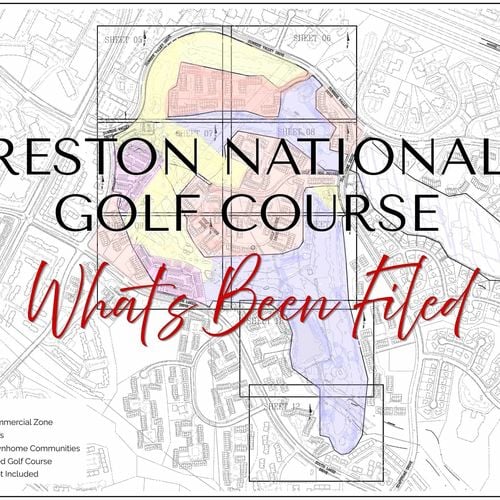
Part 1 of this series documented the three concurrent zoning applications filed by Virginia Investment Partners 2019, LLC and NVR Inc. — and how they route around two failed Comprehensive Plan reviews using a process the public believes exists to protect against exactly this scenario. Part 2 documented what those applications propose to build: a 2-story 35-foot lighted commercial driving range, night golf with no defined boundary, a standalone restaurant on Soapstone Drive, and 306 stacked condos — across roughly 100 acres surrounded by five existing residential townhome communities.
Part 3 focuses on the financial trade. Not the political argument. Not the procedural question. The math — sourced entirely from Fairfax County’s own tax records, modeled with disclosed methodology, and structured so any reporter, planning commissioner, or supervisor can verify a single number without picking up the phone.
Three answers come out of 812 county records:
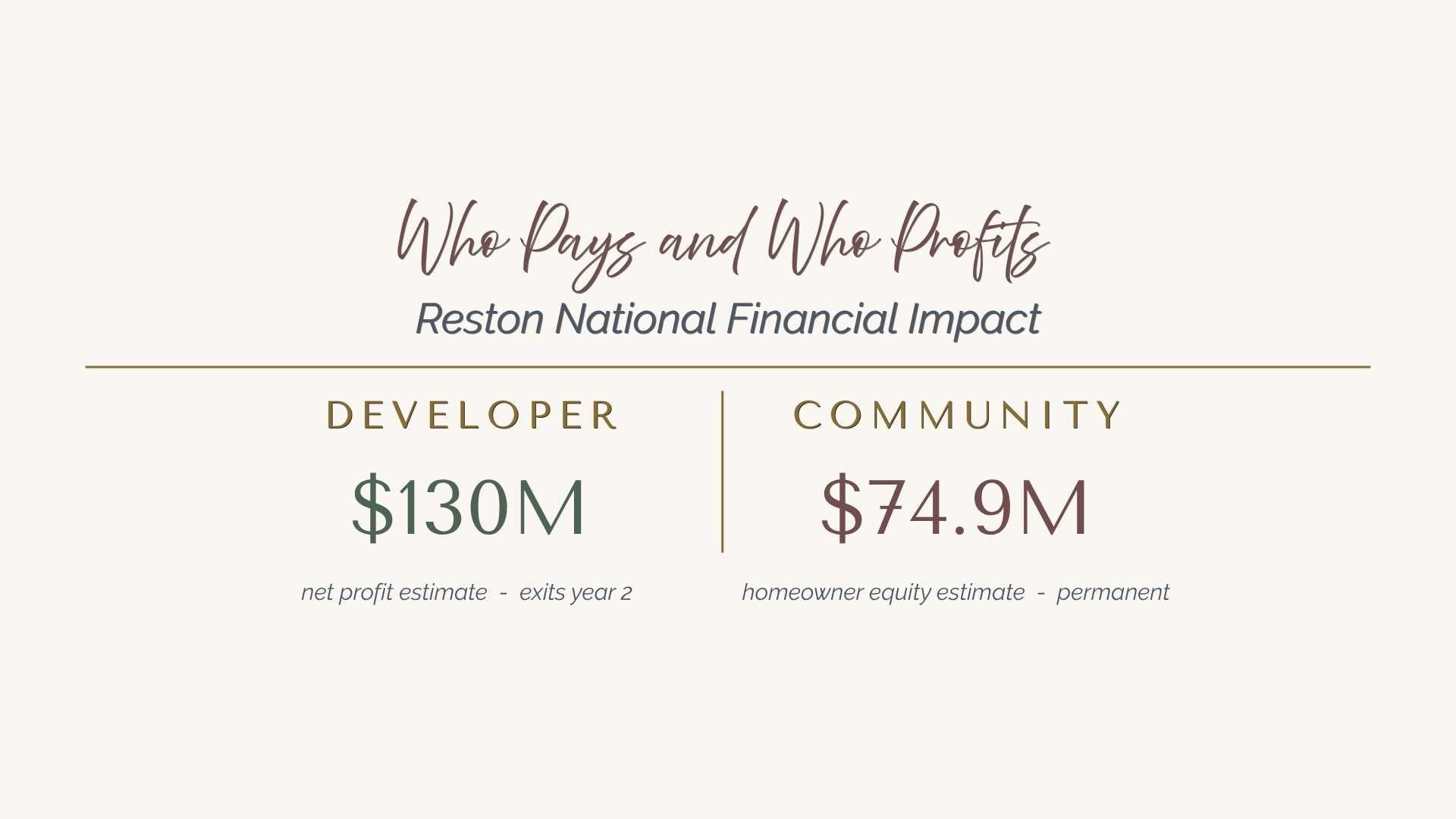
- The Developer nets an estimated $130–140 million and exits by Year 2.
- Existing Homeowners lose an estimated $74.9 million in equity — permanently. 93 families cross over into negative equity.
- The County loses an estimated $763,855/year in existing tax revenue starting Day 1, breaks even cumulatively in Year 3, and reaches a net annual gain of $1.7M only at full build-out.
No one has published this estimate and comparison. The county hasn’t either. This post is the published version, with methodology disclosed and every number traceable to its source. It is not meant to estimate precise gains and losses, but illustrate directionally estimated impact.
Why do I care? I don’t live next to the golf course or in Reston.
Your assessed value is one supervisor vote away from the same math. If a 60-year-old residential approval can be reactivated through a plan amendment to override a 1971 Open Space designation in Reston, the same legal argument applies to every PRC parcel and every aging open-space designation across Fairfax County.
- The County breaks even on this trade. The Community does not. At a Year 5+ net annual gain of $1.7M, Fairfax County earns back the $74.9M in homeowner equity loss over roughly 44 years. The homeowners do not earn it back at all.
- Hidden Creek is next. 150 acres of identically designated PRC Open Space in North Reston, owned by Wheelock. They have not filed an application yet. I expect they are watching this one play out.
- The Comprehensive Plan either means something, or it does not. Two failed SSPA reviews are now being worked around through plan amendments. If this passes, every long-range county plan loses operational meaning.
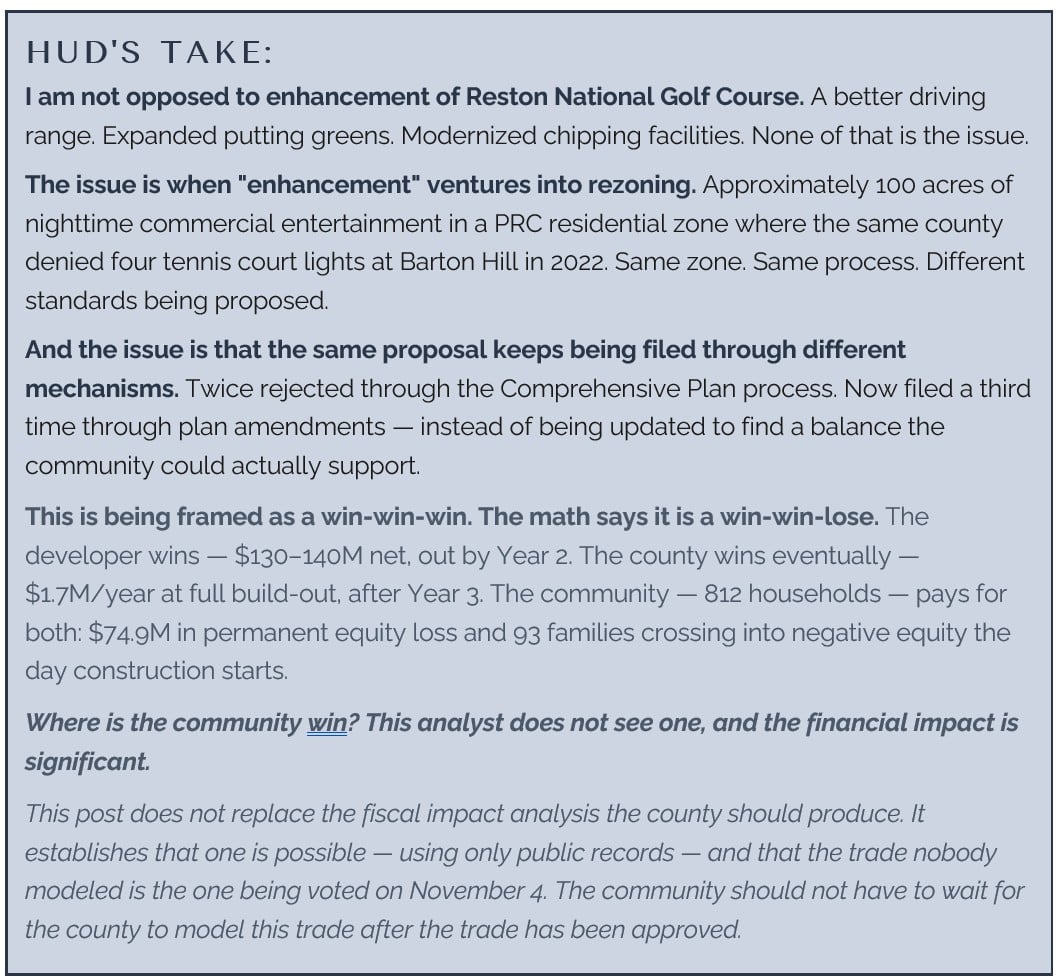
This is a Community Financial Impact Estimate — not a formal fiscal impact analysis. It is sourced entirely from Fairfax County’s public tax assessment records and the developer’s own filed application documents. Methodology is disclosed in full at the end of this post for anyone who wants to verify the math. Cross-validates within 8% of land use attorney John Farrell’s prior independent estimate. The trade-off is the question. The exact math is not.
WHAT THE PRC PLAN AMENDMENT REVIEW WILL LIKELY COVER AND WHAT IS FILED
The procedural gap is the entire story. Here is the gap, in one table.
Fairfax County’s published process for a PRC plan amendment specifies what the staff review will likely include — compliance against the Comprehensive Plan, transportation review, lighting compliance against PRC zone standards, use category review, density compliance, and standard fiscal commentary on new construction tax revenue. These are the items the staff report is expected to address. We will not know exactly what the staff report contains until it is released roughly two weeks before the November 4 hearing.
What we do know is what the application has filed and the gap between the two is significant.
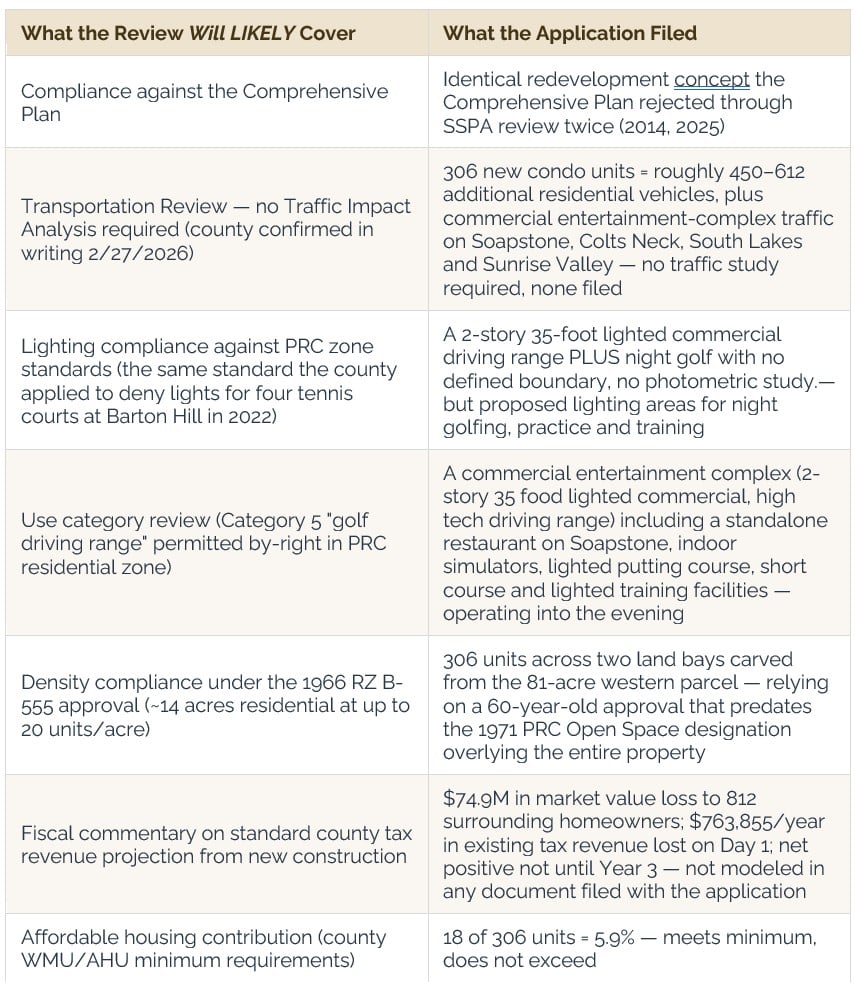
Read the table the way a Planning Commissioner would. The left column is what we expect the staff review to cover based on the published process. The right column is what we already know is filed. Whether the items in the right column are actually addressed at the depth they deserve — or addressed at all — depends on what is in the staff report when it is released. The amendment process is what creates this gap. The same items, filed as a rezoning, would trigger a Traffic Impact Analysis, a fiscal impact assessment, a lighting plan, and a separate commercial zoning review. Filed as a plan amendment, they may or may not
THE DEVELOPER EQUATION
$244.8M gross. $130–140M net. Out by Year 2.
306 stacked townhome-style condo units. Estimated sale price $800,000 per unit, consistent with comparable NVR new-construction pricing in the Reston submarket at this product type and finish level.
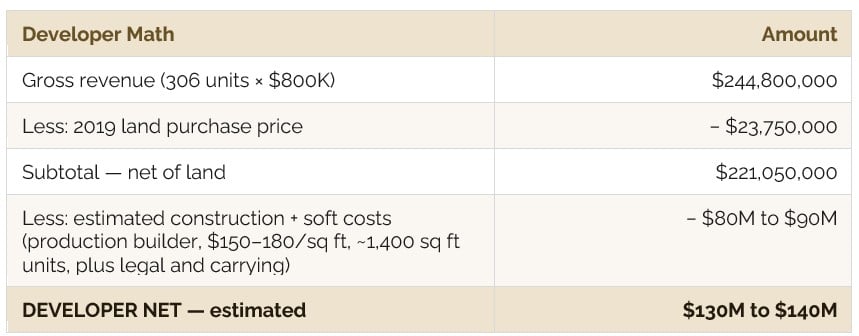
The 2019 purchase price tells its own story. $23.75M for 166 acres of designated PRC Open Space is not the price of land you keep as a golf course, it is the price of land you buy on the bet that the Open Space designation can be worked around. County records flag the price as reflecting future redevelopment value. The current applications are the play behind that bet.
Developer model: build, sell, exit. NVR’s production cadence is roughly 60–80 units per year in this market, which puts full absorption between 4 and 5 years. Cash-positive by Year 2. The community lives with what is left — for the next 30+ years.
THE COUNTY EQUATION
Net negative for 2 years. Net positive by Year 3. $1.7M/year by Year 5+. Worth it?
This section is for the Planning Commission, the Board of Supervisors, and the county staff finalizing their recommendations. The math is simple. The trade-off is not.
Note the mechanism here. The county does not lose tax revenue because of an accounting choice. The county is obligated by its own assessment rules to mark assessed values down when market values drop. Tax follows assessment, and assessment follows the market. The $763,855/year revenue loss is therefore not optional — it is the automatic consequence of approving a development that drives 812 surrounding properties down in market value.
On Day 1 — the moment construction begins the existing homes around it lose market value — Fairfax County is required to follow with assessed value reductions based upon market values, but will understandably lag 1-2 years. That triggers the $763,855 per year in existing tax revenue lost, before a single new condo closes. 812 existing homes drop in estimated market value by a combined $74.9 million; assessed value follows by a comparable amount; tax base contracts; revenue contracts.
New condo revenue offsets that loss — eventually. At $725,000 estimated assessed value per new unit (conservative for new NVR product), full annual tax revenue at 100% absorption is $2.49M. But absorption is not instant. NVR builds and sells over years, and Fairfax County assesses on a January 1 cycle — units closing mid-year are not fully assessed until the following January.
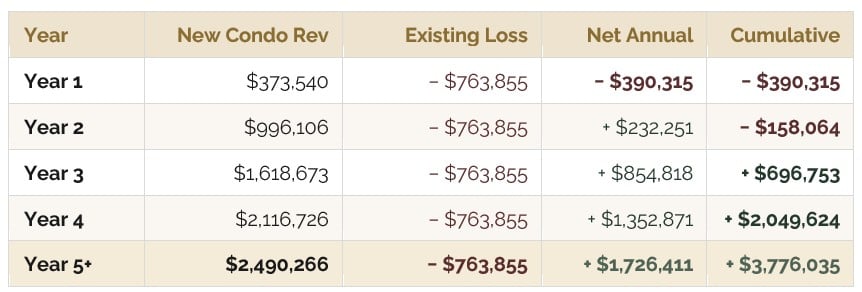
Read this table the way a county budget officer would. The county absorbs a $390,000 net loss in Year 1 and a cumulative $158,000 deficit through Year 2, only reaching cumulative net positive in Year 3. The developer’s exit timeline and the county’s break-even timeline are not aligned. The developer is gone before the county finishes recovering.
Year 5+ net annual gain to the county: $1.7 million. Permanent equity loss to existing homeowners: $74.9 million.
At $1.7M/year, the county “earns back” the homeowner loss in approximately 44 years. The homeowners do not earn it back at all.
Same proposal, different mechanism. Three times. And the precedent stretches far beyond Reston National. Eleven other planning commissioners and nine other supervisors have constituents living adjacent to designated open space across Fairfax County. Hidden Creek Country Club — 150 acres in North Reston, same PRC Open Space designation, same vulnerability — held by Wheelock under the same corporate structure as the Sunset Station development now breaking ground at the Hidden Creek property line. If plan amendments succeed at Reston National, the playbook is on the shelf for every comparable parcel in the county.
THE HOMEOWNER EQUATION
812 households. $74.9 million in equity. Gone the day ground breaks.
If you live in one of the five communities surrounding and within Reston National Golf Course, this section is for you. The numbers below come from your own county tax record.
Two zones, conservatively defined:
- Zone 1 — Direct Impact (441 homes): properties directly surrounded by or immediately adjacent to the course. Modeled at a 15% market value impact.
- Zone 2 — Fairway Impact (371 homes): properties along the fairway corridor of South Lakes Drive, some with and some without direct frontage. Modeled at 10% market value impact.
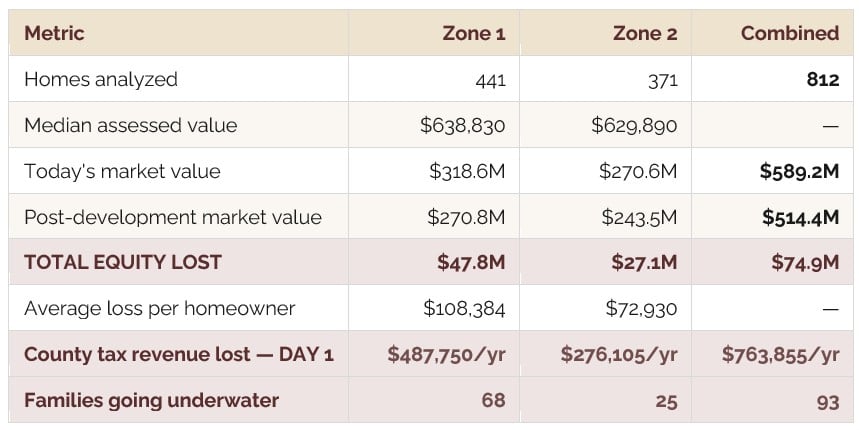
Homeownership period does not save anyone. If you bought in 2003, the equity loss takes 15% off your current market value. If you bought in 2023, same percentage, smaller dollar number, proportionally more painful relative to your down payment.
The hit lands on present-day value. The premium you paid — or refinanced into — for the golf course view becomes a discount overnight. What replaces the view is not a neutral amenity. It is, by the developer’s own filed plans, a 35-foot lighted driving range, night golf, and a commercial restaurant on Soapstone.
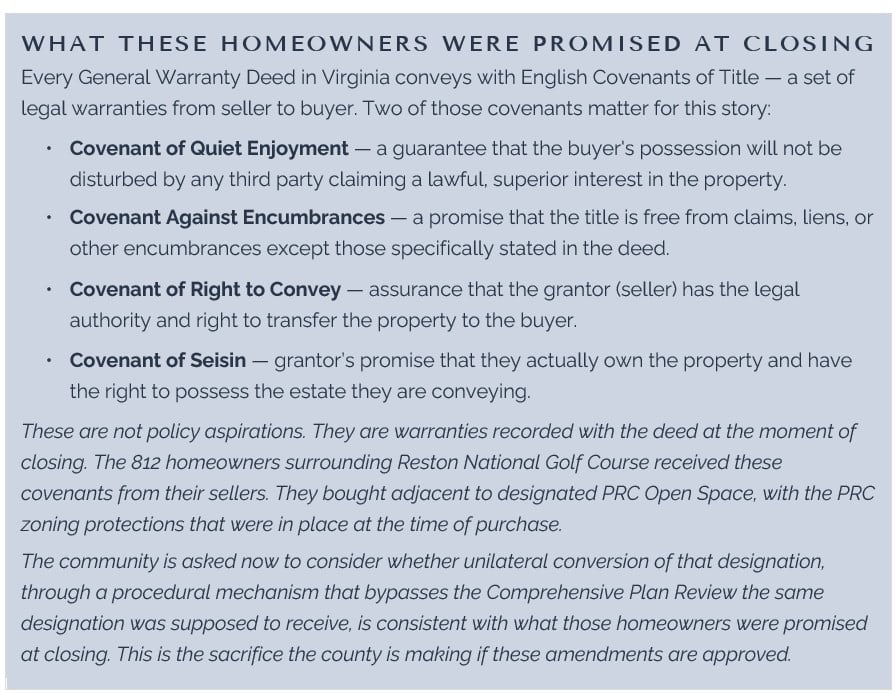
THE UNDERWATER STORY
93 families homes are worth less than they purchase price. None of them were asked.
Of the 812 households in the impact zones, 93 cross the line into negative equity the moment construction starts. “Underwater” is not jargon — it has a precise, painful meaning:
- You owe more on your mortgage than the home is worth. While I do not know the mortgage information for any individual home, I do know that the home is worth less than what was paid for it.
- You cannot sell without bringing cash to closing to cover the gap.
- You cannot refinance — appraisers will not support the loan-to-value ratio.
- Any life event requiring a move — job, divorce, illness, death, downsizing — becomes a financial event the family did not plan for.
These are families who paid a premium for the golf course view during a historic real estate cycle — that is why they bought in this part of Reston, that is why they paid the premium they paid. The premium evaporates. What they get in exchange is a chain link fence, lighting into the evening, and a commercial entertainment complex measured in lumens disturbing the peaceful living they bought into here in Reston.
An Honest Advisory — Not a Sales Pitch
This is the part of the post most agents would skip. I am not going to.
If you live in one of the impact zones and you anticipate needing to relocate in the next 5 to 7 years — for any reason, planned or unplanned — the analyst-honest answer is to consult about your options before November 4, not after.
Here is why, and it has nothing to do with whether the project ultimately passes:
- Uncertainty alone depresses values. From the moment the Planning Commission hearing is calendared, your home enters a limbo period. Buyers’ agents will see the headlines, the filed applications, and the proximity, and they will price the risk in. “Diseased” is the unkind way some buyers’ agents will describe a property like this — and they will. They already are. The target market for these townhomes are the first-time home buyer who is very “risk averse” and cash poor. They will no sooner pick up a paint brush, much less touch a risky investment proposition this situation represents.
- Limbo persists whether the project passes or fails. If November 4 approves the amendments, your value moves toward the post-development number above. If November 4 denies them, the developer files again — through a different door, with different language. The 36 acres east of Soapstone is held clean and waiting. Hidden Creek is held clean and waiting. The cloud does not lift.
- If you will need to move in the next 5–7 years, the cleanest equity window is now. Today’s market still reflects the golf course as the amenity it has been for 50 years, however, the buyer pool is currently tainted with an unknown risk. Once construction begins, that premise is gone. The window between now and the first headline cycle around the November 4 vote is the cleanest window you will see for a long time.
This is the same advisory I provided Regency homeowners adjacent to the Ashburn data center expansion last month. It is not emotional. It is not a sales pitch. It is what a 30-year market analyst would tell a family member at the kitchen table. If your timeline is longer than 7 years, ride it out — long-run trends still favor Reston as a whole. If your timeline is shorter, talk to someone who will model your specific position before the Planning Commission hearing, not after.
Now let’s play this out. If the amendments pass and homeowners need to sell, this becomes an investor playground to pick-up under market value properties in Reston to hold as rental properties. If these HOA clusters do not currently hold rental caps for their clusters, they can quickly fall into what lenders and insurance companies label as “investment neighborhoods”, further impacting and dragging home values. Investors have nothing but time to hold a property as a rental unit until market appreciation returns over the very long haul.
THE QUESTION – WIN-WIN-WIN OR WIN-WIN-LOSE
Strip the language down to its bones. The applicants are asking Fairfax County to make a trade. Three parties, three ledger entries:
DEVELOPER — WIN. $130–140M net. Out by Year 2. Built and gone before the county finishes recovering.
COUNTY — WIN. + $1.7M/year at full build-out. After Year 3. Earns back the homeowner equity loss in approximately 44 years.
COMMUNITY — LOSE. $74.9M equity lost. 93 families underwater. Permanent. And the precedent reaches every PRC and open space designation in Fairfax County.
So here is the question for the Planning Commission, the Board of Supervisors, and the county staff finalizing their recommendation:
Is Fairfax County prepared to tell 812 existing homeowners — 93 of whom will go underwater — that their equity and community peace are an acceptable casualty of $130 million in private developer profit and $1.7 million a year in incremental tax revenue that takes three years to net positive?
And if the answer is yes here, what does any open space designation in this county actually protect?
The county should produce its own fiscal impact analysis before November 4. The Community Financial Impact Estimate published here is not a substitute — it is a public-record contribution sourced from county tax data, intended to be considered alongside whatever the staff report produces. The precedent — which reaches every PRC and open space designation in Fairfax County, not just this one course — deserves to be debated against numbers, not adjectives.
WHAT YOU CAN DO
County staff finalizes its recommendation to the Planning Commission ahead of the July 9 staff cycle. Comments submitted before that date go into the record staff actually reviews. Comments after still count for the record, but the recommendation is largely formed by then.
Submit Written Comments
Email the FULL Planning Commission — all 12 commissioners (9 district + 3 at-large) vote on this, not just Hunter Mill and Supervisor Alcorn.
email to: [email protected]; [email protected]
subject line: RZPA-2025-HM-00034 · RZPA-2026-HM-00007 · RZPA-2026-HM-00008
I am: [Full Name] My Reston Cluster/Address: [Name and Address]
I am writing to oppose the three concurrent PRC plan amendment applications filed by Virginia Investment Partners 2019, LLC for Reston National Golf Course — RZPA-2025-HM-00034, RZPA-2026-HM-00007, and RZPA-2026-HM-00008.
This application proposes 306 new stacked condos AND a commercial entertainment complex — including a lighted driving range, night golf, and a mid-course restaurant — in a residential PRC community. No traffic study has been required. No lighting plan has been filed. Two prior attempts to redevelop this property failed through the proper Comprehensive Plan process.
Three Questions the Commission Should Answer Before Voting
- On lighting consistency. In 2022, the Reston Association proposed adding LED lights to four tennis courts at Barton Hill — a routine recreational upgrade in this same PRC zone. The county required a full PRC plan amendment, Planning Commission review, and BZA appeal. Lights were ultimately denied; the courts were renovated without lighting.
Confirm that the same lighting standard applied to four tennis courts at Barton Hill is being applied to the proposed 2-story 35-foot driving range with lighted targets and the undefined night golf zone in this application.
If a different standard is being applied, identify the difference and the basis for it in writing before staff finalizes the recommendation.
- On scope. Define at what scale, operating hours, or commercial intensity a permitted Category 5 “golf driving range” use in a PRC residential zone becomes a commercial entertainment complex requiring its own commercial zoning designation or special exception approval.
The current filed application proposes a 2-story, 35-foot, commercially operated, lighted-until-night facility with Top Tracer technology, a standalone restaurant, night golf, and indoor simulators. Where is that line?
- On vehicle. Confirm whether a single PRC plan amendment is the appropriate vehicle for simultaneously approving 306 new residential units AND converting 120 acres of golf course open space into a commercial entertainment complex that failed at the SSPA level twice — or whether the commercial component requires a separate zoning action with its own public review process.
I ask Supervisor Alcorn and the Planning Commission to oppose this application and request that the county require a full traffic analysis and lighting study before the November 4th Planning Commission hearing.
Respectfully, [Name]
Plan to attend or submit written testimony for November 4th.
The Planning Commission hearing is open to public testimony — in person, by phone, or by pre-recorded video. Written testimony submitted in advance becomes part of the permanent public record. You do not need to attend in person to be heard. Sign-up opens at 1:00pm on the day of the hearing. Details at: fairfaxcounty.gov/planning-development.
I’ve mapped the impact zone parcel by parcel from county tax records. If you own near the course and want to know where your specific house sits — what’s proposed nearby, and what it means for your value — I’ll walk through it with you. No cost, no obligation.
STAY INFORMED. TAKE ACTION.
Subscribe to receive direct updates on Reston development straight to you inbox.
SUBSCRIBE LINK AND ADD YOUR NAME TO THE LIST
Every subscriber becomes part of a documented constituent record to be delivered to Supervisor Alcorn’s office.
SHARE THIS POST WITH EVERY NEIGHBOR WHO NEEDS TO KNOW.
“𝙏𝙝𝙚 𝙘𝙤𝙪𝙣𝙩𝙮 𝙙𝙚𝙛𝙞𝙣𝙚𝙨 𝙬𝙝𝙖𝙩 𝙞𝙨 𝙗𝙪𝙞𝙡𝙩. 𝙍𝙚𝙨𝙩𝙤𝙣 𝘼𝙨𝙨𝙤𝙘𝙞𝙖𝙩𝙞𝙤𝙣 𝙜𝙤𝙫𝙚𝙧𝙣𝙨 𝙝𝙤𝙬 𝙞𝙩 𝙡𝙤𝙤𝙠𝙨. 𝙏𝙝𝙚 𝙘𝙤𝙢𝙢𝙪𝙣𝙞𝙩𝙮 𝙈𝙐𝙎𝙏 𝙥𝙧𝙤𝙩𝙚𝙘𝙩 𝙩𝙝𝙚 𝙘𝙤𝙢𝙢𝙪𝙣𝙞𝙩𝙮 𝙗𝙚𝙘𝙖𝙪𝙨𝙚 𝙩𝙝𝙖𝙩 𝙞𝙨 𝙣𝙤𝙩 𝙥𝙧𝙤𝙩𝙚𝙘𝙩𝙚𝙙 𝙖𝙣𝙮𝙬𝙝𝙚𝙧𝙚 𝙚𝙡𝙨𝙚.” – 𝗠𝗶𝗰𝗵𝗲𝗹𝗲 𝗛𝘂𝗱𝗻𝗮𝗹𝗹 | 𝗪𝗵𝗶𝘁𝗻𝗲𝘆 𝗣𝗮𝗿𝗸 𝗘𝗮𝘀𝘁 𝗛𝗢𝗔 𝗣𝗿𝗲𝘀𝗶𝗱𝗲𝗻𝘁
I am not an activist. I am a 30+ year market analyst from the tech market. I believe in sharing analysis for educational purposes.
𝘠𝘰𝘶𝘳 𝘪𝘯𝘧𝘰𝘳𝘮𝘢𝘵𝘪𝘰𝘯 𝘸𝘪𝘭𝘭 𝘣𝘦 𝘶𝘴𝘦𝘥 𝘴𝘰𝘭𝘦𝘭𝘺 𝘵𝘰 𝘥𝘦𝘭𝘪𝘷𝘦𝘳 𝘶𝘱𝘥𝘢𝘵𝘦𝘴 𝘰𝘯 𝘵𝘩𝘪𝘴 𝘵𝘰𝘱𝘪𝘤 𝘢𝘯𝘥 𝘵𝘰 𝘥𝘰𝘤𝘶𝘮𝘦𝘯𝘵 𝘤𝘰𝘯𝘴𝘵𝘪𝘵𝘶𝘦𝘯𝘵 𝘤𝘰𝘯𝘤𝘦𝘳𝘯 𝘵𝘰 𝘚𝘶𝘱𝘦𝘳𝘷𝘪𝘴𝘰𝘳 𝘈𝘭𝘤𝘰𝘳𝘯’𝘴 𝘰𝘧𝘧𝘪𝘤𝘦. 𝘐𝘵 𝘸𝘪𝘭𝘭 𝘯𝘦𝘷𝘦𝘳 𝘣𝘦 𝘴𝘩𝘢𝘳𝘦𝘥 𝘸𝘪𝘵𝘩 𝘵𝘩𝘪𝘳𝘥 𝘱𝘢𝘳𝘵𝘪𝘦𝘴 𝘰𝘳 𝘶𝘴𝘦𝘥 𝘧𝘰𝘳 𝘮𝘢𝘳𝘬𝘦𝘵𝘪𝘯𝘨 𝘱𝘶𝘳𝘱𝘰𝘴𝘦𝘴.
RESTON RE-ZONING SERIES:
Part 1: The Three Applications and What They Actually Ask. (Published)
Part 2: The Fun Zone and What’s Really Paying for the Golf Course Upgrades. (Published)
Part 3: $75M Loss in Homeowner Equity — What Redevelopment Costs the Households in the Impact Zone. (This Post)
Part 4: Process, Precedent, and the Future of the Fairfax County Comprehensive Plan. (Published)
Part 5: Governed Growth. What I Filed With Fairfax County. (Published)
Part 6: The November 4th outcome — what the Planning Commission vote means for every PRC and every open-space designation in Fairfax County. (Forthcoming)
Michele Hudnall
Real Estate of Northern Virginia | Equity-First Real Estate Strategy
Life Long Northern Virginia Native | 25-Year Reston Resident | HOA Board President, Whitney Park East | South Lakes Drive
[email protected] | 703.867.3436
RealEstateofNVA.com | @realestateofnva
I help Northern Virginia buyers and sellers make smarter decisions with local market analysis, strategic guidance, and real-world context, not hype headlines.
Disclosure: Michele Hudnall is a licensed real estate agent in Virginia. This post represents her personal analysis and good-faith opinion as a Reston resident and does not constitute legal or financial advice. Full disclosure at RealEstateofNVA.com. All analysis and opinion are my own and based upon local, real-time data. Please consult with a financial or legal professional as required.
Privacy Statement | Disclosure Notice
THE NUMBERS BEHIND THE NUMBERS – FULL METHODOLOGY
Every number in this post comes from one of two places: Fairfax County’s public tax assessment records, or the developer’s own filed application documents (RZPA-2025-HM-00034, RZPA-2026-HM-00007, RZPA-2026-HM-00008) accessible through the county’s PLUS system. No private data. No third-party estimates. No advocacy organizations sourced.
What this is — and what it is not. This post is a Community Financial Impact Estimate — an analysis of what the surrounding community stands to gain or lose, in measurable dollar terms, sourced from public tax records. It is not a fiscal impact analysis. A formal fiscal impact analysis would model school capacity, public safety service load, infrastructure burden, capital improvement triggers, economic multiplier effects, and risk-adjusted absorption — and it should be produced by the county before November 4.
This estimate answers a different question, one that has not yet been asked of this application: what does the existing community lose, in measurable equity terms and over what timeline does the county recover any incremental tax revenue?
The Hud Method — Disclosed
Current market value = Assessed Value × 1.10. Fairfax County assessors target within 10% of market value. The 1.10 multiplier converts assessed to a market-value anchor — not appraisal-grade, but rooted in real analysis and validated repeatedly in transactions across this market. The intent is not to be precise on the number, but on the magnitude of impact.
Post-development market value = Assessed × (1 − impact %) × 1.10. Impact percentages applied conservatively:
- Zone 1 (direct adjacency): 15% — loss of open space buffer, addition of commercial entertainment complex, lighting, traffic, and 4-story stacked condos replacing the view.
- Zone 2 (fairway-adjacent, some with and some without direct frontage): 10% — traffic, noise, and light pollution with and without direct adjacency.
Tax revenue impact = Assessed value loss × $1.1225 per $100. Fairfax County’s 2026 published rate. Note: market value drives assessed value, not the reverse. When market value drops, the county is obligated by its assessment rules to mark assessed values down to track the market. The tax revenue loss flows automatically from that obligation.
Independent Validation
Land use attorney John Farrell’s prior estimate for Reston National put homeowner loss at roughly $40 million across approximately 400 directly-impacted homes — about $100,000 per home. The Hud Method calculation lands at $47.8M across 441 homes, or $108,384 per home average. Two independent methodologies. Aligned within 8%. That is the credibility test. The math is not the question. The trade-off is the question.
SOURCES: ALL PUBLICLY ACCESSIBLE – NO SUBSCRIPTION REQUIRED
Fairfax County PLUS System — All Three Applications: https://plus.fairfaxcounty.gov — Search: Virginia Investment Partners 2019 LLC
Fairfax County 2026 Real Estate Tax Rate: https://www.fairfaxcounty.gov/budget — $1.1225 per $100 assessed value
Fairfax County Real Estate Tax Assessment Records: https://icare.fairfaxcounty.gov — Public tax record data — 812 records pulled by parcel
Filed PRC Plan Set (49 pages): https://plus.fairfaxcounty.gov — RZPA-2026-HM-00007 and RZPA-2026-HM-00008 attachments
Statement of Justification — Cooley LLP: https://plus.fairfaxcounty.gov — Filed March 2, 2026
Alcorn Office Written Response: https://huntermill.fairfaxcounty.gov — April 24, 2026 — Mark Goldberg-Foss, Land Use Aide
FFXnow — Reston National two-pronged approach: https://www.ffxnow.com/2025/04/03/reston-national-golf-course-owner-takes-two-pronged-approach-to-proposed-redevelopment/ — April 3, 2025
FFXnow — BOS rejection June 2025: https://www.ffxnow.com/2025/06/11/push-to-redevelop-reston-national-golf-course-for-housing-suffers-major-setback/ — June 11, 2025
FFXnow — Barton Hill lighting ruling: https://www.ffxnow.com/2022/12/02/new-lighting-no-longer-part-of-barton-hill-tennis-courts-upgrades/ — December 2, 2022 — PRC zone lighting precedent
NVR Inc. (Ryan Homes / NVHomes) construction cost benchmarks: https://www.nvrinc.com — Production builder pricing references
Rescue Reston: https://www.rescuereston.org — Community advocacy reference