
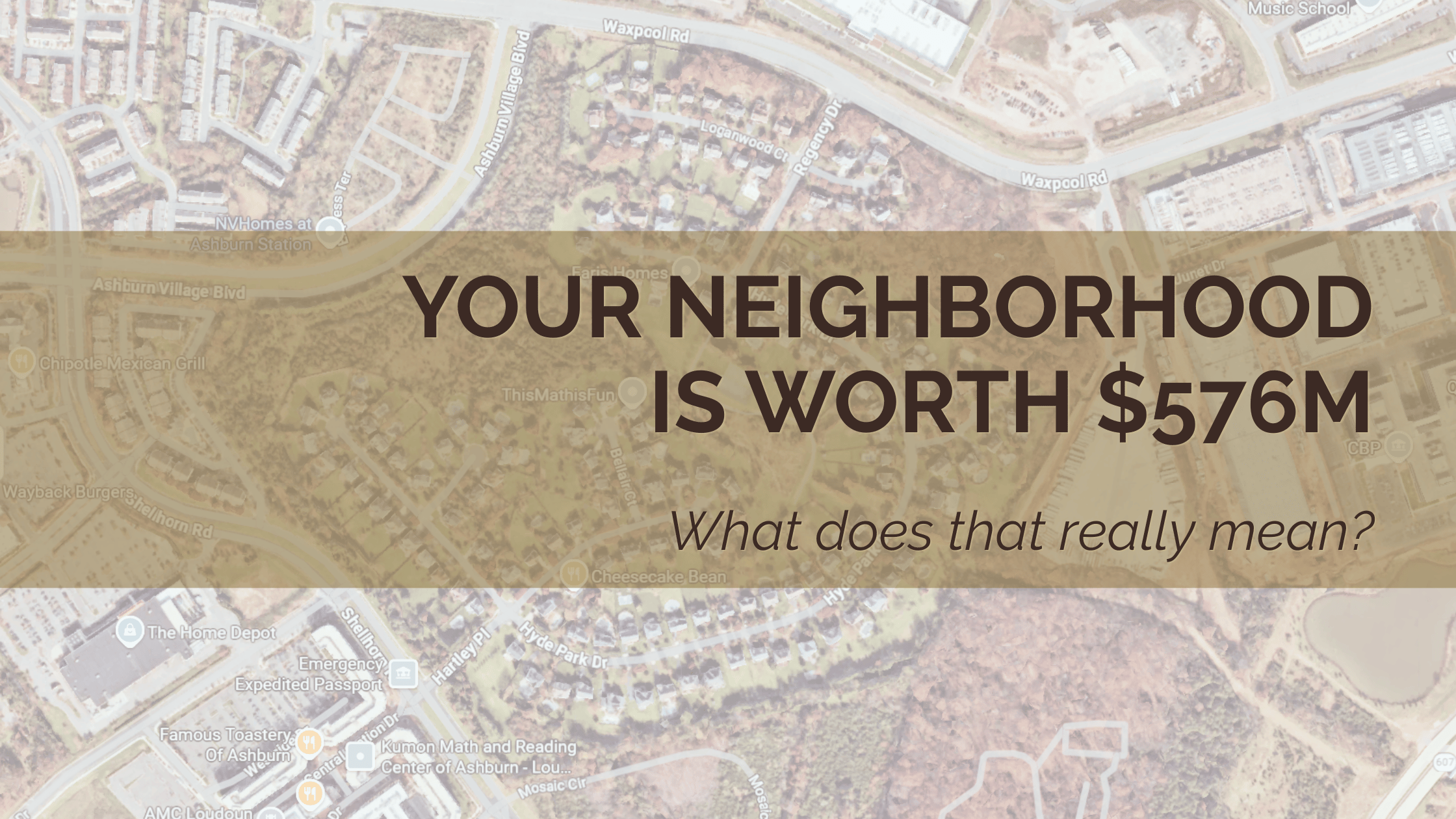
The number that broke the internet this past week and the irony of that phrase will make sense in a moment. $4.4 million per acre, a 143-home neighborhood in Ashburn, Virginia, The Regency, is reportedly in discussions to sell to a data center developer. Total deal: $576 million.
The Regency sits on an island in the middle of Data Center Alley, the six square miles of Loudoun County through which an estimated 70% of the world's internet traffic flows every single day. The phone call you just made, the video you just streamed, the email you just sent . . . yes, a significant portion of it touched a server within a mile of this neighborhood.
I ran the numbers to understand hype from reality: tax records on all 143 homes, MLS data, mortgage profiles and market turnover benchmarked against Loudoun County and the local ZIP.
I found the story the press has missed.
HERE’S WHAT WE ARE COVERING:
- What $4.4M per acre means per homeowner and why the number is likely closer to $4M.
- Why this neighborhood's assessed values decline while the County's rise and the land use shifts this signal.
- What the MLS freeze tells you, zero sales in all of 2025, in a market that was accelerating.
- The regulatory wall, the anonymous buyer, and why silence is a risk factor, not just a mystery.
- The Prince William Digital Gateway example of what happens when a deal stalls for years.
- The coordination trap of County approvals, HOA complexity and unanimous alignment.
- The due diligence lesson Northern Virginia buyers cannot afford to skip.
- BONUS Real-time validation: Fairfax County voted 7-0 to sell County land to a data center developer at the same price per acre, $4M / acre, named developer, named hyperscaler, County endorsed. Check out the final addendum to this post.
"Don't fall in love with real estate. It won't love you back."
MY PREDICTION: the deal closes if the homeowners choose to move forward, but only IF the County can align. The deal counts on the homeowners choosing the deal, the HOA aligning to dissolve and most importantly, the County approving the zoning change. The homeowners who engage the process strategically will come out ahead. The ones waiting passively for a better number may find themselves in a neighborhood that loses its premium and their ability to move along with it.
Let's break it down . . .
1. The Real Math: What $4.4M Per Acre Means Per Homeowner
Let's start with the number everyone is misreading.
Most coverage has been reporting $4.4M per acre, leaving confusion on the offer to homeowners sitting on half acre lots and thus set to receive roughly $2.2 million. That is an incomplete calculation, and it undersells the actual offer by nearly half.
According to Loudoun County public records, the 143 homeowner lots total approximately 69.36 acres. The HOA-owned common property, parks, stormwater areas, internal roads, community space, adds another 46.93 acres based on MLS records.
That is 116.29 verifiable acres. The developer's referenced site plan covers approximately 130 acres. The roughly 14-acre gap almost certainly represents road right-of-way, utility easements, and buffers that are included in the development footprint but don't appear on individual deeds. A data center campus requires all of it, contiguous and unencumbered.
THE MATH AS I ESTIMATE IT
| Total reported deal value | $576,000,000 |
| Reported site acreage | ~130 acres |
| True price per acre | $4,430,769 |
| Homeowner lots — public record total | 69.36 acres |
| HOA common property — MLS total | 46.93 acres |
| HOA common property share per homeowner (÷ 143) | 0.42 acres each |
| Median homeowner lot size | 0.47 acres |
| Median total acreage per owner (lot + common share) | 0.89 acres |
| Median payout at $4.43M/acre | $3,943,384 |
| Average payout per homeowner ($576M ÷ 143) | $4,027,972 |
| Median estimated 2026 market value (assessed × 1.1) | $1,276,880 |
| Median gain above open market value | $2,693,905 |
Every homeowner's pro-rata share of the 46.93 acres the HOA owns adds approximately $1.86 million to their individual payout. That land does not belong to the developer until the HOA votes to dissolve and convey it. That is not a technicality, it is an important piece of leverage the community holds.
The closest comparable transaction: Amazon Data Services paid $3.5 million per acre for the George Washington University campus in Ashburn: 122 fully entitled, infrastructure ready acres just down Route 7.
The Regency is being offered $4.43 million per acre for land that still has 143 occupied homes on it and requires full rezoning from residential to industrial. That $930K premium per acre above the Amazon/GW deal is not charity. It signals a buyer who wants this location and is willing to pay to move fast.
ONE DATA POINT THE HEADLINES MISSED: The 2026 assessed values for these 143 homes declined 3.5%, while Loudoun County's broader residential market rose 1.4%, representing a 4.9% swing. The County assessor's model attributes this to 'external obsolescence' specifically, detrimental proximity to heavy industrial use. QUESTION WORTH ASKING: Is this the market adjusting to slower residential demand, or is it already beginning to price a neighborhood that data center economics have claimed? The answer to that question changes everything about timing.
2. This is Not Appreciation: It is A Land Use Shift From Homeowner to Landowner
This is a shift from homeowner to landowner which no longer factors the value of the home on the property.
Appreciation happens when a home becomes more valuable as a home. What is happening in The Regency is fundamentally different. The land is becoming more valuable to an entirely different class of buyer, for an entirely different use. Once that shift fully registers, it does not reverse.
The Regency sits on an island in the middle of what has become the most strategically important piece of real estate infrastructure. The six square miles of Loudoun County known as Data Center Alley carry an estimated 70% of the world's internet traffic every day. The Pentagon is miles away. The fiber networks run beneath the streets. The power infrastructure is being rebuilt to accommodate demand that has grown faster than any utility in the country anticipated.
UNFORTUNATELY, THE REGENCY IS AN ISLAND INSIDE THE PERIMETER:
- DataBank and Sabey sit directly to the north
- Aligned Data Centers is directly to the east
- Digital Realty anchors the south
- CloudHQ is planned along the southeast
- Dominion Energy is planning high-voltage transmission infrastructure along the Route 7 corridor to feed all of it running directly through the ZIP code
The residential use case did not lose a fight here. It became encircled while the County was looking elsewhere. The battle was fought quietly over two decades, parcel by parcel. This offer is just the bill coming due.
As Loudoun Board Chair Phyllis Randall noted during the 2025 zoning debates: "I have people say, 'I will pay more. Stop building these.'" That is not a peripheral comment. It captures exactly what residents near these projects already experience and what The Regency has been living with for years. Randall is also quoted as saying in a DC News Now interview on March 26, 2026: “I cannot even slightly imagine in what scenario I would vote for a mixed use development with a data center and certainly not a data center standalone.” This deal may be putting “the cart in front of the horse” in terms of county approval.
When the land around your home is worth $4.4 million an acre to an industrial buyer, and your home is worth $1.1 to $1.3 million to a residential buyer, you are no longer primarily a homeowner. You are a landowner sitting on industrial-grade real estate that happens to have a house on top.
QUESTION FOR THE COUNTY: Do the County leaders fully understand their role in how this happened and how they must participate in the resolution of this situation by supporting the current homeowners with their difficult decision? Saving homes for the sake of it may not be the solution to this situation.
3. What the Market Already Knows: The Freeze Creates a New Trap
The story the data tells that the headlines have missed that the homeowners have been feeling for a long time.
Here is my original analysis of the data and the story the press missed.
ANNUAL TURNOVER COMPARING THE REGENCY TO THE ZIP AND COUNTY
| Market | 2023 Sales | 2023 Rate | 2024 Sales | 2024 Rate | 2025 Sales | 2025 Rate |
| Loudoun County (detached) | 2,097 | 2.6% | 2,251 | 2.8% | 2,510 | 3.1% |
| 20147 ZIP (detached) | 232 | 3.5% | 229 | 3.4% | 265 | 4.0% |
| THE REGENCY | 8 | 5.6% | 3 | 2.1% | 0 | 0.0% |
* Source: BrightMLS SmartCharts, detached homes, March 2026. Rates calculated against Loudoun County (~81,668 units) and ZIP 20147 (~6,666 units) per demographic estimates.
While the 20147 ZIP accelerated to 4.0% turnover in 2025 and Loudoun County reached 3.1%, The Regency went to zero. Not slow. Not one listing. In an active market. The neighborhood is already in a real estate freeze due to the current status of the situation.
The three homes that did sell in 2024, in April and May, just before the Reddit rumors went public closed between $1,325,000 and $1,400,000 with a median DOM of 4 days and an average SP/OLP ratio of 103.9%. Those sellers either did not know what was coming, or they read the map and took market value while it was clean.
Nobody has listed since. Coincidence?
HERE IS THE RISK THE FREEZE IS CREATING
What if you need to move?
The data center news is now public. Every buyer doing even minimal due diligence on a home in The Regency will immediately find the buyout story. Most will walk away not because the home is undesirable, but because they do not want to buy into a neighborhood with an uncertain future, declining values and one that may be converted and displaced. The pool of willing residential buyers has shrunk.
The sellers who are considering listing are competing for a smaller audience. The homes sitting on the market without the buyout as a backstop face a compounding problem: declining assessments, industrial neighbors, and public uncertainty about the neighborhood's future. The open market has already started pricing in the uncertainty.
This is the part of the story nobody is telling. The freeze feels like strategy and for those who are prepared to stay for years, it is. However, for anyone who might need liquidity due to a job change, a family situation, a health event; the freeze means the neighborhood has quietly become harder to exit on your own terms.
THE QUESTION BECOMES: Do the residents understand that their exit options are narrowing not because of the developer's offer, but because the public nature of the deal has changed the calculus for every homeowner considering selling and every residential buyer considering The Regency as a future home?
4. The Anonymous Buyer: Why Silence is a Risk Factor
Here is what we know about the buyer: almost nothing and that is deliberate and it matters.
According to Data Center Dynamics, the deal involves a third-party data center developer who would hold the lease, with a major U.S. cloud hyperscaler as the anchor tenant. Both have been identified by DCD as having significant existing footprints in the Ashburn area and yet both have denied involvement when contacted directly. Neither is on record.
The hyperscalers active in Ashburn are not a mystery Amazon Web Services, Microsoft, Google, Meta, and Oracle are all major players in the corridor. Any one of them has the capital to execute a $576 million land acquisition without noticing the rounding error. However, the developer, the entity that would actually buy the land, manage the entitlement process, and build the campus is an unknown. What is their track record? Do they have the capital? Are they in it for the long haul?
"That anonymity creates a legitimate risk question: What is their track record for a deal of this magnitude? Do they have the capital to tie up in this project? How committed is the developer and what happens if the deal becomes more difficult than anticipated?"
Data center developers range from global institutional players with multi-decade commitments to regional operators who are more opportunistic. A developer who walked away from an $800 million land deal because the regulatory process took longer than modeled is not unheard of in this industry, especially now that Loudoun County has eliminated by-right approvals and every project requires a Special Exception hearing with public testimony.
THE REGULATORY WALL IS REAL, AS OF LATE MARCH 2026
- No rezoning application has been filed with Loudoun County.
- Power to the site is projected in the mid-2030s, a decade away even under an optimistic approval timeline.
- The County is simultaneously fighting Amazon's plans for the GW University campus down Route 7, signaling the Board will scrutinize residential-adjacent conversions.
- Broad Run District Supervisor Sylvia Glass has stated the County's comprehensive plan calls for housing and commercial uses on that land, not data centers.
FOR CONTEXT, COMPARE ANOTHER RECENT DEAL: Cologix recently paid $375 million for a 40-acre Ashburn office park, four times its assessed value, specifically because they needed to secure a foothold in a highly constrained market. A CEO who describes Ashburn as offering 'opportunities of this caliber' are 'exceptionally rare' is telling you exactly how much they want land here. The Regency is irreplaceable in its position.
The deal is more likely to close than not because the strategic value of this land is genuinely irreplaceable and the hyperscaler behind it has infinite capital. However, 'more likely than not' is not the same as certain. The timeline is long enough that the deal outlasts market conditions, political cycles, and the patience of 143 individual homeowners trying to coordinate.
THE QUESTIONS REMAIN: Whether the unnamed developer at the table is capable and committed enough to see a 3 to 7-year entitlement process through? Will the County support the homeowners in their decision to move forward with the deal and pass the re-zoning? Are 143 homeowners set to take the gamble to stay put for almost another decade and possibly watch their assessed values decline in the meantime for an unpromised future payday?
5. The Prince William Warning: What Happens When These Deals Stall
If you want to look at a deal magnitudes larger than this deal in real-time, you need only look southward to Prince William County.
If you want to understand what The Regency risks facing over the next 5 to 10 years, look 25 miles south to Prince William County and the Digital Gateway project. It is the closest comparison to what The Regency homeowners are contemplating, and it is a cautionary tale. This author grew up in Prince William County and understands firsthand the number of projects and dynamics that have been historically proposed in similar proximity to the Manassas Battlefield between developers, the County, homeowners turned landowners and nearby homeowners.
PROJECT COMPARISON
| Factor | Prince William Digital Gateway | The Regency (Ashburn) |
| Location | Near Manassas Battlefield, western PW | Heart of Data Center Alley, Ashburn |
| Scale | ~2,100 acres, up to 37 data centers | ~130 acres, up to 6 data centers |
| Developers | Compass Datacenters & QTS (named, public) | Unknown, both deny involvement |
| Acreage price paid | $315K–$910K per acre (by developer) | $4.43M per acre (reported offer) |
| Homeowner/landowner payout | ~$910K per acre for best-positioned sellers | ~$4M per homeowner (est.) |
| Regulatory status | Rezoning voided Aug. 2025; appeal in courts | No application filed; SUE required |
| Years in process | 5+ years (began 2019) | Rumored 2024; public March 2026 |
| Property tax challenges for sellers? | YES — taxed at industrial rates before closing | TBD, currently residential |
| Project killed by courts? | Nearly voided on public notice technicality | No, not applied yet |
The Digital Gateway was initially approved in a 27-hour marathon board meeting in December 2023 and then voided by a circuit court judge in August 2025 because the County failed to properly publish the required public notice. The entire rezoning was declared void ab initio, invalid from the start, on a procedural technicality.
But here is the part that should make every Regency homeowner's stomach turn: In the years between initial approval and the court ruling, the County reassessed the land at its industrial data center value. One family reported their annual property taxes increased from $5,300 to over $728,000. They are required to pay those taxes as if they have already sold the land, even though the final sales cannot close until all legal appeals are resolved. The houses themselves were devalued to a nominal $100 because they are slated for demolition.
That is not a typo. A family paying $5,300 per year in property taxes suddenly owed $728,000, while the deal that justified the assessment is tied up in court.
The Regency situation differs in important ways as it is a smaller and a more targeted deal in the heart of the corridor rather than agricultural land at the fringe. The land's industrial premium is already baked into its geography but the lesson from Prince William is similar.
"The path from 'we have an offer' to 'we have our money' runs through years of regulatory, legal, and coordination risk that the headline number does not reflect."
The developers behind Prince William's Digital Gateway are Compass Datacenters and QTS, named public companies with significant institutional backing and yet they are now years into a legal battle with no guaranteed outcome. The Regency's buyer has not even put their name on record. That is a meaningful difference.
THE QUESTIONS REMAIN: Whether the unnamed developer at the table is capable and committed enough to see a 3 to 7-year entitlement process through? Will the County support the homeowners in their decision to move forward with the deal and pass the re-zoning? Are 143 homeowners set to take the gamble to stay put for almost another decade and possibly watch their assessed values decline in the meantime for an unpromised future payday?
6. The Coordination Trap: HOA Complexity and the Holdout Risk
Even when the regulatory path clears and the buyer commits, the deal still needs to unanimously get through the 143 neighbors and that has already proven difficult.
According to NBC4 Washington, it was former HOA president Mital Gandhi, himself a real estate developer, who devised the plan and found the data center buyer willing to pay roughly $4 million per household. Current HOA president Kevin McCaughey has publicly stated there is 'currently no offer' and called media reports 'categorically inaccurate.' Those two statements are from people who presumably attend the same HOA meetings, and they describe different realities. That gap is the coordination risk.
OWNERSHIP PICTURE ILLUSTRATE WHY ALIGNMENT MAY BE DIFFICULT
| Ownership Band | Share | Median Close Price | Median Payout* | Motivation |
| 0–24 months | 3% | $1,375,000 | $3,899,000 | Swing vote |
| 25–60 months | 21% | $1,115,000 | $3,964,000 | Likely yes |
| 61–120 months | 23% | $870,000 | $3,943,000 | Strong yes |
| 121–240 months | 25% | $735,000 | $3,899,000 | Strong yes |
| 241+ months (20+ yrs) | 28% | $625,000 | $3,943,000 | Strongest yes |
* Payout figures reflect lot value plus pro-rata HOA common area share at $4.43M/acre. Source: Loudoun County tax records + BrightMLS + Real Estate of NVA analysis.
The Regency neighborhood is nearly split in half in what may be varying motivations to move, stay and calculate net gain. Newer homeowners, 0 to 120-month bands, did know what they were buying into. These data centers have been there and under construction for years. There should have been no surprise of the industrial neighbors. They made a choice to buy into a desirable neighborhood despite these neighbors and are now being offered a significant short-term premium to exit. The emotional complexity is real, but the geography was never secret.
What is new and genuinely disruptive is the HOA structure. The establishment of Community Works, LLC as a separate negotiating entity is a material change to the HOA's governance profile. In your due diligence checklist, this belongs front and center: an HOA that has created a separate LLC to negotiate a potential dissolution of the community is fundamentally different from a standard HOA managing common area maintenance. If you are a buyer considering The Regency today, that LLC's existence is the single most important document to request and review before making any offer.
FOR CURRENT HOMEOWNERS, HERE IS THE DECISION FRAMEWORK THAT REFLECTS THE RISK:
- If you are a long-term owner who can stay comfortably for 7 or more years, the strategic move is to engage the process, not wait passively for the premium to come to you and assess accordingly.
- If you might need to sell in the next 2 to 3 years for any reason, job, family, health, financial, the open market has already started pricing in the uncertainty and waiting for the buyout while your exit options narrow is risky.
- If you choose to hold out for a higher individual price, understand that you are betting against both a buyer who has other options and a timeline that will continue to compress the neighborhood's residential appeal
"Not selling isn't holding your ground. It's staying in a neighborhood whose
residential future is already written and whose exit door is closing."
7. The Due Diligence Lesson: Buyers Everywhere in Northern Virginia
Here is the number to contextualize Northern Virginia’s position before we talk about what every buyer needs to know.
An estimated 70% of the world's internet traffic flows through Data Center Alley, the six square miles of Loudoun County around Ashburn, every single day. Not a regional estimate. Not a seasonal figure. Every day. The AI infrastructure investment is running at roughly $40 billion per month nationally in 2025 according to the U.S. Census Bureau.
The demand for data center capacity in this corridor is not moderating, it is accelerating. Why? Infrastructure (fiber, power, water), land, economic incentives, labor, proximity to DC and low risk to natural disasters. That means the land pressure will expand, and it will move in one direction: outward from the core, into adjacent neighborhoods and adjacent Counties.
If you are buying in Northern Virginia, here is the due diligence checklist that belongs on every transaction and that most buyers are still not running:
- Check the zoning of every adjacent and nearby parcel. Not the current use, the permitted use under the zoning ordinance. In Loudoun County, the difference between those two things is now worth millions of dollars per acre.
- Pull the Loudoun County and Fairfax County comprehensive plan maps. Where is data center activity designated? Where are utility and transmission corridors planned? Where is Dominion expanding substation capacity along Route 7?
- Request and read all HOA documents, not just the standard disclosures. If the HOA has created any affiliated LLCs, holding entities, or negotiation structures, especially one named Community Works, LLC or anything similar, that is a material change that signals the community is in active discussion about its own potential dissolution. You can outlive a standard HOA issue. You may not be able to outlive a community that is actively positioning itself for conversion.
- The view from the backyard is not a permanent feature. It is a variable. Underwrite it as one.
- Ask about buyer anonymity in land deals nearby. An unknown developer offering to buy a neighborhood is not standard residential real estate. It is a commercial assemblage transaction dressed in residential clothing. The legal and financial complexity is categorically different.
As available land dries up in the core of Data Center Alley, the expansion has already started moving south. Prince William, Stafford, Spotsylvania, and Fredericksburg are seeing entitlement requests spike. Prince William's Digital Gateway experience, five years of legal battle, property tax challenges, and community fracture — is a preview of what unmanaged data center expansion looks like when it runs into organized residential opposition.
If you are buying in Northern Virginia, you are not just buying a home. You are buying a position in one of the most dynamic and consequential land-use corridors in the world. Due diligence should not be an afterthought as Virginia adherence to the legal doctrine of caveat emptor, or "let the buyer beware". Unlike many states that require sellers to proactively disclose every known defect, Virginia law places the primary responsibility for discovering property issues on the buyer, inclusive of the home condition and location.
Final Word: The Questions That Matter
This is not a case study of a neighborhood in transition, but rather one of County incentives, land use zoning and the perfect storm of favorable conditions for infrastructure providers.
The Regency is not just a neighborhood in transition. It is a case study in what happens when the internet's physical infrastructure runs out of room and starts consuming the residential fabric around it. The Prince William Digital Gateway is what happens when that process takes five years and ends up in the Virginia Court of Appeals. The Regency's geography is stronger, but the process ahead is no shorter and the buyer is not transparent.
The market freeze signals the residents sense the premium payday. The declining assessments signal the residential market already knows the trajectory. The lack of sales in 2025 in a ZIP code that moved 265 detached homes that year signals a collective, quiet calculation is already underway.
The unfortunate component of this story is that the land purchased around a residential community collided in timing for development of both in the late 1990’s. The community has become an island in the middle of the data center parks. This reality has changed the community aesthetic for those who were early homeowners and has left the community financially impacted regardless of the future.
The homeowners have a very heavy choice to make that is emotionally taxing, complex, riddled with risk and lengthy in duration. Let’s hope the County supports the homeowners in their choice regardless of that choice. Here is a framework for a decision like this:
- If the land value now significantly exceeds the lifestyle value of the home . . .
- And the surrounding trajectory makes that gap wider, not narrower, over time . . .
- And your personal circumstances might require liquidity before the deal fully resolves . . .
- Then this decision deserves a serious conversation with your financial advisor regarding your specific financial situation, tax implications, reinvestment options and what happens in each scenario, including the one where the deal never closes.
The homeowners who understand what they are sitting on and engage in the process with strategy rather than sentiment will look back and call this exactly what it was: the exit window regardless of the outcome. Please consult with your trusted financial advisor regarding your unique situation.
REMAINING QUESTIONS:
- Whether the unnamed developer at the table is capable and committed enough to see a 3 to 7-year entitlement process through?
- Will the County support the homeowners in their decision to move forward with the deal and pass the re-zoning?
- Are 143 homeowners set to take the gamble unanimously to stay put for almost another decade and possibly watch their assessed values decline in the meantime for an unpromised future payday?
"Don't fall in love with real estate. It won't love you back."
Michele Hudnall
Northern Virginia’s Equity Strategist | Real Estate of NVA
I help Northern Virginia buyers and sellers make smarter decisions with local market analysis, strategic guidance, and real-world context — not hype headlines.
If you want a clear read on your home, your neighborhood, or your next move, let’s talk.
Privacy Statement | Disclosure Notice
8. BONUS Update 03/19: Fairfax County Sells Chantilly Land – $166.8M for 41.7 Acres
$4M per acre appears to be the validated going rate for data center land in Northern Virginia where infrastructure is in place. The Regency offer is consistent; the timeline difference is significant. Fairfax has infrastructure ready; the Regency is looking at mid-2030s for power.
One day before the Regency story broke, Fairfax County's Board of Supervisors voted 7-0 to approve the sale of 41.7 acres of county-owned land at 3721 Stonecroft Boulevard, the former Police Department training facility near Dulles Airport, to Starwood Capital Group for $166.8 million. The hyperscaler end-user is AWS. The vote was unanimous.
"$166.8 million divided by 41.7 acres equals approximately $4 million per acre/em>
This is not a coincidence. This is the market.".
Unlike the Regency situation, this deal has named parties, a County endorsed purchase, an approved sale agreement, and an existing industrial zoning designation that requires no rezoning; only a potential Special Exception for building height. Dominion Energy infrastructure is already in development in the area. The County projects tax revenue starting at $20 million annually once the site is operational. Closing is targeted for Spring 2027, with construction of the new police training facilities running through Spring 2031.
The County framed the sale as "a rare opportunity to strengthen public safety while also being good stewards of taxpayer dollars." Nearest residential properties are approximately 2,700 to 2,800 feet from the site. The nearest school is approximately 1.3 miles away.
Two Counties. Two deals announced within 24 hours of each other. Both at approximately $4 million per acre. One with named parties and County support. One with anonymous buyers and a County comprehensive plan that calls for housing on the land.
$4 million per acre is the validated, going-rate market price for data center land in Northern Virginia where infrastructure is in place. The Fairfax deal confirms it with a public vote, a named developer, a named hyperscaler, and a third-party appraisal on record.
The infrastructure question of power, fiber and water is what separates a deal that closes in Spring 2027 from one that won't see power until the mid-2030s. For Regency homeowners watching the Fairfax deal move efficiently through the process, that timeline gap is worth understanding.
Source: Fairfax County Board of Supervisors, official topic page — fairfaxcounty.gov
Check out this article next