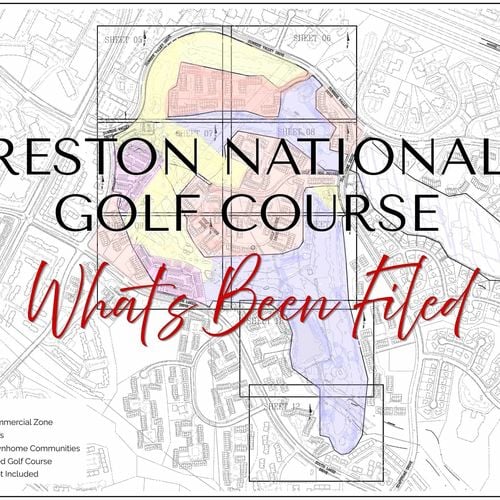
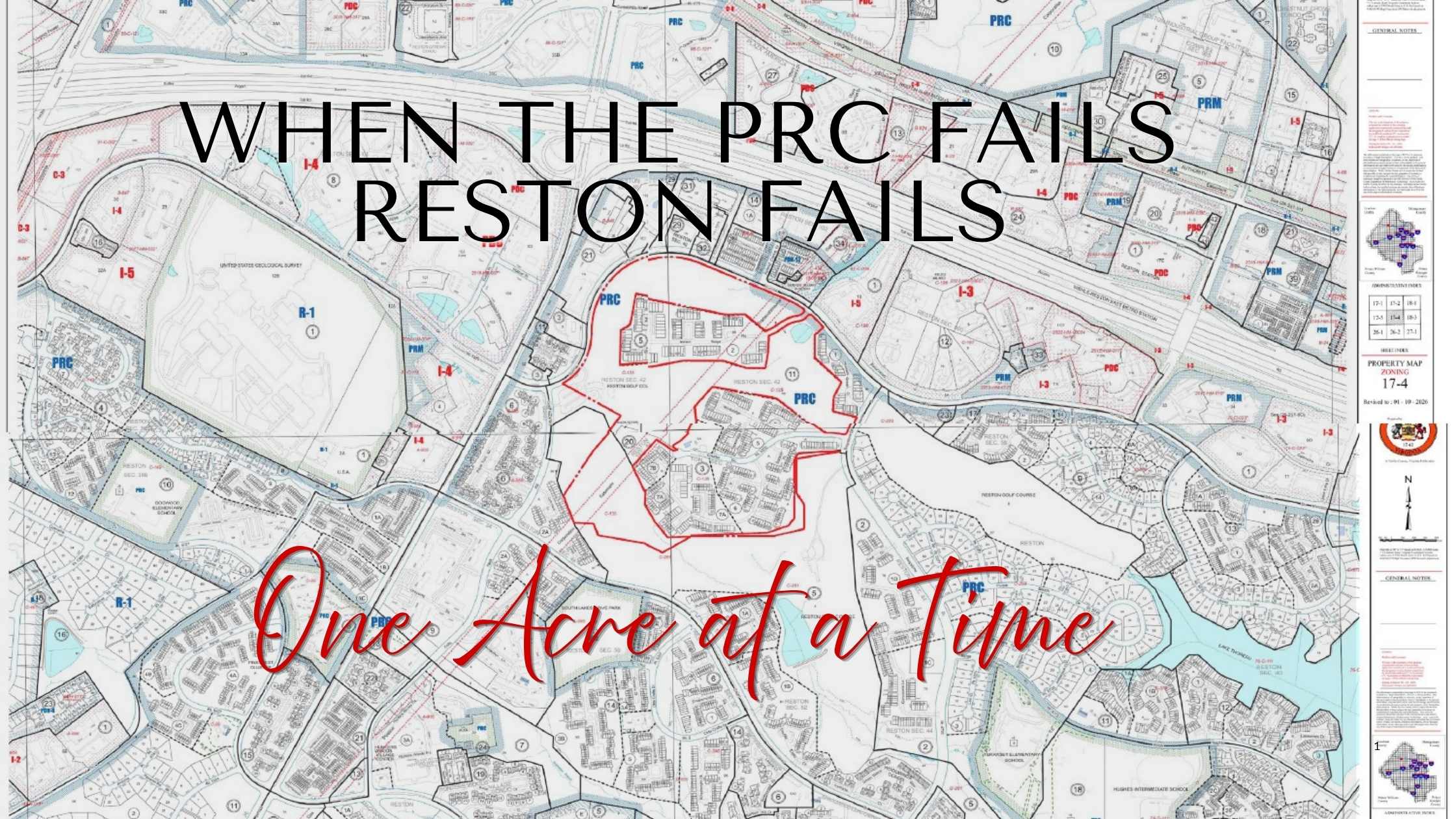
306 Units, Not 288. Three Zoning Cases, Not One. A November 4th Hearing Scheduled. Here’s What’s in the Filed Documents
Editor’s Note: This post has been updated on April 25, 2026 to include correspondence received from Supervisor Alcorn’s office on April 24, 2026, clarifying the 2007 PRC ordinance amendment and the county’s position on the developers’ legal argument. The update appears in the section titled “The 2007 Fix Fairfax Already Built” below.
If you are a Restonian, you’ve been following the story of one application for approximately 14 acres of the Reston National Golf Course. That’s not quite the full picture.
As of today, there are three concurrent applications filed by War Horse Cities — a Baltimore-based real estate developer operating through its subsidiary Virginia Investment Partners 2019 LLC — with NVR Inc., one of the largest production homebuilders on the East Coast, already named as co-applicant on all three. The 14 acres is the first legal wedge. The strategy is larger. The window to act is narrower than most Restonians realize.

Supervisor Alcorn has publicly committed not to support redevelopment without broad community consensus. The developers have now found a path that goes directly to the Board of Supervisors — bypassing the Site Specific Plan Amendment (SSPA) process that defeated this twice — with a Planning Commission hearing already scheduled for November 4th, 2026. County pre-staffing begins May 4, 2026. The window to influence the framework is now.
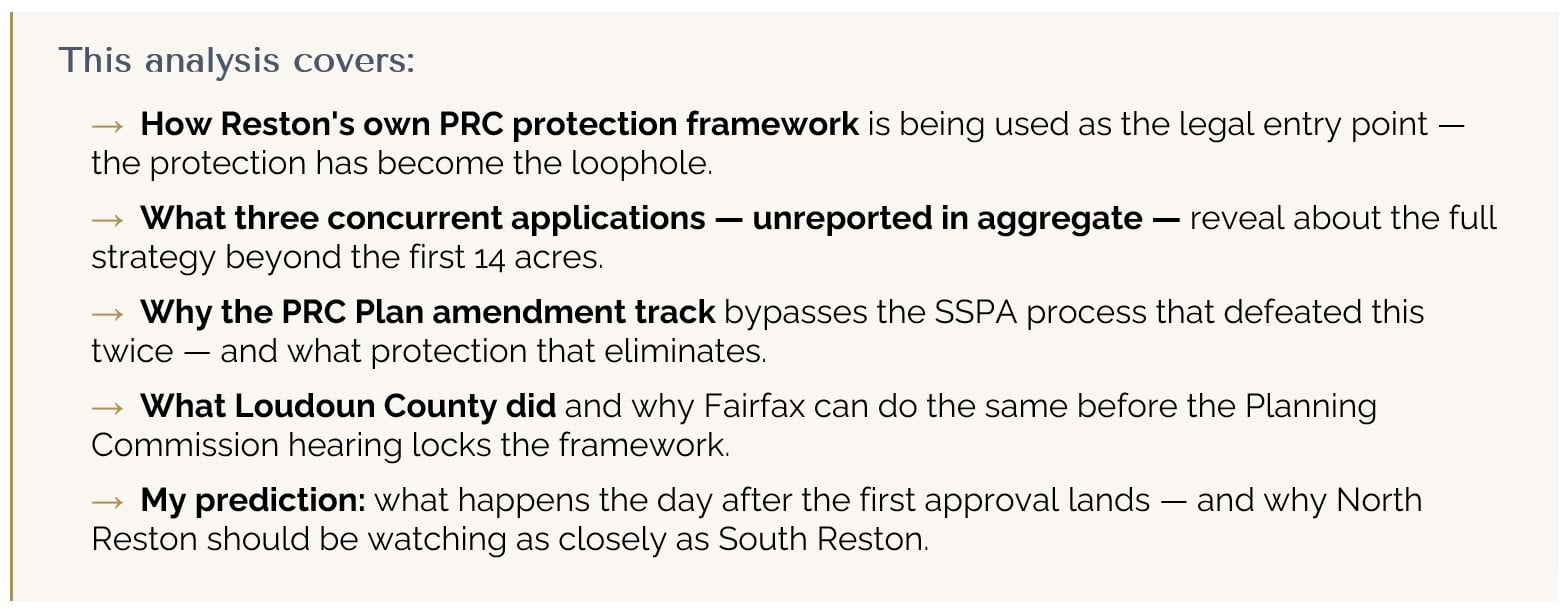
The ask is not emotional. It’s procedural. Do what Loudoun County did: require legislative review for applications invoking pre-1975 zoning approvals before the staff framework locks. Reston Association Board President and land use attorney John Farrell warned publicly what a successful outcome for the developers would introduce to this community. He called it chaos. He wasn’t being dramatic. Here’s why.
One more thing before we get into the data. Reston National is not the only privately held PRC Open Space in Reston. Hidden Creek Country Club — 150 acres in North Reston, owned by Wheelock Communities out of Greenwich, Connecticut — carries the identical zoning designation, the identical Comprehensive Plan language, and the identical vulnerability to the same argument.
Do you think the Connecticut owners of Hidden Creek aren’t watching every move of this process? Do you think NVR — or another production homebuilder — hasn’t already had that conversation?
How many Stacked Townhomes before Reston is saturated with “Tiny Condo Syndrome”?
HUDS TAKE: Hidden Creek is the next shoe to drop. The only question is whether Fairfax County acts before the first shoe lands.

The Protection That’s Being Used Against Itself
Reston’s open space is not unprotected. The Planned Residential Community (PRC) district, established in 1962, was built on a foundational principle: adequate and well-designed open space for the use of all residents. That principle was codified into every development plan approval for every parcel in the PRC. Both of Reston’s privately held open spaces were formally designated under those approvals in 1966 and 1971. The Fairfax County Comprehensive Plan explicitly states that both are planned to remain.
That protection is real. The problem is not that it doesn’t exist. The problem is that the developers’ attorneys have found a way to use the protection’s own architecture against it.
Every PRC development plan is by definition amendable — that flexibility was built into the framework deliberately, to allow Reston to evolve over time. The argument now being made is that converting PRC Open Space to 306 residential units is simply an amendment to an existing development plan — not a Comprehensive Plan change, not a new rezoning, not a legislative act requiring the full SSPA public input process that defeated this twice.
If the Planning Commission and Board of Supervisors accept that framing, the community loses the SSPA protection layer that stopped this in 2022 and again in 2025. The public hearings still happen — but the legal standard being applied is lower, the community’s strongest procedural tool has been bypassed, and the precedent established reaches far beyond these 14 acres.

ADDENDUM — The 2007 Fix Fairfax Already Built
Updated April 25, 2026 — following correspondence with Supervisor Alcorn’s office
Since publication, Supervisor Alcorn’s land use aide Mark Goldberg-Foss responded directly to a formal policy inquiry submitted to the Hunter Mill District office on April 20, 2026. His response clarifies a critical piece of the legal architecture that deserves its own explanation.
The PRC district operates on a two-level entitlement process. The first level is the Development Plan, sometimes called the “blob plan”, which broadly establishes permitted uses and densities with minimal site-specific detail. The second level is the PRC Plan, formerly called the preliminary site plan, which provides the specific layout and design of what actually gets built.
Before 2007, PRC Plans could be processed administratively, meaning a county staff determination, not a public hearing, not a Planning Commission recommendation, not a Board of Supervisors vote. A desk decision. That is the door the developers’ original argument was pointed at.
In 2007, the Fairfax County Board of Supervisors closed that door. They amended the PRC Zoning District — Article 8 of the Zoning Ordinance — to require legislative review for all PRC Plans and PRC Plan Amendments. Every PRC Plan. No exceptions. Planning Commission hearing. Board of Supervisors vote. Community input. On the record.
Fairfax County saw the vulnerability and fixed it. Nineteen years ago.
This is why the Loudoun parallel is so precise. Loudoun faced developers using historical by-right claims to bypass public process on data center projects. Loudoun required legislative review before those claims could be implemented. Fairfax did the same thing for PRC Plans in 2007. Both jurisdictions recognized that administrative desk decisions on consequential land use changes were incompatible with community governance. Both acted.
The 2007 amendment is the protection that is now being tested.
The developers’ three concurrent applications are not arguing they can avoid the Planning Commission or the Board of Supervisors, they are going through that process. What they are arguing is that their specific situation, the dormant 1966 RZ B-555 entitlement, gives them a legal basis for Board approval that does not require a Comprehensive Plan amendment. They are using the 2007 legislative process while simultaneously arguing that the Comprehensive Plan amendment requirement that defeated this project twice does not apply to them.
Goldberg-Foss stated directly in his April 24 response:
“Any assertion on the part of the applicant that their PRC Plans are subject only to administrative review would appear not to be in conformance with administrative procedure set forth in Article 8 of the Zoning Ordinance. Supervisor Alcorn is familiar with the applicant’s position, and he has stated publicly that he is not convinced.”
That is the Supervisor’s own land use aide, on the record, stating that the developers’ core legal argument appears to conflict with the 2007 ordinance Fairfax County itself enacted.
The door Fairfax closed in 2007 is the door these applications are testing. The Planning Commission hearing on November 4th, 2026 is where that test gets answered.
What the County’s Own Records Show
War Horse Cities acquired the property through its subsidiary Virginia Investment Partners 2019, LLC and the ownership history requires no editorializing.

Nobody pays 4.7 times the previous sale price for a property they intend to operate as-is. The county’s own transaction record documents the intent. That note — “Price reflects future redevelopment” — is a line in the Fairfax County public tax record, retrievable by any resident at no cost. The property continues to operate under KemperSports management. Green fees are being collected today on land that three active applications are seeking to convert.

Three Applications. One Coordinated Legal Strategy.
The public narrative has focused on a single by-right claim — one application, 14 acres, one 1966 zoning document. That framing describes the legal wedge. It does not describe the strategy. Here is what I found in Fairfax County’s PLUS system using the developer’s full legal entity name: Virginia Investment Partners 2019, LLC. These records do not surface when searched by property address, Reston National or by the name most people know — War Horse Cities.
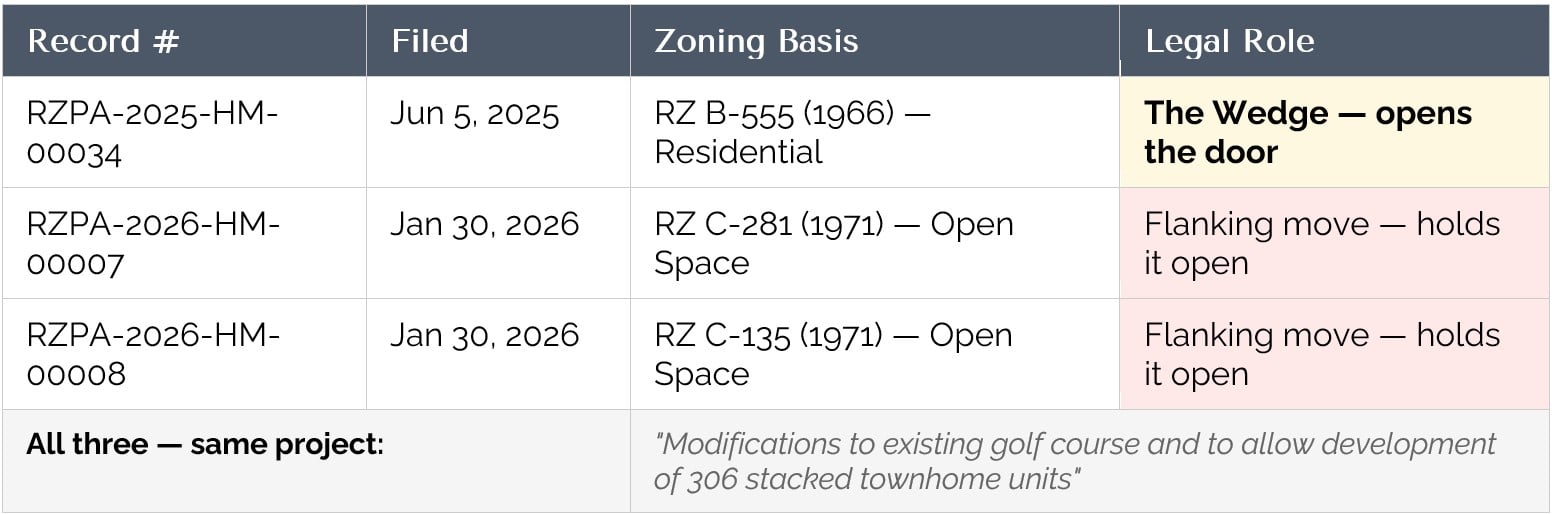
The press has reported 288* units on 14 acres. The filed applications describe 306 units — which at the stated density of 20 units per acre implies 15.3 acres, not 14. That discrepancy has not been publicly reported. The applications are technically public. Without knowing the legal entity name, they are practically invisible.
*”The discrepancy has since been clarified by Supervisor Alcorn’s office: 288 market-rate units plus 18 Affordable Dwelling Units (ADUs) required under Fairfax County’s zoning ordinance — 306 total. The press reported 288. The filed applications say 306. The ADU breakdown doesn’t change the density calculation or what gets built. Source: Alcorn office written response, April 24, 2026; Statement of Justification (SOJ), filed March 2, 2026.”
Application 1 — The 1966 Wedge
The first application invokes a September 1966 Board of Supervisors rezoning approval designating approximately 14-15 acres on the western edge of the property for medium-density residential development at up to 20 units per acre. This was raw land pre-zoned before the site opened in 1970. That residential designation was never formally revoked. It sat dormant for 60 years — until a Baltimore developer’s attorney found it.
The developers’ own SOJ, filed with Cooley LLP and publicly available in the PLUS record, states their argument plainly: the 1971 open space designations “did not amend the RZ B-555 approval or its development plan; therefore, the B-555 Land remains subject to the development plan associated with RZ B-555 permitting medium-density residential at 20 units per acre.”
Applications 2 and 3 — The Flanking Move
Seven months after filing the 1966 claim, the developers filed two additional applications invoking the 1971 zoning cases — the very cases that designated the remaining 150+ acres as permanent open space. Each of the three historical zoning cases carries an associated PRC development plan document. By amending all three simultaneously, the developers eliminate the community’s strongest counterargument before it can be made: that the 1971 open space designations supersede the 1966 residential claim.
They are not asking to develop 166 acres today. They are asking the Board to approve 15 acres in a way that makes the remaining 150 acres legally indefensible tomorrow with 2 additional applications covering the broader property.
Once the Board approves the first PRC Plan amendment, the precedent is established that these development plan documents — including the 1971 open space designations — are amendable through this same process. The two previous SSPA defeats become legally irrelevant to the remaining acreage.

NVR Inc. Is Already in the Room
Virginia Investment Partners 2019, LLC is not testing a legal theory alone. NVR Inc. — operating under the Ryan Homes and NVHomes brands — is named as co-applicant on all three filings. Production homebuilders of NVR’s scale conduct feasibility analysis, underwrite land costs, and commit legal resources before signing co-applicant agreements. Their presence signals that this project is already in pre-development planning.
NVR gets paid when units close. They are not here to speculate. They are here because someone has already done the math on sales velocity, unit pricing, and return on cost — contingent on Board approval of the PRC Plan amendment.
What Gets Built — And What It Means on the Ground
The application describes 306 stacked townhomes — but that term requires translation. A stacked townhome is a condominium unit. Two owners per building footprint. One owner occupies the lower floors, entering through the front door. The second owner occupies the upper floors, entering through a separate door. Neither owns the exterior walls, the roof, or the land beneath the building. That is condo ownership — not fee simple. This also brings a minimum of 4 parking slots per stack.
As properties within Reston’s POA boundary, Reston Association’s Master Deed covenants apply — as they do to every Reston property including existing condominiums. What these new units will not have is the cluster supplement layer that surrounding communities have built over decades. NVR creates the minimum condo documents required to sell units. Rental restrictions, occupancy requirements, and investor limitations are not standard inclusions. Without them, every unit is legally rentable from day one.
The financial math drives the design. At 18.7 units per acre — two units per building footprint — the development achieves near-apartment density behind a townhome exterior. This is condominium density accomplished through townhome aesthetics, in a zone that caps density at 20 units per acre.
What the adjacent cluster homeowner sees on the ground: the wooded buffer that currently separates their cluster from open space gets clear-cut for foundations and infrastructure. The golf course, the pond, the wooded view — the amenity they paid a premium for — becomes a four-story building face at the lot line. The financial impact of that transformation is the subject of Part 3 of this series.

The Process That Was Bypassed — And Why It Matters
This application is not purely administrative. It goes to the Planning Commission and ultimately to the Board of Supervisors. Supervisor Alcorn will have a vote. But the process being used is materially different from what defeated this before.
The SSPA process — Site-Specific Plan Amendment — requires a Comprehensive Plan change. It opens a full public input cycle, Planning Commission recommendation, and Board vote on whether to even begin staff study. That process rejected this project in 2022 and again in June 2025 when the Board unanimously removed it from the work program. Supervisor Alcorn’s pledge not to support changes without community consensus was made in the context of that SSPA process.
What the developers are now arguing is that no Comprehensive Plan amendment is required — this is a PRC Plan amendment, a lower legal bar. It goes to the Board directly, without the SSPA gatekeeping process. The community still gets a Planning Commission hearing on November 4th, 2026. But the strongest procedural protection — the SSPA work program gate that requires the Board to approve even beginning the study — has been bypassed entirely.

Farrell is not describing bulldozers in every Reston backyard. He is describing legal uncertainty cascading through every PRC development plan designation in the community. If the Board approves this PRC Plan amendment, it establishes that these historical plan documents are amendable through this process — and the argument applies to every privately held parcel in Reston operating under a pre-1975 development plan.
For the approximately 400 homeowners whose properties directly border the affected parcel, Farrell cited an estimated $40 million in lost assessed value. That is also $40 million in lost tax base for Fairfax County. The full financial picture — by household, by cluster, by street — is the subject of Part 2.
By enabling PRC Plan amendments an acre at a time as lots surface, is degrading the community as a whole and creating the “Tiny Condo Syndrome” by looking at an acre to develop and not the whole of the PRC. Reston was intended to evolve, but as a community as a whole — not an acre at a time bypassing the SSPA process. This is the subject of Part 4 in this series.

The Loudoun Precedent — There Is a Policy Solution
This is not unsolvable. Loudoun County faced a structurally identical challenge in 2021 — developers using historical by-right claims to advance projects that bypassed public process. Loudoun amended its zoning ordinance proactively: legislative review required for applications invoking historical by-right approvals, with a grandfathering provision for projects already in flight. Loudoun acted before the loophole became permanent.
The result: $1.2 billion in annual tax revenue now flowing through an orderly, transparent, publicly accountable process. Development did not stop. It was required to happen in a way the community could see. However, due to the grandfathered projects, The Regency community has become an “island” surrounded by data centers and Dominion Power infrastructure (Read more about it here). This is where property value impact occurs when not looking at the whole community and bypassing the process, again the subject of Part 4 in this series.
Fairfax faces the inverse equation. Three concurrent applications seeking to convert PRC Open Space to 306 residential units — zero offsetting revenue to the county, $40 million in lost assessed value to adjacent homeowners, and the potential to establish a precedent that reaches the second privately held PRC parcel the moment this one is approved.
The specific ask: require that any application invoking pre-1975 zoning approvals be subject to the full Comprehensive Plan amendment process — before the current Planning Commission framework is set and before pre-staffing on May 4, 2026, locks the approach. Loudoun built this mechanism. Fairfax has the same opportunity now.


The Second Parcel — Hidden Creek Is Watching
Reston National is one of two privately held PRC Open Space parcels in Reston. Hidden Creek Country Club — 150 acres in North Reston, owned by Wheelock Communities out of Greenwich, Connecticut — carries the identical zoning designation, the identical Comprehensive Plan language, and the identical vulnerability to the same argument.
As of the date of this publication, no applications for Hidden Creek appear in Fairfax County’s PLUS system. Wheelock is not filing anything yet. The strategic logic is straightforward: let Virginia Investment Partners absorb the community opposition, secure the Board approval, establish the precedent. Then file.
South Reston is first. North Reston is next. The legal question being decided at the November 4th Planning Commission hearing has consequences for both privately held open space parcels and for every cluster in Reston that borders either one.
What I Put on the Record
On the evening of April 20, 2026, I sent a formal policy inquiry to Supervisor Alcorn’s district office at [email protected] — documenting the three active applications with their public record numbers, the unit count discrepancy between press reporting and actual filings, NVR’s co-applicant status, the $40 million assessed value figure, John Farrell’s public warning, and the Loudoun precedent. I asked a specific policy question on record before county pre-staffing begins May 4.
I am not an activist. I am a licensed real estate professional, a 25-year South Reston resident, and the HOA Board President of Whitney Park East cluster. I pulled the county’s own public records, read the filed SOJ, ran the math, and sent the letter.
Supervisor Alcorn has publicly committed not to support redevelopment without broad community consensus. The developers have now found a path to his desk that bypasses the process where that commitment was made. He still has a vote. The question is what information reaches his office before the framework is set.
I’ve mapped the impact zone parcel by parcel from county tax records. If you own near the course and want to know where your specific house sits — what’s proposed nearby, and what it means for your value — I’ll walk through it with you. No cost, no obligation.
What You Can Do Right Now
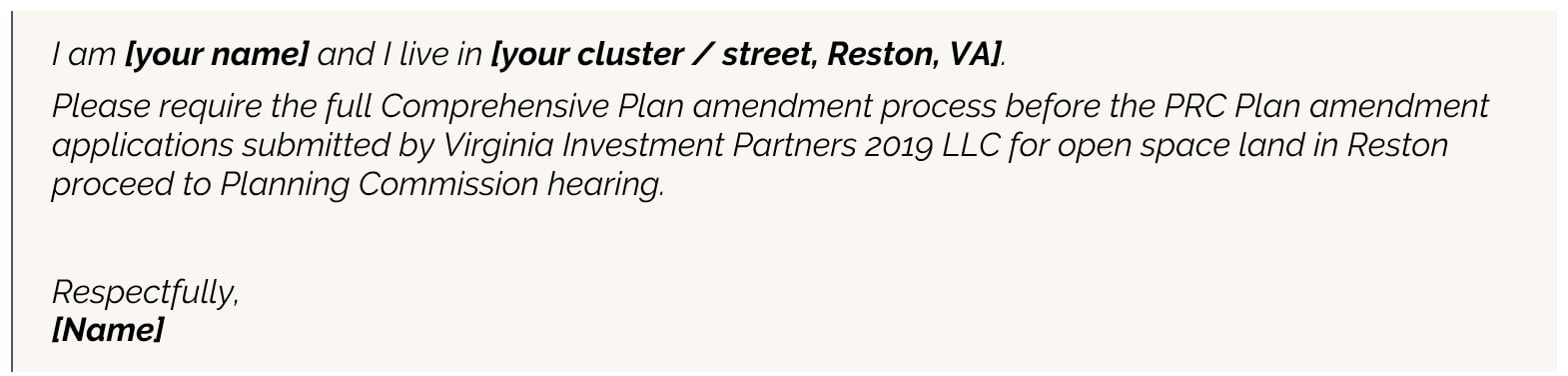
Three sentences to the Supervisor’s office are enough — who you are, where you live in Reston, and that you are asking the county to require the full Comprehensive Plan amendment process before the PRC Plan amendment proceeds.
Email: [email protected]
Subject: Reston PRC Open Space — Please Require Full Comp Plan Process Before PRC Plan Amendment Proceeds
Every constituent email that lands in that inbox is a data point
his office carries into the framework discussion.
Every email after is history.
STAY INFORMED. TAKE ACTION.
Subscribe to receive direct updates on Reston development straight to you inbox.
SUBSCRIBE LINK AND ADD YOUR NAME TO THE LIST
Every subscriber becomes part of a documented constituent record to be delivered to Supervisor Alcorn’s office.
Share this post with every Reston neighbor who needs to know.
“𝙏𝙝𝙚 𝙘𝙤𝙪𝙣𝙩𝙮 𝙙𝙚𝙛𝙞𝙣𝙚𝙨 𝙬𝙝𝙖𝙩 𝙞𝙨 𝙗𝙪𝙞𝙡𝙩. 𝙍𝙚𝙨𝙩𝙤𝙣 𝘼𝙨𝙨𝙤𝙘𝙞𝙖𝙩𝙞𝙤𝙣 𝙜𝙤𝙫𝙚𝙧𝙣𝙨 𝙝𝙤𝙬 𝙞𝙩 𝙡𝙤𝙤𝙠𝙨. 𝙏𝙝𝙚 𝙘𝙤𝙢𝙢𝙪𝙣𝙞𝙩𝙮 𝙈𝙐𝙎𝙏 𝙥𝙧𝙤𝙩𝙚𝙘𝙩 𝙩𝙝𝙚 𝙘𝙤𝙢𝙢𝙪𝙣𝙞𝙩𝙮 𝙗𝙚𝙘𝙖𝙪𝙨𝙚 𝙩𝙝𝙖𝙩 𝙞𝙨 𝙣𝙤𝙩 𝙥𝙧𝙤𝙩𝙚𝙘𝙩𝙚𝙙 𝙖𝙣𝙮𝙬𝙝𝙚𝙧𝙚 𝙚𝙡𝙨𝙚.” – 𝗠𝗶𝗰𝗵𝗲𝗹𝗲 𝗛𝘂𝗱𝗻𝗮𝗹𝗹 | 𝗪𝗵𝗶𝘁𝗻𝗲𝘆 𝗣𝗮𝗿𝗸 𝗘𝗮𝘀𝘁 𝗛𝗢𝗔 𝗣𝗿𝗲𝘀𝗶𝗱𝗲𝗻𝘁
I am not an activist. I am a 30+ year market analyst from the tech market. I believe in sharing analysis for educational purposes.
𝘠𝘰𝘶𝘳 𝘪𝘯𝘧𝘰𝘳𝘮𝘢𝘵𝘪𝘰𝘯 𝘸𝘪𝘭𝘭 𝘣𝘦 𝘶𝘴𝘦𝘥 𝘴𝘰𝘭𝘦𝘭𝘺 𝘵𝘰 𝘥𝘦𝘭𝘪𝘷𝘦𝘳 𝘶𝘱𝘥𝘢𝘵𝘦𝘴 𝘰𝘯 𝘵𝘩𝘪𝘴 𝘵𝘰𝘱𝘪𝘤 𝘢𝘯𝘥 𝘵𝘰 𝘥𝘰𝘤𝘶𝘮𝘦𝘯𝘵 𝘤𝘰𝘯𝘴𝘵𝘪𝘵𝘶𝘦𝘯𝘵 𝘤𝘰𝘯𝘤𝘦𝘳𝘯 𝘵𝘰 𝘚𝘶𝘱𝘦𝘳𝘷𝘪𝘴𝘰𝘳 𝘈𝘭𝘤𝘰𝘳𝘯’𝘴 𝘰𝘧𝘧𝘪𝘤𝘦. 𝘐𝘵 𝘸𝘪𝘭𝘭 𝘯𝘦𝘷𝘦𝘳 𝘣𝘦 𝘴𝘩𝘢𝘳𝘦𝘥 𝘸𝘪𝘵𝘩 𝘵𝘩𝘪𝘳𝘥 𝘱𝘢𝘳𝘵𝘪𝘦𝘴 𝘰𝘳 𝘶𝘴𝘦𝘥 𝘧𝘰𝘳 𝘮𝘢𝘳𝘬𝘦𝘵𝘪𝘯𝘨 𝘱𝘶𝘳𝘱𝘰𝘴𝘦𝘴.
Reston Zoning Series:
Part 1: The Three Applications and What They Actually Ask. (This Post)
Part 2: The Fun Zone and What’s Really Paying for the Golf Course Upgrades. (Published)
Part 3: $75M Loss in Homeowner Equity — What Redevelopment Costs the Households in the Impact Zone. (Published)
Part 4: Process, Precedent, and the Future of the Fairfax County Comprehensive Plan. (This post)
Part 5: Governed Growth. What I Filed With Fairfax County. (Published)
Part 6: The November 4th outcome — what the Planning Commission vote means for every PRC and every open-space designation in Fairfax County. (Forthcoming)
Michele Hudnall
Real Estate of Northern Virginia | Equity-First Real Estate Strategy
Life Long Northern Virginia Native | 25-Year Reston Resident | HOA Board President, Whitney Park East | South Lakes Drive
[email protected] | 703.867.3436
RealEstateofNVA.com | @realestateofnva
I help Northern Virginia buyers and sellers make smarter decisions with local market analysis, strategic guidance, and real-world context, not hype headlines.
Disclosure: Michele Hudnall is a licensed real estate agent in Virginia. This post represents her personal analysis and good-faith opinion as a Reston resident and does not constitute legal or financial advice. Full disclosure at RealEstateofNVA.com. All analysis and opinion are my own and based upon local, real-time data. Please consult with a financial or legal professional as required.
Privacy Statement | Disclosure Notice
Sources: All Publicly Accessible — No Subscription Required
Fairfax County PLUS System: plus.fairfaxcounty.gov — RZPA-2025-HM-00034, RZPA-2026-HM-00007, RZPA-2026-HM-00008 (if the link does not display the applications – use the search screen to locate PROJECT NAME: Virginia Investment Partners 2019 and be sure to check the box search all records”
Statement of Justification (SOJ): RNGC.PRC Plan SOJ (324331430.4).pdf — filed 03/02/2026, Cooley LLP, publicly available in PLUS attachments
Fairfax County Tax Records: Parcels 0174-11-0004A, 0262-05-0004, 0262-02-0008 — Virginia Investment Partners 2019 LLC
Fairfax County CPN Record: CPN-2025-III-HM-028 — Comprehensive Plan Nomination, Status: Closed June 2025
FFXnow: ffxnow.com — May 19, 2025: “Reston National Golf Course meets resistance from Planning Commission”
The Reston Letter: therestonletter.com — April 2026
Patch Reston: patch.com/virginia/reston — February/March 2026
Rescue Reston FAQ: rescuereston.org
John Farrell Bio: mccandlaw.com/lawyer/john-w-farrell
Reston Association Governing Documents: reston.org/218/Governing-Documents
The correspondence referenced above: Michele Hudnall’s April 20 policy inquiry and Mark Goldberg-Foss’s April 24 response are public constituent communications on a matter of official county business. Both are quoted accurately and in full context. The complete exchange is available upon request.