
Reston split in two this fall — detached value kept climbing while the attached market filled with listings and sellers began paying buyers to close. Here’s what it means if you’re buying or selling.
Data Sources: BrightMLS (closed sales & inventory) · Freddie Mac (mortgage rates) · Hud’s Compass proprietary behavioral market intelligence.
This October, Reston’s housing market pulled in two directions at once. Detached homes kept leading the corridor — value up 7.5% for the year, well ahead of a roughly flat county — and the well-shown house still sold in about a week. But the attached market, townhomes and condominiums, told the opposite story: a wave of new listings met the thinnest buyer demand in eleven years.
The sticker prices barely moved. What moved was the terms. In October, more than half of Reston condo sellers — and more than a third of townhome and detached sellers — paid the buyer money at closing. The discount didn’t show up on the price tag; it moved to the settlement table.
If you’re a buyer, that’s the opening you’ve been waiting for. If you’re a seller, it’s the difference between the home that sells and the one that sits.
How many homes are selling in Reston right now?
The metric, plainly: Forget the price for a moment — the honest read on demand is the contract ratio: for every home sitting on the market, how many just went under contract. Above about 1.0, buyers are elbowing each other and the seller names the terms. Drop well below 1.0 and it flips — the buyer does, and the smart play becomes negotiating the terms and buying down the rate.
What Reston did: Demand didn’t dip this year, it dropped — in every tier. Detached fell from 0.90 to 0.41, townhomes from 0.83 to 0.42, condominiums from 0.53 to 0.20. That condo reading is the lowest in the eleven-year record: barely one home going under contract for every five that are listed.
What it means: Fewer buyers are chasing each Reston home than at any point in over a decade — and that’s not a blip, it’s the mechanical reason leverage has swung to the buyer to set the terms of the sale. It shows up next as more inventory, more time, and more room to negotiate. Here’s the year-over-year picture, tier by tier:
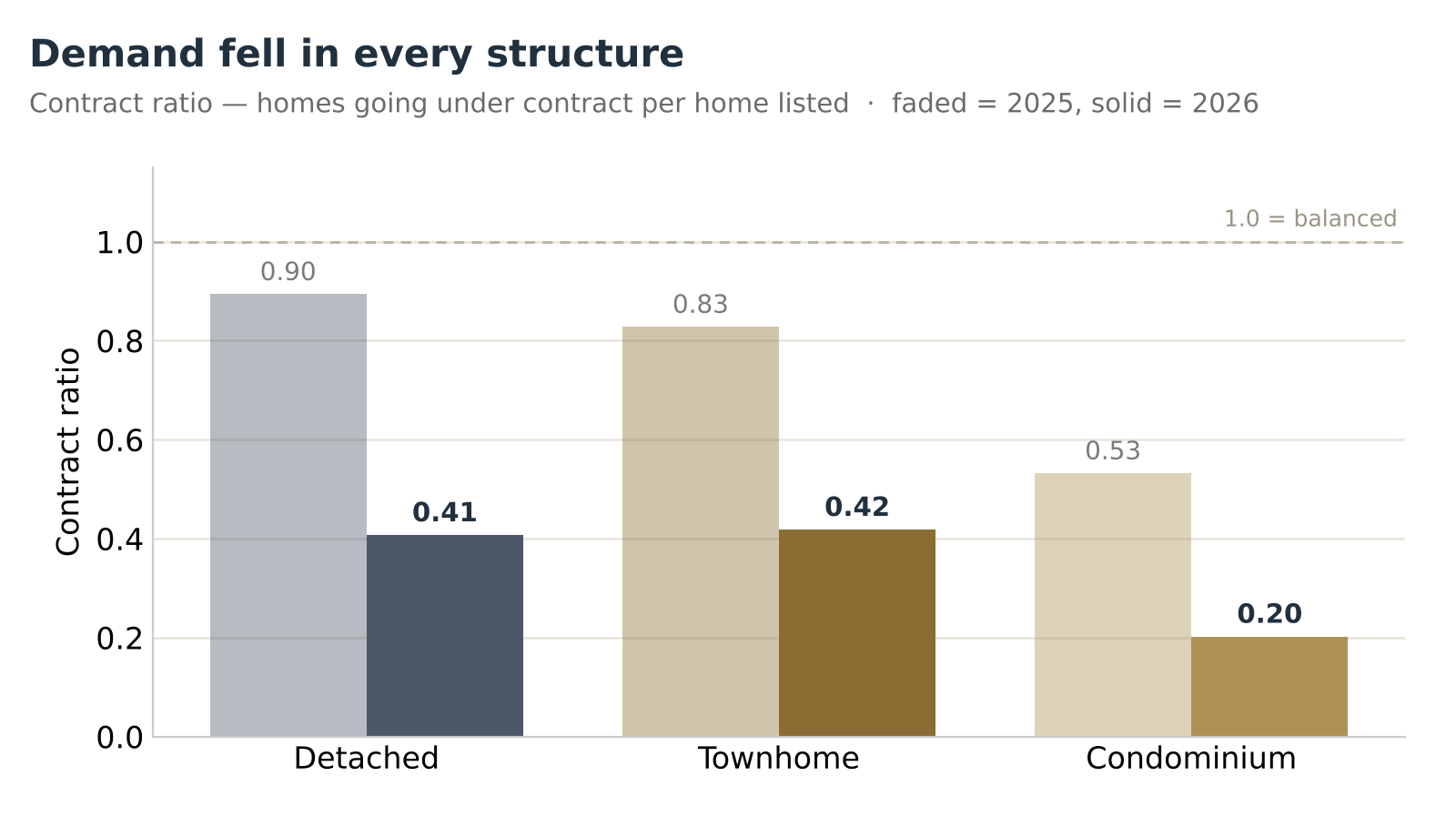
Reston Contract Ratio by structure, a year ago vs. now. Source: BrightMLS.
Is there more inventory in Reston? (Yes — a lot more.)
The metric, plainly: Months of supply answers a simple question: at today’s pace of sales, how long until every listed home is gone? Under about three months and the market is tight to balanced; climb above it and buyers finally have room to breathe.
What Reston did: The attached market filled up fast. Townhome active listings jumped 126% in a year to 79 — the most in the eleven-year record — shoving months of supply to 2.26, also a record. Condominiums rose 48%, to 2.87 months. Detached stayed tightest at 1.39. One honest caveat: roughly one in nine townhome listings is new construction marketed before it’s finished; strip that out and the resale inventory a buyer can move into today is closer to 2.0 months.
What it means: For the first time in years, attached-home buyers have the two things that create negotiating power — choice and time. A seller who prices to last spring is now one listing among many; a buyer who was boxed out a year ago can finally take a breath and make terms. Reston’s inventory, each October across the record:
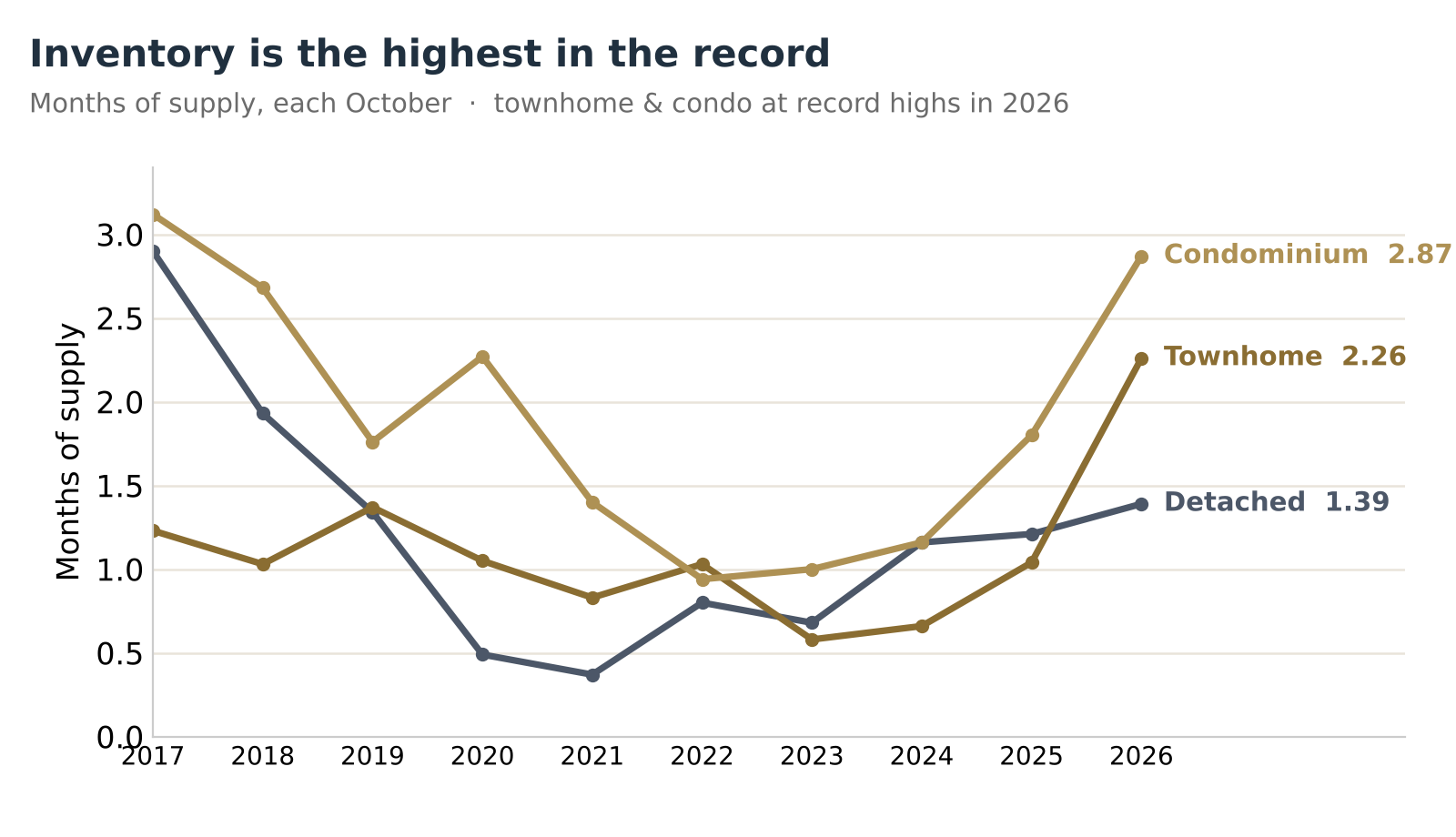
Reston Months of Supply by structure, each October through 2026. Source: BrightMLS.
Are Reston home prices falling?
The metric, plainly: A single month’s median lurches around for a dumb reason — whether big or small homes happened to sell that month. That’s a mix, not a trend. The honest view is the multi-year line: strip the monthly noise and ask one thing — is the price line still climbing?
What Reston did: Over the decade the three structures separate cleanly, and the answer is mostly yes. Detached has climbed across the decade and is still climbing — resale up 7.5% year-to-date, with October’s median firming to a record $1,050,000, up 5.0% year over year, the corridor’s leader. Townhomes plateaued at the top of their run, holding near $650,000 resale. Condominiums eased just off their peak.
What it means: This is not a market where values are falling — detached is appreciating, and townhome and condo have plateaued, not dropped. So if the price held, where did the softness go? Into the two places a median can never show you: the premium buyers will pay, and the terms sellers accept. The next two sections are each one of those — and together they’re the whole story of this fall.
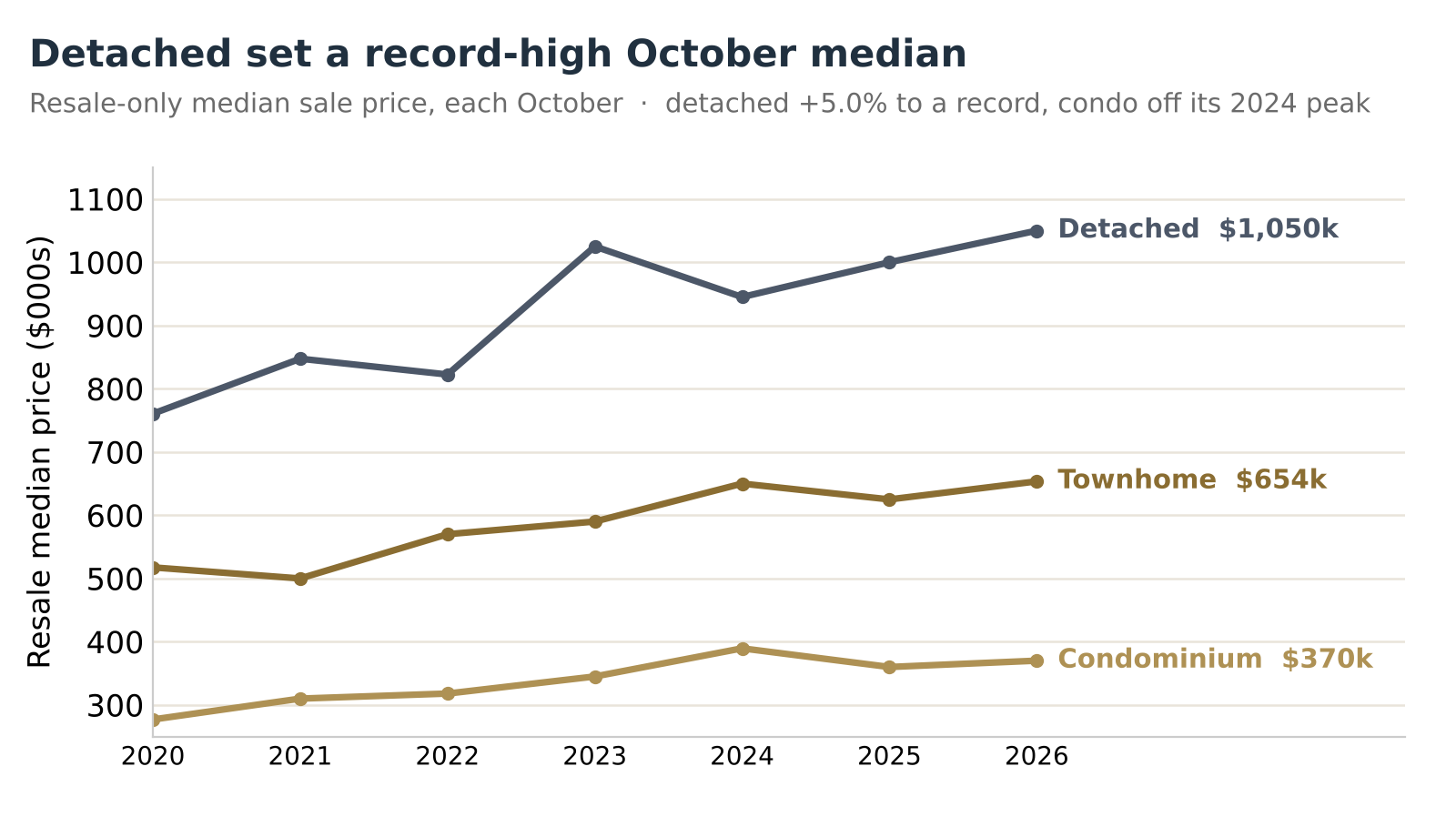
Reston resale median sale price by structure, each October 2020-2026. Source: BrightMLS.
How do we read the Reston market?
The metric, plainly: Here’s the lens no other agent will hand you. Everyone quotes a price; we quote a premium — what a buyer paid over the county’s own assessed value of the home. Read it the way a trader reads a stock against its book value: the county already set the book, so the premium is pure market conviction, and it doesn’t care whether the house is 1,200 feet or 4,000. It answers the only question a buyer has — am I overpaying? — and its mirror for the seller — am I getting full value?
What Reston did: This October, detached still carried real conviction, trading about 11 points above assessed. Townhomes drew +4; condominiums just +1 — essentially the county’s number, with almost no premium left. Watch it move through the year and you can see the conviction drain out of the attached market while detached holds its ground:
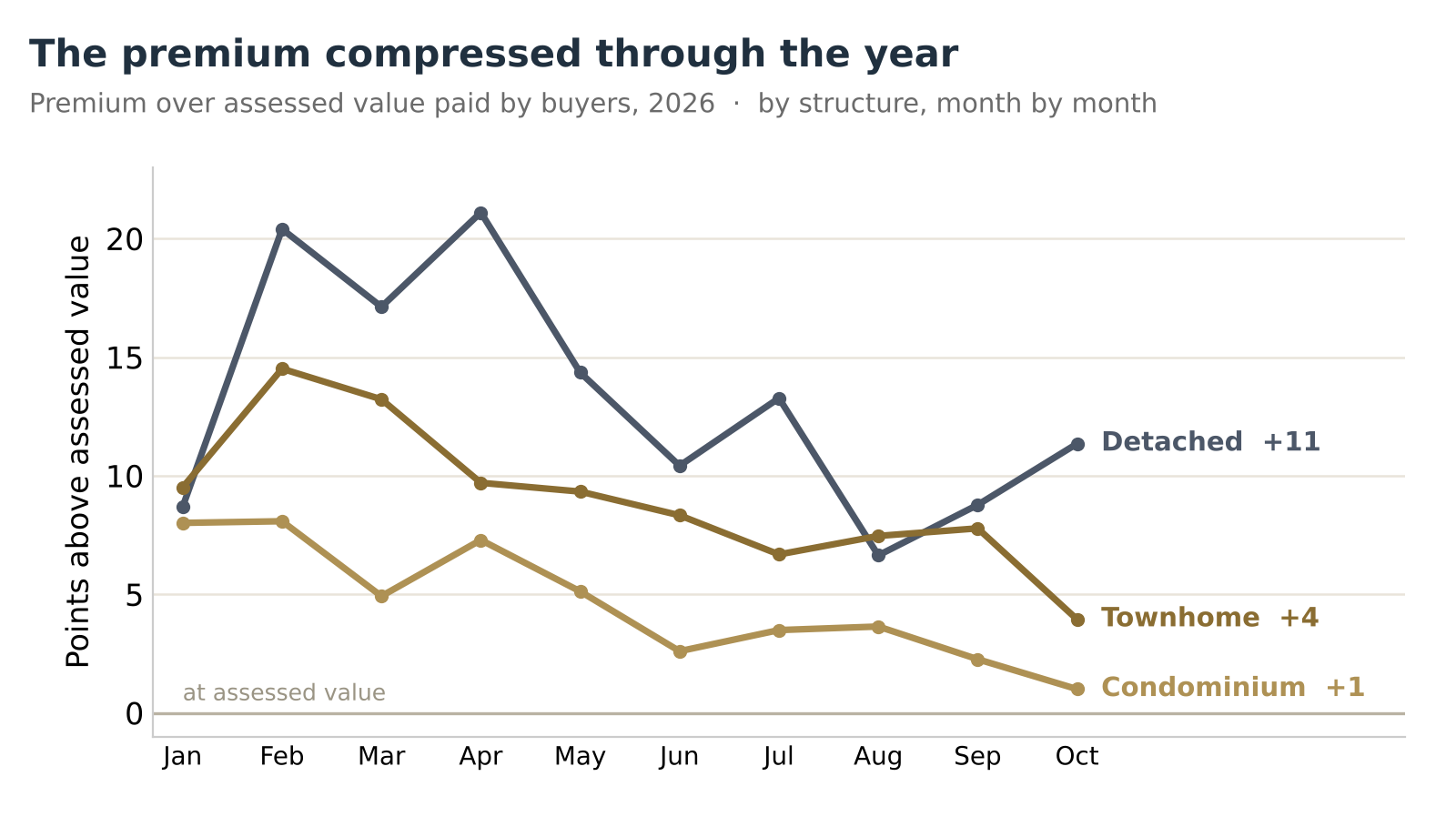
Reston premium over assessed value paid by buyers, by structure, through 2026. Source: BrightMLS.
Now hold this October against last, because the direction is the whole tell. Detached gave back the least — +14 a year ago, +11 now. Townhomes shed six, from +10 to +4. And condominiums are the signal in the noise: from +9 to +1, they handed back nearly their entire premium. Here’s what the consumer never sees: the sign prices barely moved — almost every home still closed around 100% of list, so the median shrugs and says “flat.” The premium says the opposite. It collapsed while the price held, because pricing power softens here first, a year before the median ever flinches.
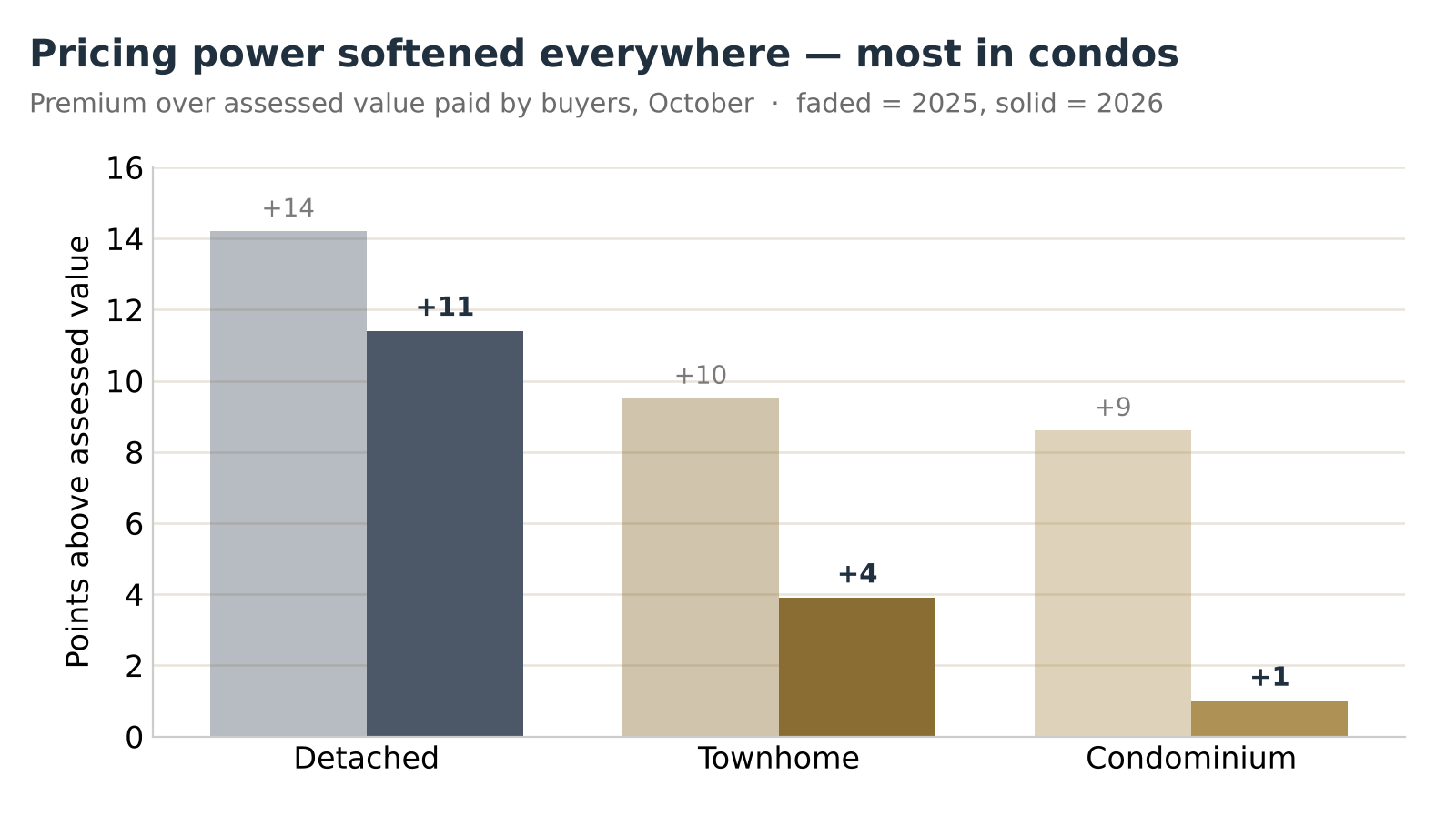
Reston premium over assessed value paid by buyers, a year ago vs. now. Source: BrightMLS.
What it means — and what to do: This is Buffett in one chart: be greedy when others are fearful. The fear is already printed in the premium, long before it reaches a number people quote at dinner. If you’re buying attached in Reston, you’re stepping into a market whose premium has already reset to the county’s number — much of the downside others are bracing for is in the price already. If you’re selling, stop anchoring to last spring’s premium; it’s gone. Price to the conviction buyers are paying today and you’ll sell while the neighbor who’s chasing the market keeps marking down. No one else on the corridor is even reading this number — which is exactly why it’s your edge.
Why are Reston sellers paying concessions?
The metric, plainly: A seller concession is cash the seller hands the buyer at closing — for closing costs, a repair, or the most powerful use of all, buying down the mortgage rate — instead of cutting the asking price. Watch the rate it happens, not the dollar figure: when more sellers pay but the price holds, the real discount has quietly moved off the sign and onto the settlement sheet.
What Reston did: It set records. 52.9% of condo sales carried a concession (median $8,675, about 2.6% of price) — the highest in seven years, up from 31.8% a year ago. Detached hit 38.1%, townhomes 37%. The sticker prices held; sellers simply paid, at the table, to get the deal closed.
The math, on a Reston townhome: Rates ran a full point higher this year — about 6.25% a year ago to roughly 7.3% now — and that didn’t kill demand, it rate-gated it: the buyers are still here, the clean home still sells in a week, they’ve just lost purchasing power. Which is the opening. A dollar spent at the closing table does far more as a rate buy-down — permanent until you refinance — than as a price cut. Take a $600,000 townhome, 10% down, a $540,000 loan on a 30-year fixed:
| The deal | Monthly payment (P&I) | You save |
|---|---|---|
| Pay full price, 7.25% | $3,684 | — |
| $10,000 off the price, 7.25% | $3,623 | $61 / mo |
| ~$10,800 concession → rate bought to 6.75% | $3,503 | $181 / mo |
| Same money. The buy-down saves about three times the monthly — and it’s permanent until you refinance, roughly $7,200 more in your pocket over five years. | ||
Illustrative; P&I only, excludes PMI. A buy-down runs about one point (roughly 1% of the loan) per quarter-percent and varies by lender and the day’s pricing.
What it means — the buyer’s play: High rates don’t feel like opportunity, but in a market this thin they are. Thin demand is exactly what hands you the leverage to make the seller buy your rate down. Stack the savvy-buyer move on top — buy closer to assessed value, add a little sweat equity — and you build equity faster and shed PMI sooner. The same lever that priced others out is the one that prices you in. That’s being greedy when others are fearful. Here’s how often sellers are already paying:
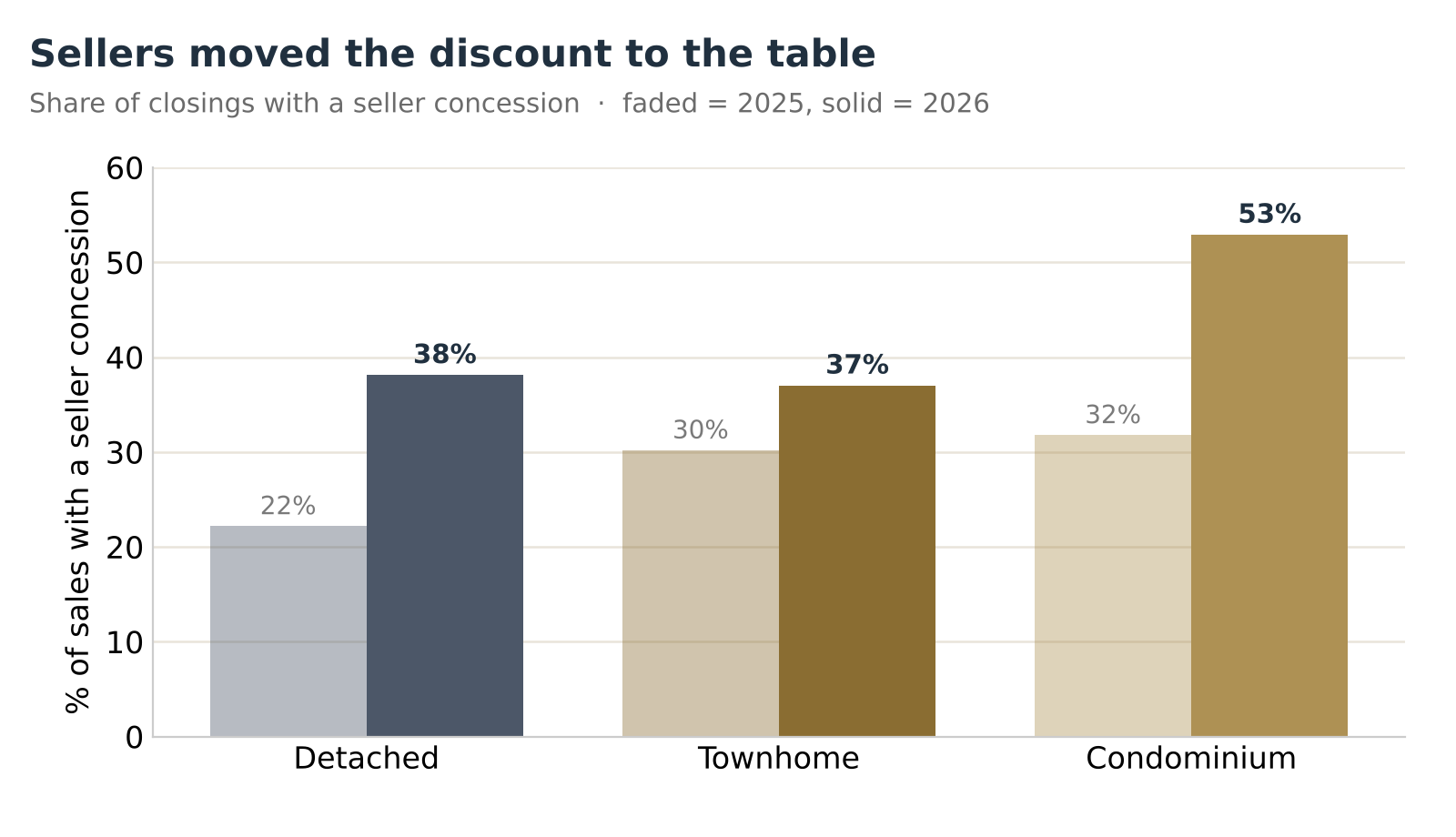
Reston seller-concession frequency by structure, a year ago vs. now. Source: BrightMLS.
What should you do in Reston right now?
If you’re selling a detached home: You’re in the strongest position in town. Price to today’s market and show it well — the clean, move-in-ready home still clears in about a week and near full ask. Build a modest concession into your plan; more than a third of October’s detached buyers received one, and offering it up front can be the difference maker in the speed and competitiveness of your sale.
If you’re selling a townhome or condo: You’re competing against record inventory, so condition and price do all the work. Price to the most recent comparable sales — not last spring’s — show the home spotless, and expect to offer a concession; half your competition already is. The turnkey, realistically priced home still sells; the one that reaches sits and then chases the market down.
If you’re buying in Reston — especially a townhome or condo: This is the clearest opening in years. You have choice, time, and leverage on both price and terms. Don’t just negotiate the number — negotiate a concession and ask your lender to apply it as a rate buy-down. In a market this soft, that’s how you convert today’s rates into a payment you’ll be comfortable with.
If you’re buying detached: Your leverage is thinner — value is still climbing and the right home moves fast — so the room is in the terms, not the price. Be ready to move decisively on the clean one, and ask for help at closing.
The bigger picture: This isn’t only a Reston story. October was the month the whole county turned — across Fairfax, inventory rose and demand fell in every structure at once, and townhome and condo contract ratios hit eleven-year lows countywide. Reston’s version is sharper on both ends: its detached value leads the corridor, and its attached oversupply is among the steepest. Reston isn’t a weak market — it’s a divergent one, and knowing which side of it your home sits on is the whole game.
HUDS COMPASS
NORTHERN VIRGINIA’S
ONLY MARKET INTELLIGENCE INDEX
Conditions data tells you what is coming — supply, demand, the direction of pressure. Anyone with an MLS login can pull it. The Compass tells you why — it reads the behavior behind the closings, scoring four needles from every closed sale. And the read tells you how to act. This month’s Reston report reads the closed side: detached value held its record while condo concessions climbed to a seven-year high — the discount didn’t show up on the sign, it showed up at the table.
One teaching point unlocks the rest. Most people watch sale-to-list price — but a list price is just an asking number a seller can type at will. Watch sale-to-assessed instead: the county’s assessed value is a fixed anchor that doesn’t move with a seller’s optimism. When a home clears above assessed with no concession, real demand paid up. When it holds its list price but closes with money back at the table, the asking number was a wish the terms quietly corrected.
Common Questions
Is Reston a buyer’s or seller’s market right now? Both, depending on what you own. Detached is still a seller’s market — tight supply, value rising, clean homes clearing in about a week. Townhomes and condominiums have turned to the buyer: record inventory, demand at eleven-year lows, and real room to negotiate.
Are Reston home prices dropping in 2026? No — not the way the headlines imply. Detached value is up 7.5% year-to-date — October’s median hit a record $1,050,000, up 5.0% year over year — townhomes held near $650,000, and the condo median ticked up to $370,000, still below its 2024 peak. Prices held across the board; what softened is the premium buyers pay over assessed value and the terms sellers accept — not the sign price.
What is the median home price in Reston right now? It depends on the structure, which is why one blended “Reston median” misleads. In October, detached ran about $1,050,000 — the highest October median on record — townhomes about $650,000, and condominiums about $370,000. A detached buyer and a condo buyer are shopping two different markets.
How much are Reston homes selling over assessed value? This is the number no other agent hands you. In October, detached traded about 11 points over the county’s assessed value, townhomes +4, and condominiums just +1 — down from roughly +14, +10, and +9 a year ago. That premium is the first thing to move when a market softens, long before the median does, and in Reston it’s compressing fastest in condos.
What is a seller concession, and what’s a rate buy-down? A concession is money the seller credits the buyer at closing. Applied as a rate buy-down, that money permanently lowers your mortgage rate — which cuts your monthly payment far more than taking the same amount off the price. In October, 52.9% of Reston condo sales carried a concession, a seven-year high.
Is now a good time to buy in Reston? In the attached market, the leverage buyers have now — choice, time, and negotiable terms — is the strongest in years, with more than half of condo sales carrying a seller concession. Waiting for lower rates often means competing against more buyers when they fall. The move is to negotiate today’s price and terms, not to wait.
Is now a good time to sell in Reston? Yes — if it’s priced to this market rather than last spring’s. Detached still commands the corridor’s highest medians and clears in about a week. Attached sellers face record inventory and choosier buyers, so accurate pricing and a built-in concession strategy matter more than they did a year ago.
How fast are homes selling in Reston? The well-shown detached home still clears in about a week near full ask; townhomes and condominiums take longer as inventory has climbed to eleven-year highs. Speed now depends far more on pricing and structure than it did a year ago.
Want to know which side of this market your home is on?
Every home tells a story the county numbers can’t. If you’re weighing a move in Reston — buying or selling — let’s read your home’s numbers together and build the strategy around them.
Michele Hudnall
Real Estate of Northern Virginia | Equity-First Real Estate Strategy
Life Long Northern Virginia Native | 25-Year Reston Resident | HOA Board President, Whitney Park East | South Lakes Drive
[email protected] | 703.867.3436 | RealEstateofNVA.com | @realestateofnva
I help Northern Virginia buyers and sellers make smarter decisions with local market analysis, strategic guidance, and real-world context, not hype headlines.
Disclosure: Michele Hudnall is a licensed real estate agent in Virginia. This post represents her personal analysis and good-faith opinion as a Reston resident and does not constitute legal or financial advice. Full disclosure at RealEstateofNVA.com. All analysis and opinion are my own and based upon local, real-time data. Please consult with a financial or legal professional as required.
Privacy Statement | Disclosure Notice