

Part 2 of the Reston Observer’s podcast series. What we covered, a short refresher on the two tracks every plan must clear, and the 1970 map notation I didn’t get to on camera.
Links to all cited sources can be found at the end.
The Reston Observer published Part 2 of its four-part podcast series on the Reston National Golf Course applications: a conversation with me, hosted by Ed Abbott and John Lovaas. Part 1 was Hunter Mill District Supervisor Walter Alcorn, which I wrote up in Alcorn on Reston National: “I Don’t Buy That”. The applicant’s attorney, Mark Looney, is scheduled later in the series.
I was asked to explain the process, and most of what I said comes down to one line: this isn’t a debate over the golf course. It is about whether the process works, and whether Fairfax County will hold to it.
The public record shows the owner has now tried three doors to reach the same result. An appeal in 2015 that no court decided on the merits. A Comprehensive Plan nomination in 2025 that was not rejected, only not scheduled. And in 2026, a by-right plan for 306 condominium units and commercial golf enhancements that never asks the Comprehensive Plan question at all. The third door is the one that sets precedent for every planned community in the county.
Below: what we covered, a refresher on how the pieces fit, and the part I didn’t say on camera, which is the 1970 development plan that, in my reading, replaced the 1966 plan the applicant relies on.
THE CONVERSATION
What we are sitting on is second-generation Reston. Offices sit largely unused. Commercial parcels that were never part of the planned community are being proposed for residential en masse, and nearly every proposal offers the same two products: four-story townhomes and four-story two-over-twos. No yards. No trees. Medium to high density. It raises a fair question: is an empty office building worth more to its owner as a rezoning candidate than as a leased one?
The same friction shows up in committee after committee: open space, walkability, density. The common thread is that there is no plan for how the new housing fits into, and adds to, the planned community around it.
The idea I brought to the table is governed growth: honor the founding philosophy without being shackled by it, and build for the next generation, the buyers who want density, Metro and walkability, through the process, not around it.
In the 1960s there was one designer and one developer, so one hand kept the plan whole. Today a dozen developers bring projects one parcel at a time, which is how a planned community becomes a patchwork quilt. The only party positioned to see the whole board is the County. In my tech years we called that role the product manager: nobody reports to you, but the product ships whole or everyone fails.
John asked whether there is a cap on how much can be built, and whether we are near it. I don’t need to argue the cap. As I said on the podcast, “if the process worked, those questions would be answered.” They aren’t, because this filing skips the step where they get asked. It is the question I keep circling in land use committee meetings and hearings: who is looking at the macro view, tracking what has already been approved, as new applications come in one parcel at a time?
Whether you like golf isn’t the question. Whether the review happens at all, and what “by right” can claim, is.
TWO TRACKS. BOTH MUST CLEAR.
A quick refresher. Fairfax County land use runs on two sets of documents. The Comprehensive Plan says what land should be used for. What people call the “Reston Master Plan” is the Reston chapter of that Plan. The zoning (the district, plus the development plans approved with each rezoning) says what may be built and where. A planned development has to clear both.
The Two Tracks
What each track asks, what it says about the golf course today, and where each stands.
| Zoning track | Comprehensive Plan track | |
|---|---|---|
| The question | May residential be built here? | Should residential be here? |
| Governing documents | PRC district, plus the development plans approved with RZ C-135, C-203 and C-281 | Comprehensive Plan, Reston chapter |
| What it says today | Residential is a permitted use in the district, but only where an approved plan designates it. The golf course is labeled permanent open space with no unit count. | Private recreation, “to remain as golf courses,” named by tax map parcel |
| How it changes | Development Plan Amendment, then a PRC Plan for the layout | Site-Specific Plan Amendment (SSPA) |
| Where it stands | Three PRC Plan Amendments filed in 2026, with no Plan amendment | Nominated February 2025 with no unit count; not added to the Board’s work program |
| The Zoning Ordinance requires a planned development to substantially conform to the Comprehensive Plan and not exceed the density it permits. The PRC Plan must clear both tracks. | ||
Sources: Fairfax County Comprehensive Plan; RZ C-135 development plan (1970); CPN-2025-III-HM-028.
Before 2007, a PRC Plan could be approved at the staff level, essentially a desk check. In 2007 the County moved PRC Plans into legislative review, with a public hearing and a Board vote, because too many questions weren’t being asked. The SSPA is how you change the Comprehensive Plan itself. The owner’s own 2025 nomination states the current Plan designation: “Private Recreation, more specifically to remain as golf courses.”
Zoning answers “may.” The Comprehensive Plan answers “should.” This filing asks only one of them.
THREE DOORS
Reston National Timeline
Sixty-four years, from the district that made Reston possible to the Planning Commission hearing.
| Year | What happened | What the terms mean |
|---|---|---|
| 1962 | RPC district created so Reston could be built. Clustering allowed in exchange for an approved plan. | RPC, now PRC: Planned Residential Community, a zoning district. One of three in the county. Density is figured on gross area, open space included. |
| 1966 | RZ B-555 rezones 134 acres from RE-2 to RPC. | RZ: Rezoning, which changes the zoning district on a parcel. RE-2 was estate zoning, roughly one home per two acres. |
| 1970–1971 | RZ C-135, C-203 and C-281 approved, each with a development plan. Every housing parcel gets a unit count. The golf course gets none. | Development Plan: the land use map approved with the rezoning. It decides what goes where and how many. Uses are permitted only where it designates them. |
| 1974–1978 | 1,123 units approved. About 1,137 built, plus two pools, four tennis courts and an elementary school. | The plan was implemented. Every parcel with a unit count was built. The parcel without one was not, and still is not. |
| 2012 | Owner’s counsel asks whether a PRC Plan alone is enough. The County says no: three steps are required. | The three steps: amend the Comprehensive Plan, then a DPA (Development Plan Amendment) to change what the 1971 plan designates, then a PRC Plan for the layout. |
| 2015 | Appeal to the BZA. Circuit Court voids it for lack of jurisdiction and decides nothing on the merits. | BZA: Board of Zoning Appeals, seven citizens who hear appeals of zoning determinations. It cannot rule on a hypothetical, which is why the court threw the case out. |
| 2019 | Sold for $23.75 million. The County record notes the price reflects future redevelopment. | Assessor’s note: flags a sale as unusable for comparison because the buyer paid a speculative premium. |
| 2022 | Reston chapter rewritten after a two-year task force. Golf courses named by parcel, to remain. | Comprehensive Plan: County policy on what land should be used for. Not the same document as the Zoning Ordinance. |
| 2025 | SSPA nominated with no unit count. Not added to the Board work program. | SSPA: Site-Specific Plan Amendment, the way to change the Comprehensive Plan. Nominations must be added to the work program to be studied. |
| 2026 | Three PRC Plan Amendments filed. 306 condominium units on 14.76 acres. Planning Commission hearing, now November 4th. | RZPA: PRC Plan Amendment. Changes the site layout under existing zoning. No rezoning filed, so no traffic or school studies attach. |
Sources: Fairfax County zoning case files and archives; Fairfax County assessment records; CPN-2025-III-HM-028; PLUS records for RZPA-2025-HM-00034, RZPA-2026-HM-00007 and RZPA-2026-HM-00008.
Read the timeline as a set of doors.
Door one, 2015: the appeal. The question of whether the 1966 plan still allows housing went to the Board of Zoning Appeals and on to Circuit Court, which voided the case for lack of jurisdiction. The BZA cannot rule on a hypothetical. Nothing was decided on the merits.
Door two, 2025: the front door. On February 12, 2025, the owner’s counsel filed an SSPA nomination proposing roughly 80 acres of open space or parkland and roughly 86 acres of housing, with no unit count. The filing called it “a vehicle for an alternative development concept” and an opportunity for “dialogue between the Applicant, the community, and the County.”
To be fair, that was a good move. It was the right door. At the Planning Commission hearing in May 2025, commissioners pressed on what they were being asked to support, and the answer was, in effect, that the owner was looking for a partner to shape it. In June, the Board of Supervisors declined to add the nomination to its work program. That is not a rejection on the merits. It is a door left unopened. As I said on the podcast, I could have gotten behind a version of it: 80 acres delivered as a finished park rather than pocket parks, with lower-density clusters stepping down from the Metro.
That same filing also said the owner “has initiated a by-right PRC Plan.” The back door was loaded before the front door was knocked on.
Door three, 2026: “by right.” Three PRC Plan Amendments: 306 condominium units on the roughly 14.8 acres the applicant says the 1966 plan still covers, plus golf “enhancements” that include a lighted multi-story driving range, gamified training areas, a new “Back 9 Grill” and nine rerouted holes. When the applicant asked County transportation staff whether a traffic study was required, the answer was that because “no RZ/PCA/SE/SEA or equivalent is submitted, no determination is needed.” No rezoning, no traffic study.
What the Filed Plan Shows
The color-coded map, as text.
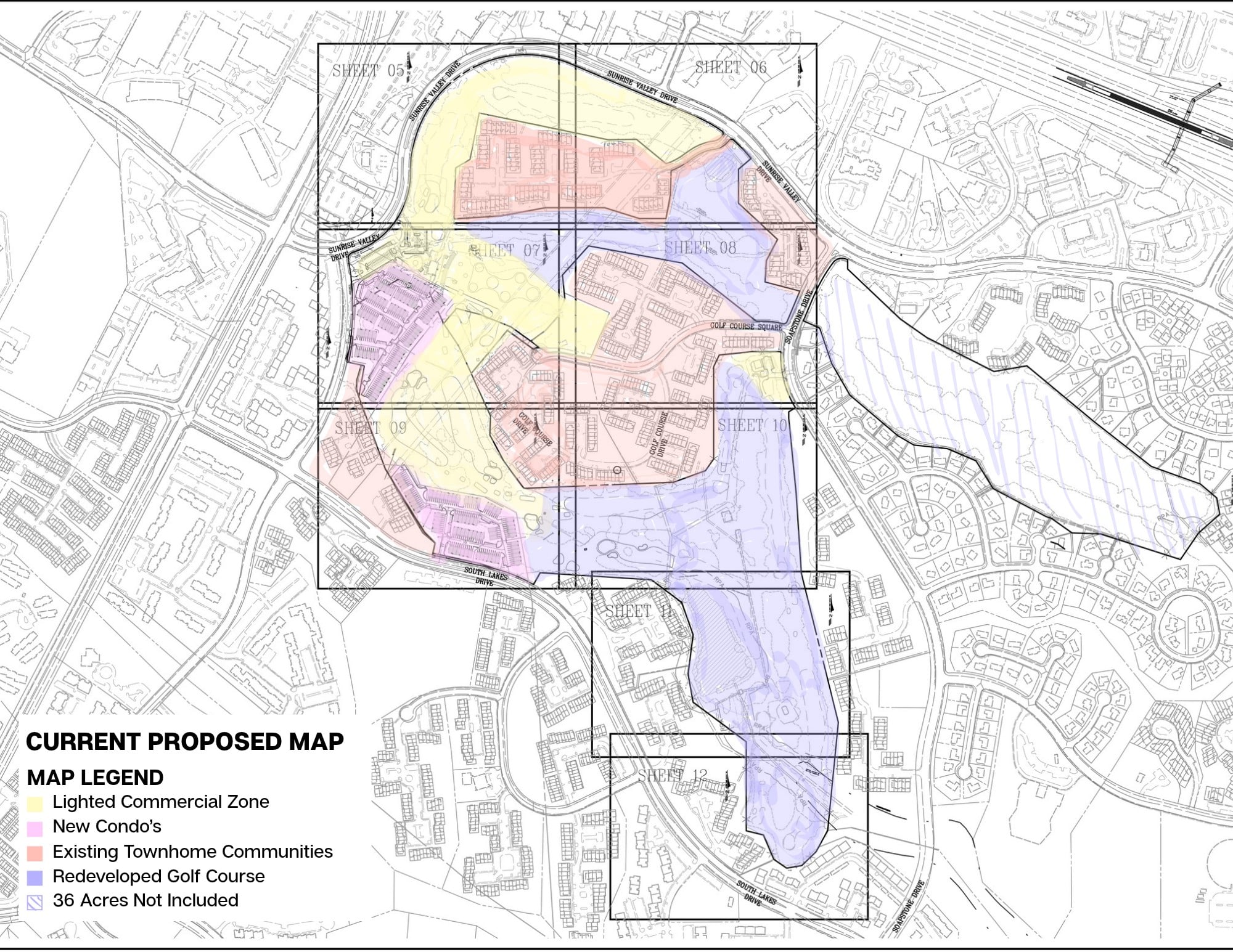
| Map zone | What it shows |
|---|---|
| Lighted commercial zone (yellow) | Lighted multi-story driving range, gamified training areas, new “Back 9 Grill” and lighted parking. Much of it wraps existing townhome clusters. |
| New condominiums (pink) | 306 condominium units on 14.76 acres, inside Reston, with no Reston Association membership. |
| Existing townhome communities (salmon) | Existing clusters. Several would back directly onto the lighted zone. |
| Redeveloped golf course (blue) | Nine holes rerouted, with changes to topography and tree canopy. |
| 36 acres not included (hatched) | The eastern arm, outside the application. Not in scope today. |
Sources: PRC Plan sheets, RZPA-2026-HM-00008; Statement of Justification, CPN-2025-III-HM-028.
Here is my read, and it is my opinion based on the sequence of actions. Door three works for the owner either way. If the County accepts the by-right argument, 306 units get built without a Plan amendment. If the County denies it, the owner has what it lacked in 2015: a concrete decision on a concrete plan, which a court can review. Door three puts the 1966 question in front of a judge.
Three Doors
Each route the owner has taken, and what it asked.
| Door | Vehicle | Question it asks | Outcome |
|---|---|---|---|
| 2015: side door | Appeal to the BZA | Does the 1966 plan still allow housing? | Voided for lack of jurisdiction. Merits never decided. |
| 2025: front door | SSPA nomination | Should the Comprehensive Plan change? | Not rejected. Not added to the Board’s work program. |
| 2026: door three | By-right PRC Plan (three RZPAs) | How will we build what we say we already can? | Planning Commission hearing November 4th. Pending. |
Sources: County zoning case record; CPN-2025-III-HM-028; PLUS records.
Three doors. Only one of them asks the Comprehensive Plan question.
WHAT I DIDN’T SAY ON CAMERA: B-555
The applicant’s case rests on RZ B-555, approved in September 1966. In its words to County staff, B-555 “permits medium-density residential uses (20 dwelling units/acre) across an approx. 14.8-acre portion of the property.” Its 2025 nomination says that area “was ultimately developed as part of the golf course” but “remains subject to the development plan associated with RZ B-555.”
Where are these 14 acres? In the County records I have reviewed, no approved plan draws them on the golf course. The one place B-555 zoning does show up today is across South Lakes Drive: 13.9 acres held by the Fairfax County Park Authority.
Three certified maps from the County archives tell a different story about the course itself.
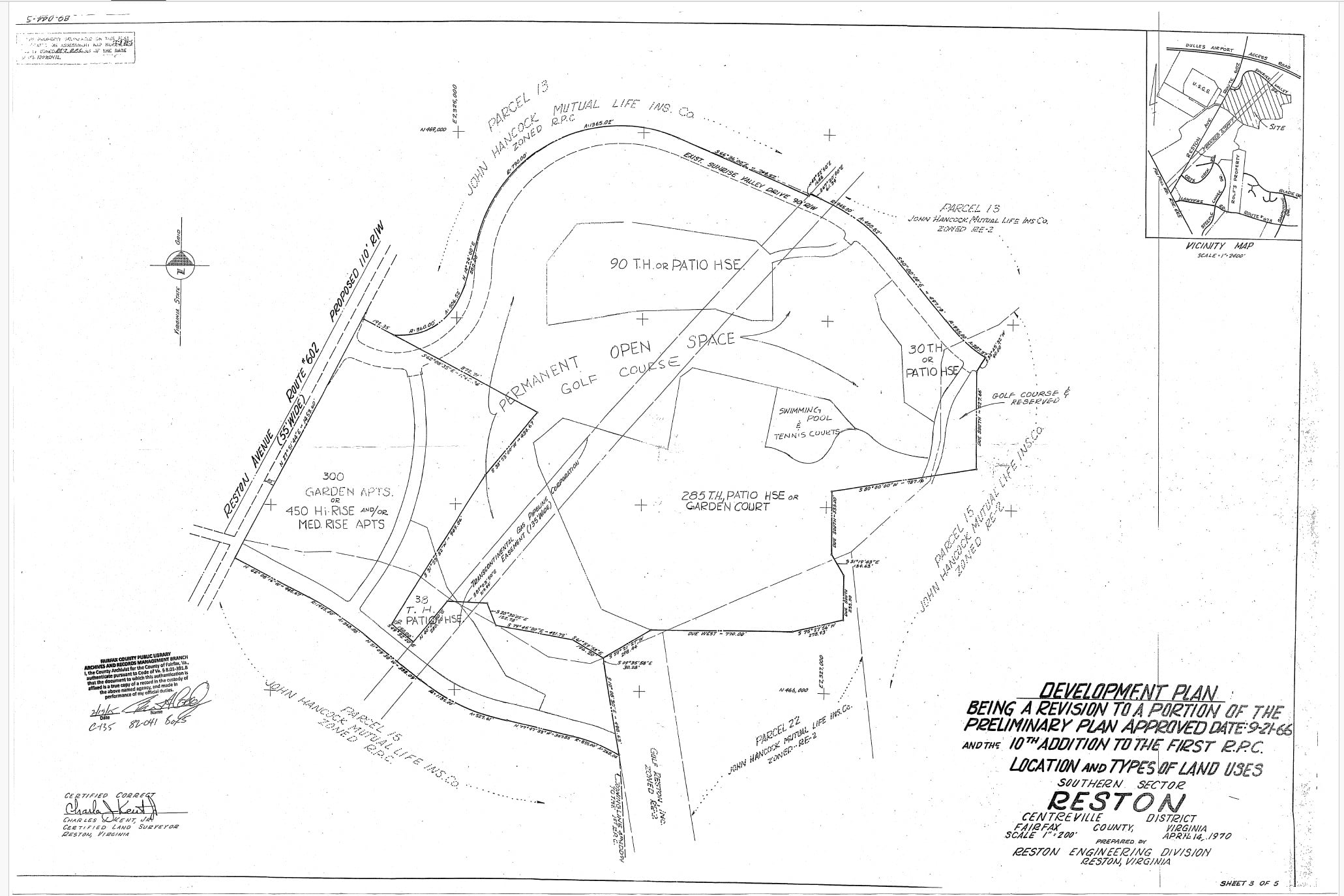 C-135 land uses, Sheet 3 of 5, April 14, 1970. Click to enlarge. |
The land use plan
The C-135 development plan, “Location and Types of Land Uses.” Every housing parcel carries a number: 90 townhouses or patio homes, 30, 285, 38, and 300 garden apartments or 450 high-rise. The golf course is labeled “Permanent Open Space, Golf Course.” It has no number. |
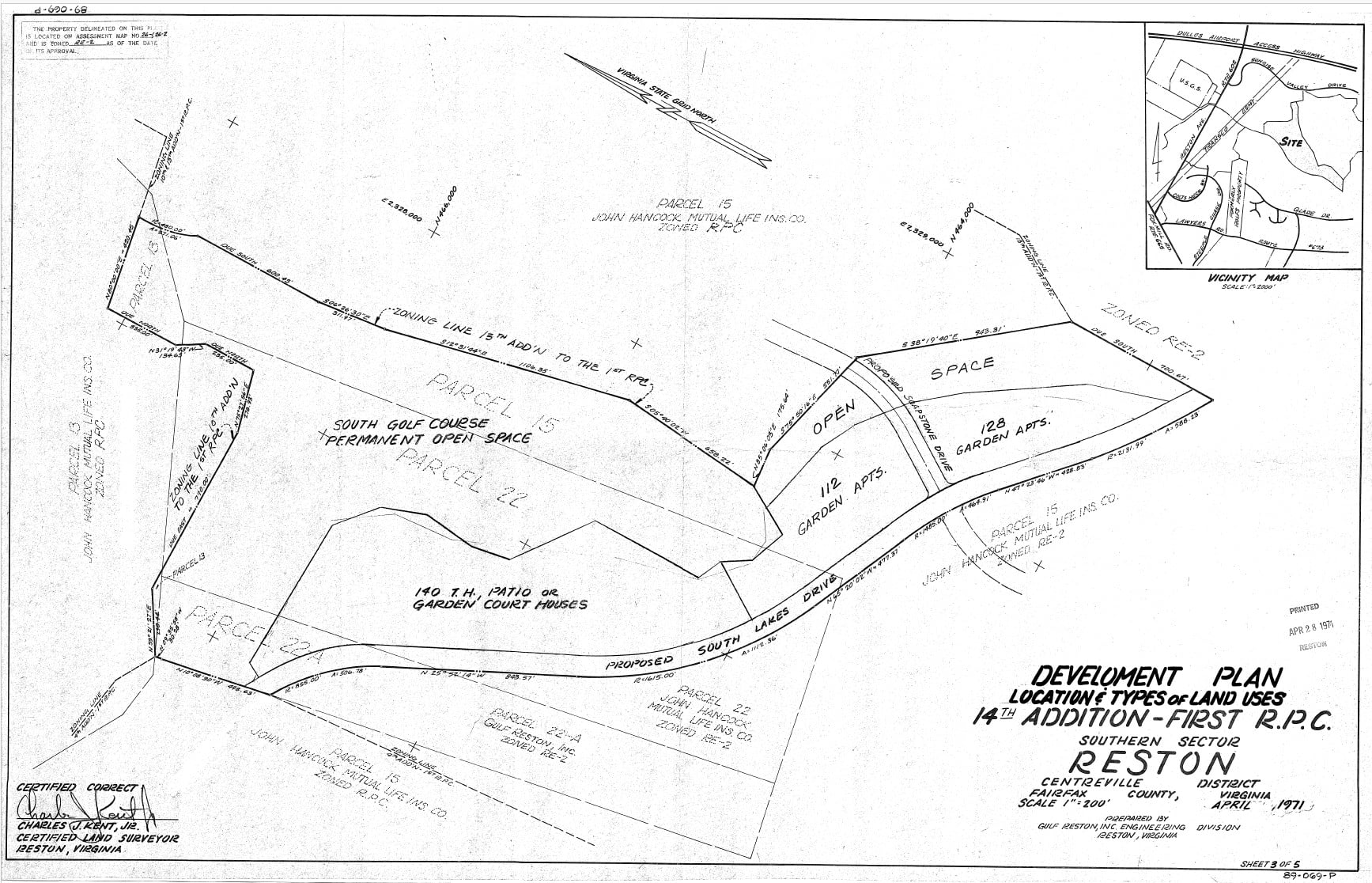 C-281, 14th Addition, Sheet 3 of 5, April 1971. Click to enlarge. |
The south course
The April 1971 plan for the 14th Addition covers the south course. Same pattern: 140 townhouses, 112 and 128 garden apartments, and “South Golf Course, Permanent Open Space.” |
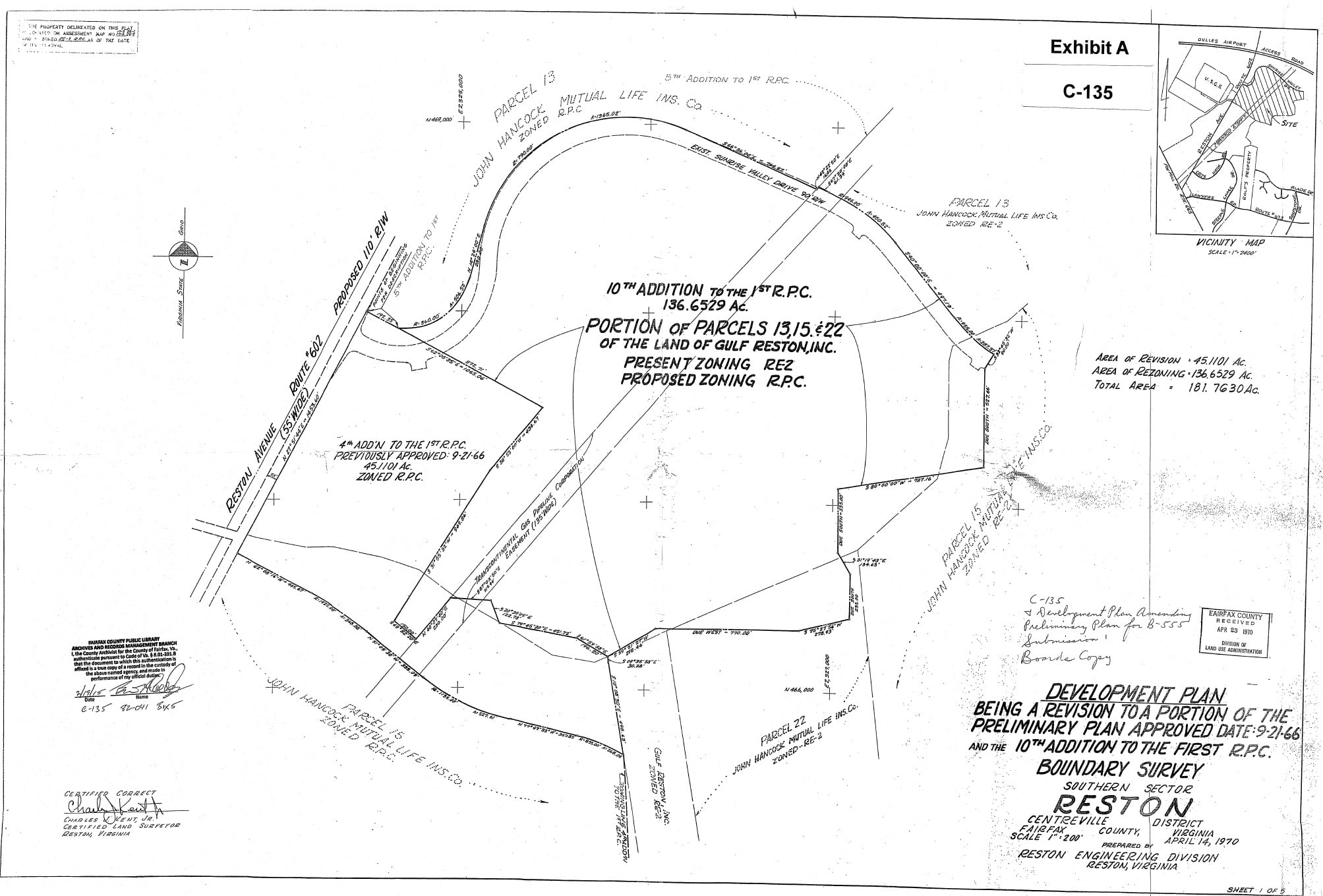 C-135 boundary survey, Sheet 1 of 5, April 14, 1970. Click to enlarge. |
The 1970 revision
The C-135 boundary survey is titled “Development Plan Being a Revision to a Portion of the Preliminary Plan Approved Date: 9-21-66.” September 21, 1966 is the B-555 approval. Inside the revised area sits the 45.11-acre “4th Add’n to the 1st R.P.C., previously approved 9-21-66.” The handwritten County notation, stamped received by the Division of Land Use Administration on April 23, 1970, reads: “C-135 & Development Plan Amending Preliminary Plan for B-555 Submission. Boards Copy.” |
Source: Fairfax County Public Library, Archives and Records Management Branch, certified copies.
In 2012, the County told the owner’s counsel that a PRC Plan alone was not enough and that three steps were required. My reading of these maps is the reason why: the 1970 plan revised the 1966 plan, and the approved plans that followed designated the course as permanent open space. And the plan was built as drawn: 1,123 units approved, about 1,137 delivered, with the pools and tennis courts it called for. Whether the 1966 plan survived that revision is a legal question. If this goes to court, a judge decides it, not me. What I can say is what the maps show.
Every parcel meant for housing got a number. The golf course did not.
WHAT IT COSTS
Leave the emotion out and count what it carries.
The Cost at Hand
Who carries the cost if the process is skipped.
| Cost | Who carries it |
|---|---|
| The golf-course premium on 812 surrounding homes: about 15% on the 441 closest to the course, about 10% on the 371 in the next ring. An estimated $74.9 million in equity. | Homeowners, including 93 households pushed into negative equity. It is worth less than what they paid for it. A lit driving range facing a back deck changes the buyer pool, and the premium goes with it. |
| Traffic and school impacts that are never studied | The County and every resident on the surrounding roads and in the surrounding schools |
| 306 condominium units inside Reston with no Reston Association membership | Reston Association members, who maintain the paths and amenities the new residents will use |
| A precedent that a PRC Plan can stand in for a Plan amendment | Every planned community in Fairfax County, and every development plan approved before 1978, which could be called into question |
Sources: Fairfax County assessment records, analysis in Who Pays and Who Profits; County transportation staff determination, Feb. 27, 2026.
The purchase and the assessments tell you where the math started. The course sold for $23.75 million in 2019, and the County flagged that sale as unusable for comparison because the price reflected future redevelopment. The approval was priced in before anything was filed.
The County’s own assessors already draw the line the applicant is asking to erase. The Park Authority’s 13.8987 acres across South Lakes Drive, which do carry B-555 zoning, assess at $3.217 million, or $231,461 per acre. Reston National’s total assessed value is $7,624,470 for 166.1136 acres, or $45,899 per acre. The County values land that carries B-555 at about five times the golf course, per acre.
This is not a Reston problem. It is a Fairfax problem. As I said on the podcast, it could happen at Penderbrook or at any golf course, pool or racquet club in any planned development: the amenity underperforms, so turn it into townhouses. Vantage Hill in Reston is a recent example: a condominium association with a pool closed for years and a $4.5 million backlog of capital repairs, selling the pool site for 28 townhouses to pay for them. That one went through the Planning Commission and a Board hearing.
I covered the five precedents in detail in One Reston Golf Course. Five Precedents. The short version: density at transit-zone levels outside the boundary of the transit zone, zoning studies that no longer happen, a Comprehensive Plan that is advisory with no teeth, density inside Reston without joining Reston, and a goal of revenue, not golf, at the cost of a community amenity.
The cost of skipping the process is not paid by the applicant.
WHAT THIS MEANS
For homeowners around the course: the premium your home carries is tied to the view and the quiet. Comments on the record are how that premium gets weighed. Silence reads as consent. For some, the home is worth less than what they paid for it.
For every planned community, and every development plan approved before 1978, in Fairfax County: if a PRC Plan can stand in for a Plan amendment here, it can stand in for one at your pool, your tennis courts or your common ground.
For the Planning Commission and the Board: the question isn’t whether 306 is too many units. It is whether the Comprehensive Plan still governs a planned community or is advisory with no teeth, and how the County weighs historical zoning against the approved plans that followed it.
For the applicant: the front door is still open. An SSPA with a unit count, clusters that match the density of the clusters already there, and 80 acres delivered as a finished park is a conversation many of us would come to the table for. There are options beyond million-dollar four-story townhomes and four-story two-over-twos with no green space. Blending duplexes and townhome clusters at the existing 10 to 12 units per acre is an option we have not seen proposed anywhere in the county.
WHAT HAPPENS NEXT
Planning Commission public hearing: Wednesday, November 4th, 2026, 7:30 p.m., Fairfax County Government Center, 12000 Government Center Parkway, Fairfax. Before that, County staff writes its report, and the comments in the file when it closes are the ones that shape it. I’m filing a community submission on Tuesday, October 6th.
- Sign the list and add your comments to the submission, if you’d rather not write your own email: sign the list here
- Take the survey on how the space could be used: take the survey here
- Prefer to write your own? See Governed Growth. What I Filed With Fairfax County. for the submission I sent, then send yours to County staff coordinator Weixuan Yang ([email protected]), Hunter Mill Planning Commissioner Paul Thomas’ office and Supervisor Alcorn’s office. Reference RZPA-2025-HM-00034, RZPA-2026-HM-00007 and RZPA-2026-HM-00008.
- Watch the rest of the series as The Reston Observer releases Parts 3 and 4.
The golf course is the parcel. The process is the precedent.
Where do you land on the space?
Park, golf, lower-density housing, or a mix? Fifteen years of yes-or-no polling hasn’t moved this. Tell me what you’d build before the October 6th submission.
Michele Hudnall
Real Estate of Northern Virginia | Equity-First Real Estate Strategy
Life Long Northern Virginia Native | 25-Year Reston Resident | HOA Board President, Whitney Park East | South Lakes Drive
[email protected] | 703.867.3436 | RealEstateofNVA.com | @realestateofnva
I help Northern Virginia buyers and sellers make smarter decisions with local market analysis, strategic guidance, and real-world context, not hype headlines.
Disclosure: Michele Hudnall is a licensed real estate agent in Virginia. This post represents her personal analysis and good-faith opinion as a Reston resident and does not constitute legal or financial advice. Full disclosure at RealEstateofNVA.com. All analysis and opinion are my own and based upon local, real-time data. Please consult with a financial or legal professional as required.
Privacy Statement | Disclosure Notice
SOURCES
Per-acre figures are calculated from Fairfax County assessment records. Home-value figures come from the analysis in Who Pays and Who Profits. Full citations for the 1966–1971 zoning approvals, the 2012 determination and the 2015 appeal are in the County submission linked below.
SOURCES: All Publicly Accessible — No Subscription Required
Reston Observer, Episode 2, September 30, 2026: https://www.youtube.com/watch?v=JT56vcGJ1hw — All Hudnall quotes in this post.
Reston Observer, Episode 1, September 23, 2026: youtube.com/watch?v=ZYe9E0etHsU — Supervisor Alcorn’s interview; written up in Alcorn on Reston National.
Governed Growth. What I Filed With Fairfax County. realestateofnva.com/reston-national-submission-fairfax-county-record — Full citations for RZ B-555, C-135, C-203 and C-281, the June 20, 2012 Zoning Administrator determination, BZA Appeal A 2012-HM-020 and Circuit Court Case No. CL-2015-0006455.
Fairfax County Public Library, Archives and Records Management — C-135 and C-281 development plans (1970, 1971): Certified copies; the B-555 amendment notation, unit counts by parcel and permanent open space designations.
SSPA Nomination CPN-2025-III-HM-028 and Statement of Justification, February 12, 2025: Fairfax County PLUS — The 80/86-acre concept, no unit count, and the owner’s “by-right PRC Plan” language.
FFXnow, June 11, 2025: ffxnow.com/2025/06/11/push-to-redevelop-reston-national-golf-course-for-housing-suffers-major-setback — Board of Supervisors declines to add the SSPA nomination to the work program.
Fairfax County Planning Commission — RZPA-2025-HM-00034, RZPA-2026-HM-00007, RZPA-2026-HM-00008: fairfaxcounty.gov/planningcommission — Hearing schedule, filed PRC Plans, unit counts, and the February 27, 2026 transportation determination.
Fairfax County Comprehensive Plan, Area III, Reston chapter: fairfaxcounty.gov/planning-development/comprehensive-plan — Reston National designated by parcel “to remain as golf courses.”
Fairfax County Zoning Ordinance, Sect. 2105.1.C: online.encodeplus.com/regs/fairfaxcounty-va — Planned developments must substantially conform to the Comprehensive Plan.
Fairfax County real estate assessment records: icare.fairfaxcounty.gov — 2019 sale notation; assessed values for the golf course parcels (166.1136 acres) and the Park Authority parcel at 11851 South Lakes Drive (Tax Map 0261-14-0009).
FFXnow, August 3, 2022: ffxnow.com/2022/08/03/vantage-hill-redevelopment-moves-forward-on-expedited-timeline — Vantage Hill pool site conversion to 28 townhouses to fund a $4.5 million capital backlog.
Who Pays and Who Profits: realestateofnva.com/reston-national-financial-impact-2026 — Equity impact across 812 homes, $74.9 million.
One Reston Golf Course. Five Precedents. realestateofnva.com/reston-national-golf-course-fairfax-comprehensive-plan-precedent — The five precedents.